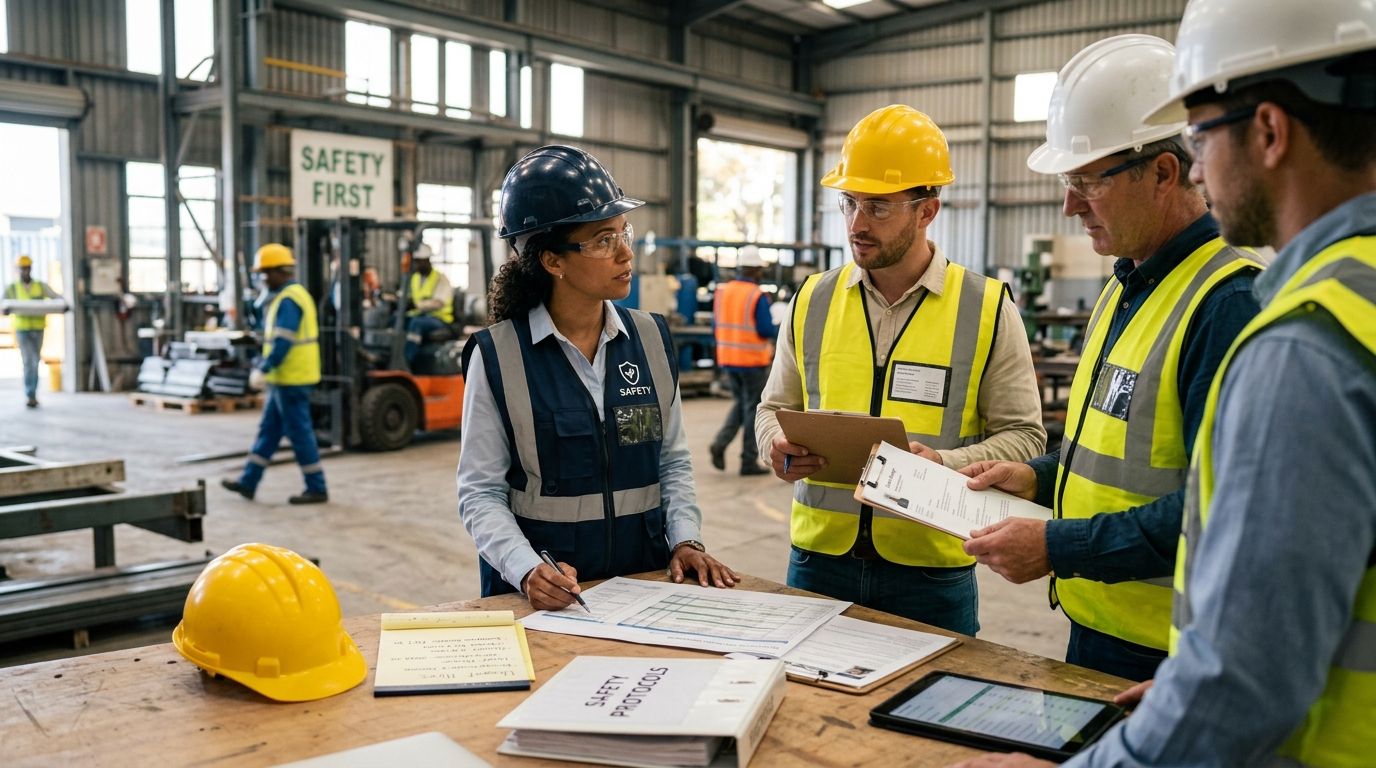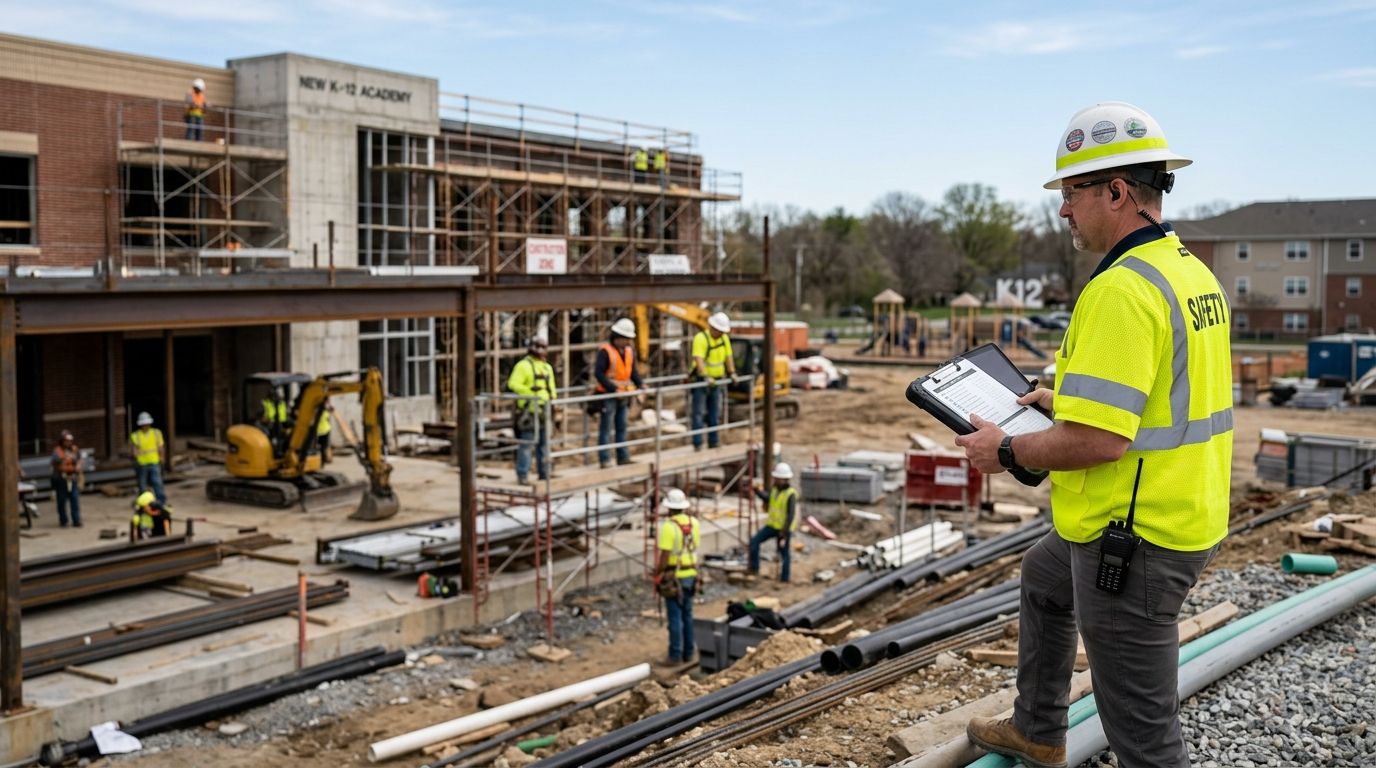
K-12 school construction safety staffing means placing certified safety managers, fire watch attendants, and confined space teams who understand occupied-campus rules, background check requirements, and the tight construction windows that come with an academic calendar. School projects carry a layer of complexity that a warehouse build doesn't: children and staff on site, district-mandated fingerprinting, and construction that has to pause or shrink whenever the bell rings.
- Safety staffing for K-12 school construction requires background-checked personnel, not just OSHA-certified ones — district clearance rules override standard site onboarding.
- Summer and holiday windows compress a year's worth of work into 10-12 weeks, so staffing surges matter more here than on most commercial sites.
- ResponsAble Staffing places vetted safety managers and fire watch attendants who can pass district background checks on short notice.
- Bilingual safety communication and phased-fencing compliance are the two most-missed line items in school construction safety budgets.
Why this matters for K-12 school construction
School districts don't treat construction sites like general contractors treat them. A site next to an occupied elementary school has to keep dust, noise, and equipment away from students walking to recess, and most districts require every worker with campus access to clear a background check before badge issuance — sometimes fingerprint-based, sometimes a state registry check. Miss that step and your safety manager can't legally set foot on the job.
Bond-funded projects add another layer: prevailing wage compliance, certified payroll, and public-records scrutiny that a private commercial job never sees. Safety staffing for K-12 school construction has to solve for all of this at once — credentials, clearance, and calendar — not just fill an OSHA 30 seat.
Update your access and clearance requirements first
Before posting a single requisition, pull the district's contractor handbook. Every school system writes its own rules, and they change by state and sometimes by individual district.
- Confirm whether background checks require fingerprinting or a name-based registry search
- Check badge and visitor-log requirements for anyone entering during school hours
- Identify fencing and sightline standards that separate construction zones from occupied buildings
- Note noise and dust curfews tied to class schedules, recess, and dismissal
- Confirm whether the district requires proof of a drug-free workplace policy
Staff a safety manager who has run phased, occupied-site construction
A safety manager who has only worked ground-up commercial builds will struggle with a renovation happening 40 feet from an active classroom. Look for someone who has managed phased work plans before.
- Require OSHA 30 at minimum, OSHA 500/501 preferred for train-the-trainer capability
- Ask for direct experience with phased construction sequencing on occupied sites
- Verify experience writing site-specific safety plans that account for pedestrian traffic patterns
- When your internal bench doesn't have this experience and the project timeline is tight, a specialized agency can place a contract safety manager who has already done occupied-campus work — ResponsAble Staffing sources exactly this profile for school and healthcare campus projects
Build your fire watch and confined space coverage for renovation scopes
Most K-12 work is renovation, not new build, which means hot work near occupied structures and confined space entry in old mechanical rooms and crawl spaces.
- Assign a dedicated fire watch attendant for any hot work within 35 feet of an occupied wing
- Staff a confined space entry team for boiler rooms, tunnels, and crawl spaces common in schools built before 1990
- Confirm your fire watch attendant holds current certification and understands the district's evacuation protocol, not just the general contractor's
- Document atmospheric testing logs for every confined space entry — districts request these during audits
Schedule safety staffing around the academic calendar, not the project calendar
The single biggest planning mistake in school construction is staffing like it's a standard 12-month job. Summer break and winter/spring holidays are when the heaviest work happens, compressed into weeks instead of months.
- Build a summer surge staffing plan 90 days ahead of the last day of school
- Add night-shift and weekend safety coverage for work that can't stop when classes resume
- Pre-clear background checks for surge staff before the break starts, not after
- Keep a standing bench of pre-vetted safety professionals so you're not scrambling in week one of summer
Vet any staffing partner's incident track record before signing
A staffing agency's safety record becomes your safety record the moment their placement steps on your site. Ask for numbers, not assurances.
- Request the agency's placement-level EMR and TRIR data, not just corporate averages
- Ask how candidates are vetted for certification authenticity
- Confirm how quickly the agency can replace a placement who doesn't pass district clearance
- Review how to vet a safety staffing agency before signing a contract before you commit to a multi-site district contract
Budget for prevailing wage and certified payroll compliance
Bond-funded K-12 projects almost always trigger prevailing wage rules. Safety staffing costs shift when certified payroll reporting is required on top of standard billing.
- Confirm prevailing wage classification for every safety role before the contract starts
- Build certified payroll review into your weekly compliance checklist
- Flag any staffing agency that can't produce compliant certified payroll documentation on request
Plan for asbestos and lead abatement in older buildings
Many districts are still working through buildings constructed before 1980. Renovation work in these buildings routinely uncovers asbestos-containing materials or lead paint that changes the safety staffing scope mid-project.
- Pre-screen buildings for known abatement history before crews mobilize
- Staff certified abatement supervisors separately from general site safety managers
- Build contingency time into the schedule for unplanned abatement discovery
“A safety manager who has never worked a phased, occupied campus will cost you more in schedule delays than the fastest hire ever saves.”
Comparing staffing options for K-12 school construction
| Option | Best for | Key limitation |
|---|---|---|
| In-house safety hire | Districts or GCs with a steady pipeline of school work year-round | Slow to scale for summer surge, hard to backfill on short notice |
| General staffing agency (non-specialized) | Filling generic labor roles quickly | Rarely pre-screens for district background check or OSHA credentials |
| Specialized safety staffing agency | Contract or project-based safety managers, fire watch, confined space teams with a compliance track record | Requires lead time for background check clearance even with a vetted bench |
| Direct hire recruiting | Long-term district partnerships needing a permanent safety director | Longer time-to-fill than contract placement, not suited to short summer windows |
Verdict: for districts and contractors juggling a compressed summer schedule and district clearance rules, a specialized safety staffing partner beats a general labor agency almost every time — the clearance and certification vetting has to happen before the placement shows up, not after.
Common mistakes in K-12 safety staffing
- Treating background checks as a formality. Districts reject placements who show up without cleared fingerprinting, costing days of schedule.
- Underestimating summer surge headcount. A project that needs 3 safety staff in October can need 8 in July when three buildings run simultaneously.
- Skipping bilingual safety communication. Many school-adjacent construction crews are majority Spanish-speaking; safety briefings delivered only in English create real gaps — see how to find bilingual safety professionals for job sites for what to check.
- Ignoring fencing and sightline standards until an inspection flags them. Retrofitting fencing mid-project burns budget that should have been planned upfront.
- Comparing school projects to standard commercial builds. Higher education campus construction shares some of the same occupied-site logic — the higher education campus construction guide covers the overlap in phased access control.
Staff your next school project
Talk through your district's clearance timeline and summer surge headcount.
FAQ
What certifications does a K-12 school construction safety manager need?
OSHA 30 is the minimum most districts require, with OSHA 500 or 501 preferred for anyone training subcontractor crews. Districts often add their own background check and fingerprinting requirement on top of standard certifications.
Do school districts require background checks for construction workers?
Most districts require a background check, and many require fingerprinting, for any worker with campus access during the school year. Requirements vary by state and district, so confirm the specific process before mobilizing crews in 2026.
How far in advance should you staff for a school summer construction window?
Start staffing 90 days before the last day of school so background checks and certifications clear before the surge begins. Waiting until the break starts means losing the first one to two weeks of a 10-12 week window.
Is a specialized safety staffing agency better than a general staffing agency for school projects?
A specialized agency pre-screens for the OSHA credentials and background check compliance school districts require, which a general labor agency typically does not. For occupied-campus work, that pre-screening prevents schedule delays from rejected placements.
What's different about safety staffing for K-12 versus commercial construction?
K-12 projects require district-specific background checks, compressed academic-calendar scheduling, and phased fencing to separate construction from occupied classrooms. Commercial sites rarely carry any of these three requirements at once.
How do you handle asbestos abatement discovered mid-project in an older school?
Staff a certified abatement supervisor separate from the general site safety manager and build contingency time into the schedule. Many school buildings built before 1980 still carry undocumented asbestos-containing materials that surface during renovation.
Does prevailing wage apply to safety staff on bond-funded school projects?
Most bond-funded K-12 construction triggers prevailing wage classification, including for safety roles, which requires certified payroll reporting. Confirm classification for each safety role before the contract starts to avoid compliance gaps.
One last thing
The clearance timeline is the part most contractors underbudget on a K-12 project — not the labor rate, not the certification requirement, the fingerprinting turnaround. A safety manager who's OSHA 30 certified and ready to start Monday is worthless if the district's background check office takes three weeks to clear them. Build that lead time into your contract date before you build anything else.