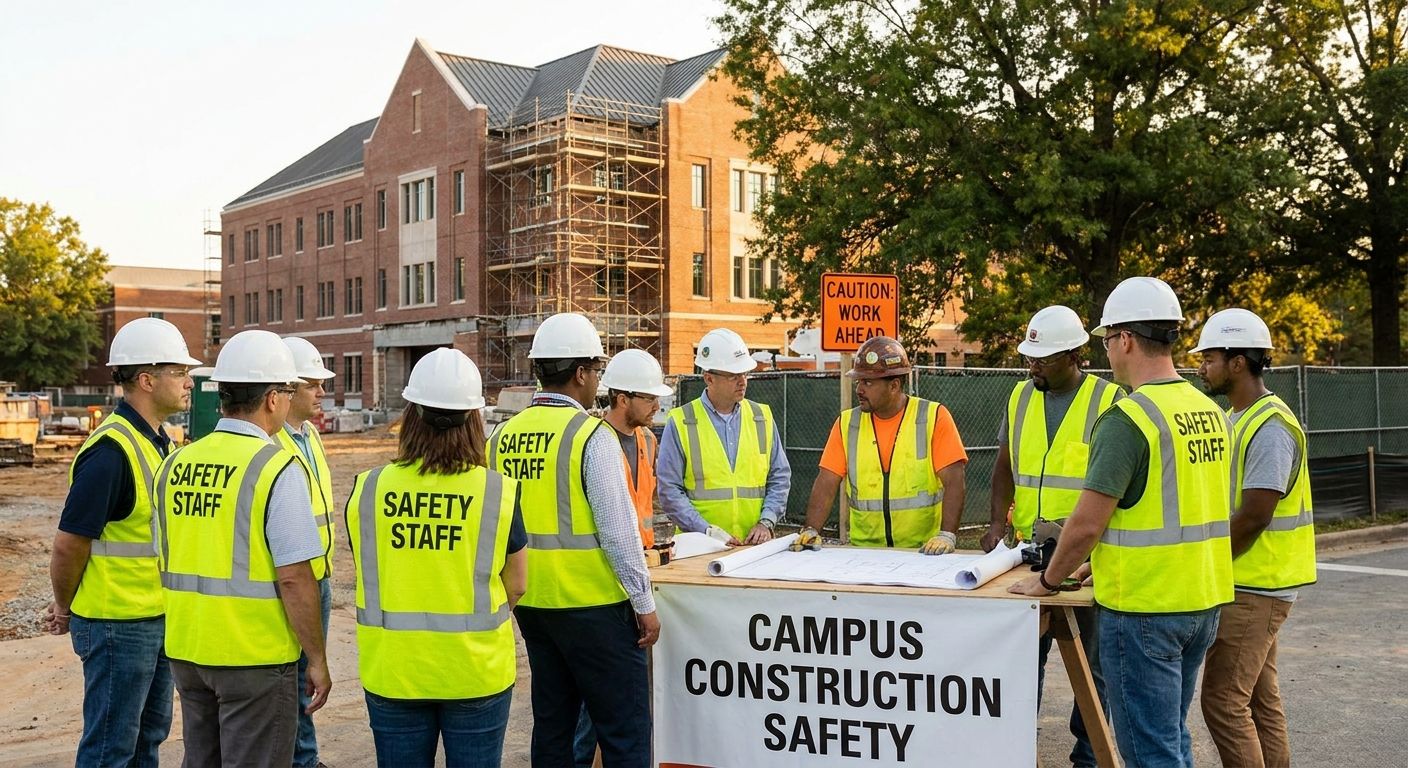
Campus construction safety staffing means finding EHS professionals who can run a job site fifty feet from a dining hall, a dorm move-in, or a home football game without slowing the project or triggering an OSHA citation. This guide covers what to look for, which roles matter most on a university build, and which staffing shortcuts cost more than they save in 2026.
- Campus construction safety staffing needs officers experienced with occupied buildings, not fenced industrial sites. Buy fast-track EHS staffing for summer-window renovations.
- Confined space attendant staffing is mandatory for utility tunnel and mechanical room work under older campus buildings. Buy.
- Direct-hire safety managers fit multi-year capital plans, not single-summer projects. Consider.
- Fire watch crews without campus background-check clearance stall hot-work permits mid-semester. Skip.
Why this matters
University construction projects don't get an empty site. A crane goes up 200 feet from students walking to class. A confined space entry happens under a dorm during finals week. One incident report during an active semester turns into a campus-wide safety review, a call from the provost's office, and a schedule delay measured in months, not days.
Most general contractors staff safety the same way they'd staff a warehouse build: post the role, hire whoever's certified and available first. That works on an industrial site with a fenced perimeter and no foot traffic. It breaks down the moment your safety officer has to coordinate with campus police, student housing, and a facilities director who can pause the schedule with one phone call.
Campus construction safety staffing in 2026 is its own category. Treating it like a generic commercial build is where most delays start.
Who this is for
This guide is built for facilities directors, capital projects VPs, and construction project managers running new builds, renovations, or infrastructure upgrades on a college or university campus. If your job site has pedestrian traffic, occupied buildings, or a schedule dictated by an academic calendar instead of a contract date, the staffing rules below apply to you. ResponsAble Staffing places EHS professionals against this exact set of constraints.
What to look for in campus construction safety staffing
Experience running safety programs near occupied buildings
A safety officer who's only worked fenced industrial sites has never had to reroute a confined space entry because a class lets out in ten minutes. Ask for specific campus, hospital, or K-12 project history, not just years of general construction experience. The skill that matters here is judgment under foot traffic, not certification count alone.
OSHA 10/30 credentials plus site-specific certifications
OSHA 30-hour is table stakes for anyone supervising a campus site in 2026. The real filter is site-specific credentials: confined space entry supervisor, fall protection competent person, and hot work permit authority. A resume with OSHA 30 and nothing else means you're paying to train the gaps yourself.
Speed to scale for the academic-calendar construction window
Most heavy campus renovation work happens in a compressed 10 to 14-week summer window between spring finals and fall move-in. A staffing partner who takes three weeks to fill a confined space attendant role has already cost you a fifth of your build window. Speed to fill matters more here than almost anywhere else in construction staffing.
Background-check turnaround that matches campus policy
Many universities require background checks or campus clearance before any contractor sets foot near residential or academic buildings, on top of the standard site badge. A staffing agency that can't turn a clean background check in a matter of days, not weeks, will bottleneck your onboarding regardless of how qualified the candidate is.
Multi-building, multi-trade coordination
A single campus capital project often spans a dorm, a dining hall renovation, and a utility tunnel upgrade running at the same time. Safety staff need to track different permit requirements, different occupancy statuses, and different subcontractor crews across all three without dropping a checklist. This is where a generalist safety hire, capable but unfocused, starts to miss things.
Top picks for campus construction safety staffing
The safe pick: fast-track safety officers for the summer-window build. If your renovation has to happen inside a 10 to 14-week academic break, you need officers who can start within days, not weeks. Fast-track construction safety staffing is built around exactly that compressed timeline. Buy if your project window is fixed by the academic calendar and can't slip.
The must-have: confined space attendants for utility tunnels and mechanical rooms. Steam tunnels and mechanical rooms under 40 and 50-year-old campus buildings are some of the highest-risk confined spaces on any job site type. Confined space attendant staffing covers this role specifically, with attendants who understand permit-required entry, not general laborers cross-trained into the job. Buy for any project touching campus utility infrastructure.
The overlooked pick: fire watch for hot work in occupied buildings. Welding or cutting inside a building that still has classes running down the hall requires a fire watch attendant who understands occupied-building hot work permits, not just a warehouse fire watch checklist. Skipping this role, or filling it with someone unqualified, is one of the fastest ways to trigger a fire marshal inspection mid-semester. Buy for any renovation involving hot work near occupied space.
The long-game pick: direct-hire safety managers for multi-year capital plans. If the university has a five or ten-year capital plan with sequential building projects, a permanent safety manager on staff makes more sense than rotating temporary hires project to project. This role carries institutional knowledge of campus protocols that a new temp has to relearn every time. Consider this only if the capital plan runs multiple years, not a single build.
The onboarding pick: OSHA outreach trainers for new subcontractor crews. Every new subcontractor crew arriving on a campus site needs a site-specific safety orientation beyond their standard OSHA 10. An outreach trainer who can run that orientation quickly keeps your schedule from stalling every time a new trade shows up. Consider this add-on for projects cycling through multiple subcontractors over the build.
Need campus-ready safety staff fast?
Vetted EHS professionals sourced for occupied-building job sites, ready in days.
What to avoid
- Industrial-only crews with no clearance process. A safety officer who's never cleared a university background check policy will hold up your onboarding while the paperwork catches up to the start date.
- Fire watch attendants sourced purely on hourly rate. The cheapest fire watch hire without hot-work-permit experience in occupied buildings is the one who misses the fire marshal's actual concern.
- Staffing firms that can't commit to a fill timeline. If a firm won't give you a specific number of days to fill a confined space attendant role during your summer window, assume it's longer than you need.
Verdict comparison
| Staffing type | Best for | Typical certification | Engagement length | Verdict |
|---|---|---|---|---|
| Fast-track safety officers | Summer-window renovations | OSHA 30 + fall protection | 10-14 weeks | Buy |
| Confined space attendants | Utility tunnels, mechanical rooms | OSHA confined space entry | Project-based | Buy |
| Fire watch attendants | Hot work in occupied buildings | Fire watch / hot work permit | Daily to weekly | Buy |
| Direct-hire safety managers | Multi-year capital plans | CSP / CHST | Permanent | Consider |
| OSHA outreach trainers | New subcontractor onboarding | OSHA outreach trainer card | Short-term, recurring | Consider |
“A safety officer who's never worked near a live campus spends the first two weeks learning what your GC already knows.”
FAQ
What is campus construction safety staffing?
Campus construction safety staffing is the placement of EHS professionals, like site safety officers, confined space attendants, and fire watch crews, on university and college construction projects. It differs from general commercial construction staffing because sites are near occupied buildings, active pedestrian traffic, and a fixed academic calendar.
How much does campus construction safety staffing cost in 2026?
Rates vary by role, certification level, and whether the placement is temporary or direct hire. Confined space attendants and fire watch roles typically price differently than a direct-hire safety manager, so get a quote scoped to your specific project.
Is a confined space attendant required for utility tunnel work on campus?
Yes, if the tunnel or mechanical space meets OSHA's permit-required confined space criteria, a trained attendant is required by law, not just best practice. Older campus buildings with steam tunnels almost always meet that threshold.
How fast can a staffing agency fill a safety role during the summer construction window?
Specialized agencies built for fast-track construction can often fill roles within days rather than weeks, which matters when your build window is fixed at 10 to 14 weeks. Ask any agency for their specific fill-time track record before signing.
Do university job sites need bilingual safety staff?
Many do, especially on large capital projects with mixed-language subcontractor crews. Bilingual safety coverage reduces miscommunication on permit requirements and daily safety briefings.
What certifications should a campus fire watch attendant carry?
A campus fire watch attendant should hold hot-work permit training specific to occupied buildings, not just a general warehouse fire watch card. Experience with campus fire marshal protocols is a strong secondary signal.
Can a staffing agency handle university background-check requirements?
A specialized safety staffing agency should be able to turn background checks and campus clearance requirements around in days, not weeks. If an agency can't quote a specific turnaround, that's a sign they haven't staffed campus projects before.
What's the difference between temporary and direct-hire safety staffing for campus projects?
Temporary staffing fits single-project or seasonal work, like a summer renovation window, while direct hire fits universities running multi-year capital plans that need institutional continuity. Match the staffing model to the length of your capital plan, not just the current project.
One last thing
Most university capital projects lose two to three weeks scrambling for a confined space attendant after the utility tunnel contract is already signed. Book that role at the same time you sign the trade contract, not after the crew shows up ready to work. The clearer you get on what the role actually requires before you post it, the faster the whole project moves forward.