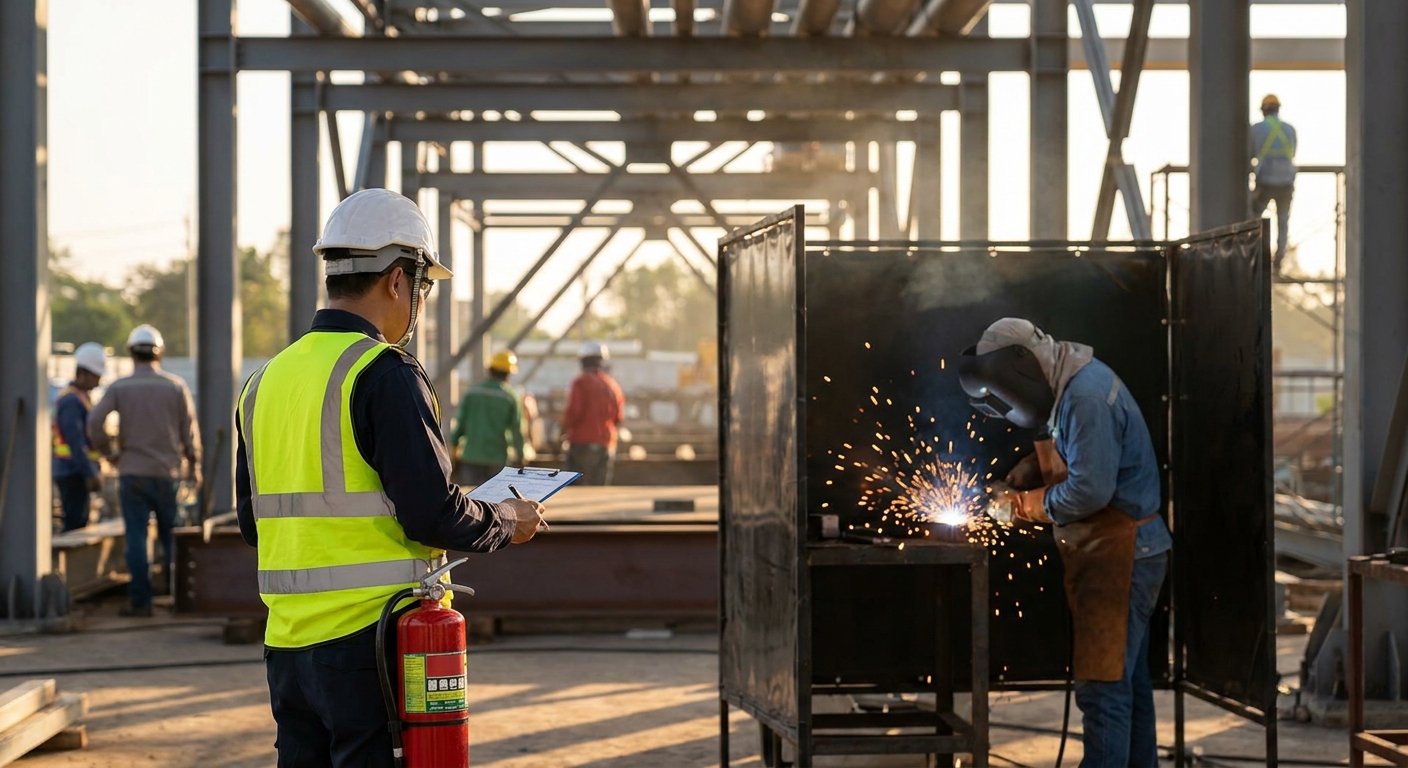
Fire watch staffing services decide whether a hot work permit closes clean or turns into an OSHA citation — and the right attendant for a refinery turnaround looks nothing like the right attendant for a warehouse re-roof.
- Fire watch staffing services for turnarounds and pipeline work need OSHA 10/30 certified attendants — generalist temp labor falls short here.
- NFPA 51B expects fire watch to stay on site after hot work ends; confirm your staffing partner trains to that standard.
- Direct hire fits plants running hot work daily; project-based staffing fits turnarounds and pipeline builds — match the model to the schedule.
- Marine terminal and shipyard hot work stacks confined-space entry on top of fire watch duty. Treat it as a specialty hire, not a generalist, in 2026.
Why this matters
A hot work permit is a paper trail. OSHA 29 CFR 1910.252 and NFPA 51B put the fire watch attendant's name and certification on that paper trail, and if a fire or an insurance claim follows the work, the first question is who was watching and were they qualified.
Staffing a fire watch position with whoever is free on a Friday afternoon is how a routine hot work job turns into a claim that dwarfs the original scope. In 2026, more insurers are asking for documented fire watch credentials before they underwrite hot work on active sites, and general contractors are pushing that requirement down through their subcontractors.
Fire watch staffing services exist because the attendant standing near the welding blanket matters as much as the welder does.
Who this is for
This guide is written for safety directors, EHS managers, and project managers at construction sites, oil and gas turnarounds, chemical plants, and manufacturing facilities who need OSHA-compliant fire watch coverage tied to active hot work permits. It is not for a facilities manager who needs a one-time extinguisher check.
ResponsAble Staffing works this exact lane: temporary, project-based, and direct hire placement of vetted industrial safety professionals — fire watch included — across construction, oil and gas, and manufacturing nationwide.
What to look for in fire watch staffing services for hot work permits
OSHA and NFPA 51B training, not just a badge
An attendant who can recite "I hold a fire watch card" isn't the bar. The attendant needs to know extinguisher classes, evacuation routes, and how long to stay after the torch shuts off under NFPA 51B guidance. A staffing partner should be able to describe that training, not just confirm a certificate exists.
Verified certifications and background checks
OSHA 10 or OSHA 30 credentials, a clean background check, and site-specific orientation records need to travel with the attendant before dispatch. Ask the agency how they verify this — a copy of a card on file is not the same as a confirmed, current certification.
Deployment speed that matches your permit window
Hot work permits often get issued same-day once a job is scoped. Ask how fast the staffing partner can put a qualified body on site, and whether that answer changes for a rural pipeline right-of-way versus an urban plant.
Industry-specific experience
A fire watch attendant who has worked refinery turnarounds understands permit stacking with confined-space entry and lockout-tagout in ways a generalist doesn't. Pipeline crews, chemical plants, and manufacturing floors each carry different hazard profiles, and experience in one doesn't automatically transfer to another.
Staffing model flexibility
A weekend outage needs temporary coverage. A six-week turnaround needs project-based staffing with shift rotation built in. A plant running hot work permits daily might justify a direct hire fire watch role. The right agency offers all three models instead of forcing one.
Documentation for permit audits
If OSHA or your insurer asks for records after an incident, you need time logs, certification files, and incident reports produced fast. A staffing partner that can't hand over a clean file same-day is a liability dressed up as a convenience.
Need fire watch coverage fast?
Talk through your hot work permit schedule and staffing model.
Where fire watch staffing services get tested hardest
Turnaround projects at refineries and oil and gas plants — the high-stakes pick. Turnarounds compress months of deferred hot work into a two-to-four week outage window, which means dozens of simultaneous permits and fire watch attendants working extended shifts across the unit. Turnaround safety staffing for oil, gas, and refinery projects is built around exactly this scheduling pressure. Verdict: Buy for any outage with more than a handful of concurrent hot work permits in 2026.
Pipeline construction — the mobile crew problem. Welding crews move site to site along the right-of-way, and fire watch coverage has to move with them, often into locations with no fixed water source or extinguisher station nearby. Safety staffing for pipeline construction projects is staffed for that mobility. Verdict: Buy for linear projects where the crew relocates weekly.
Chemical and petrochemical plants — the highest-consequence pick. Combustible dust and flammable vapor zones raise the training bar for fire watch attendants well above a standard hot work job, since a missed permit condition here has a different failure mode than a warehouse fire. EHS recruiting for chemical and petrochemical plants screens specifically for that hazard class. Verdict: Buy for process units with active hot work permits and vapor monitoring requirements.
Marine terminals and shipyards — the confined-space overlap. Vessel repair hot work routinely stacks fire watch duty on top of confined-space entry monitoring, which means the attendant is doing two safety jobs at once. This is a specialty combination worth flagging to any staffing partner before you scope the job, even without a dedicated page to point at. Verdict: Consider, and confirm the attendant is cross-trained before the permit gets pulled.
What to avoid
- General labor with no OSHA 10/30 on file. It looks cheap on the invoice and looks worse on the audit file when the certificate request turns up nothing.
- One-person, one-shift coverage on multi-week turnarounds. Fatigue and shift-change gaps are a common failure point when the same attendant covers a 12-hour shift for two weeks straight.
- Agencies that can't produce a certification file same day. If a permit gets pulled for review, "we'll get that to you next week" is not an answer that holds up in 2026's tighter insurance environment.
Verdict comparison
| Setting | Deployment urgency | Training depth needed | Verdict |
|---|---|---|---|
| Refinery/oil & gas turnaround | High — concurrent permits | OSHA 30, confined-space overlap | Buy specialized |
| Pipeline construction | High — crew relocates | OSHA 10/30, mobile-site protocol | Buy specialized |
| Chemical/petrochemical plant | High — vapor/dust zones | OSHA 30, hazard-class specific | Buy specialized |
| Marine terminal/shipyard | Moderate — scheduled repair | Confined-space + fire watch dual cert | Consider cross-trained |
| Standard manufacturing floor | Lower — planned maintenance | OSHA 10 baseline | Consider general coverage |
FAQ
What's the best fire watch staffing option for a weekend plant outage?
Temporary, project-based fire watch staffing fits a weekend outage best, since it matches the short window without committing to a direct hire. Confirm the attendant holds current OSHA 10 or OSHA 30 certification before the shift starts.
Is fire watch staffing required for every hot work permit?
Not every hot work permit requires a dedicated fire watch, but OSHA 29 CFR 1910.252 requires one when combustible materials can't be removed 35 feet from the work area. Most construction and industrial sites default to fire watch coverage to stay compliant.
How much does fire watch staffing cost in 2026?
Day rates vary by region, hazard class, and shift length, so ask any staffing partner for a rate card broken out by certification tier. Turnaround and chemical plant work typically commands higher rates than standard manufacturing coverage due to training depth.
Can one fire watch attendant cover multiple hot work permits at once?
Generally no — NFPA 51B expects direct observation of the hot work area, which makes simultaneous coverage of separate permits a compliance risk. Turnarounds with multiple concurrent permits need one attendant per active work zone.
What certifications should a fire watch attendant hold?
OSHA 10 is the baseline for most sites, with OSHA 30 preferred for refineries, chemical plants, and turnarounds. Confined-space entry certification matters too when the hot work overlaps a tank, vessel, or below-grade space.
How fast can a staffing agency deploy a fire watch attendant?
Deployment speed depends on the agency's bench and the site's location, so ask directly rather than assume. Rural pipeline right-of-way jobs typically take longer to staff than urban plants with a local labor pool.
Is direct hire or temporary staffing better for fire watch coverage?
Temporary or project-based staffing fits turnarounds and short-term construction jobs, while direct hire makes sense for plants running hot work permits daily. Match the staffing model to how often your site actually pulls permits, not to habit.
One last thing
OSHA hot work citations frequently center on fire watch documentation, not the welding work itself — auditors ask for the attendant's certification file before they ask for the weld log. Fire watch staffing services that hand you a clean certification file on day one aren't a nice-to-have; they're the difference between a closed permit and an open liability in 2026.