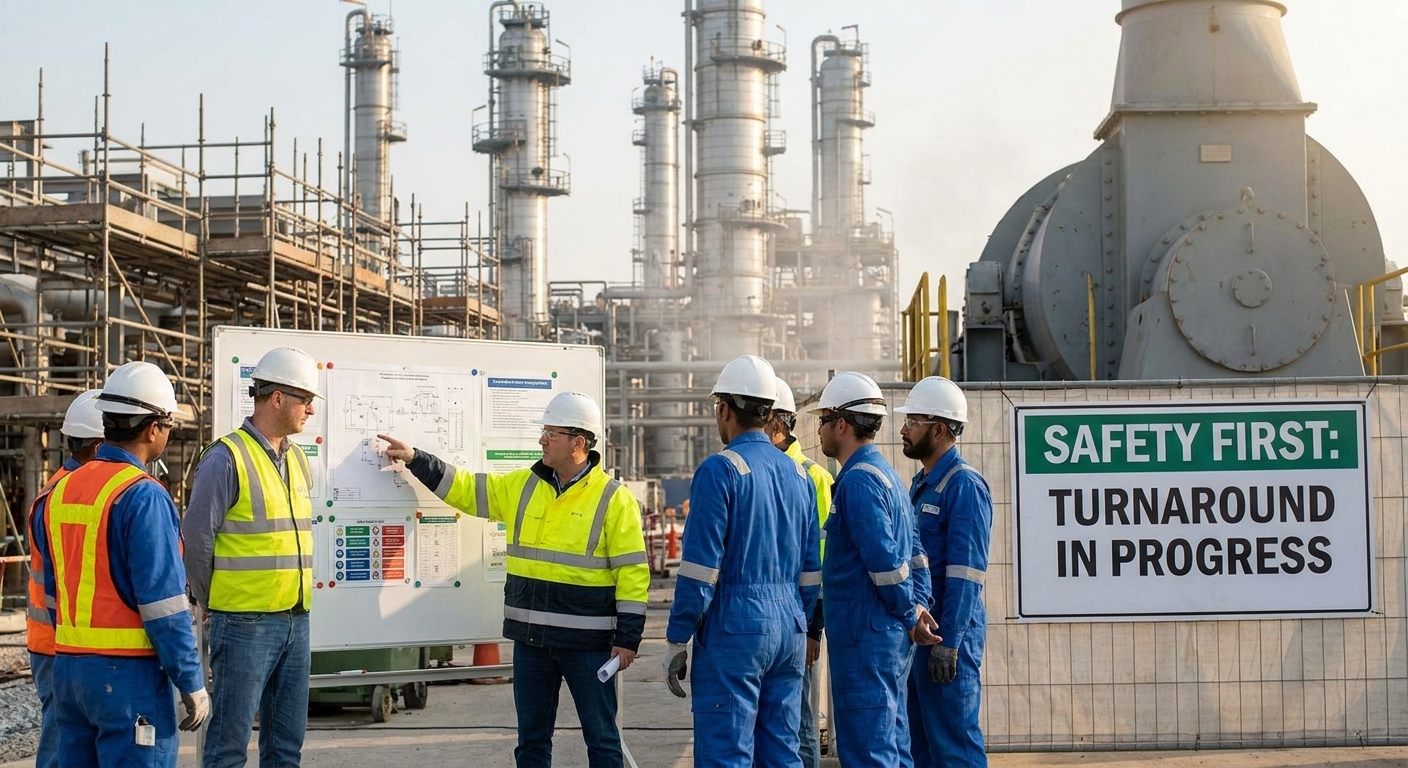
Refinery and plant turnarounds compress a year of maintenance work into three to six weeks, and the safety headcount has to scale just as fast. This guide breaks down what to prioritize when building a turnaround safety staffing plan for oil & gas and refinery projects in 2026.
- Confined space attendants and fire watch roles are the two categories to lock in first for any 2026 turnaround.
- Turnaround safety staffing works best with a 48-72 hour mobilization window built into the contract.
- ResponsAble Staffing places OSHA 30 and HAZWOPER 40-certified EHS professionals for oil & gas turnarounds nationwide.
- Skip generalist labor agencies for confined space and hot work roles — vetting gaps show up mid-shift.
Why this matters
A turnaround is the highest-risk window a refinery or plant runs through in a given cycle. Contractor headcount can jump three to ten times normal staffing within days, and every one of those workers needs a badge, a training record, and a supervisor who knows the site's permit system before the first shift starts.
Get the safety staffing plan wrong and the turnaround either slips schedule waiting on credentialed workers, or it runs with gaps that show up in an incident report. Get it right and safety staffing becomes the thing nobody talks about, which is the point.
Who this is for
This is written for turnaround managers, EHS directors, and project controls leads planning a shutdown, turnaround, or outage (STO) at a refinery, petrochemical plant, or heavy industrial site. If you're staffing a turnaround inside the next two quarters and need confined space attendants, fire watch personnel, or a temporary EHS supervisor bench, this is your checklist. ResponsAble Staffing works this exact lane — vetted industrial safety professionals placed temp, project-based, or direct hire into construction, oil & gas, and manufacturing environments nationwide.
What to look for in turnaround safety staffing for oil & gas and refinery projects
Certification depth, not just a certificate
OSHA 30-hour construction or general industry training is table stakes. For refinery turnaround work you need workers holding HAZWOPER 40-hour, confined space competent person, and often site-specific process safety orientation on top of that. A staffing partner that can show you the training matrix before mobilization, not after an incident, is the one worth using.
Mobilization speed
Turnaround schedules get set months out, but scope creep is normal — an extra 15 confined space entries show up in week two and someone has to staff them by Thursday. A 48-72 hour turnaround on qualified safety personnel is the realistic bar for 2026. Anything slower means your turnaround waits on staffing instead of staffing waiting on the turnaround.
Site-specific credentialing
TWIC cards for port-adjacent refineries, NCCER craft credentials, and plant-specific badge and orientation requirements all take time to clear. A staffing agency that pre-screens for these before presenting candidates saves days off your critical path.
Temp-to-direct-hire flexibility
Most turnarounds need a surge crew that scales down to near zero once the outage closes. Some sites also want to convert a strong EHS coordinator to a permanent role afterward. You want a staffing model that supports both without renegotiating the whole arrangement.
Track record in high-risk industries
A safety professional who's worked general construction sites is not automatically ready for a process unit with hot work permits and LOTO on live equipment. Ask for placement history specific to oil & gas, refining, or manufacturing turnarounds — not adjacent industries with looser hazard profiles.
Nationwide bench depth
Turnaround season clusters — spring and fall outages hit dozens of refineries within the same six-week window. A staffing partner with a thin regional bench will run out of qualified people exactly when you need them. Nationwide reach matters more for turnaround staffing than for almost any other industrial hiring need.
Top picks: the roles to lock in first
Confined space attendants and rescue techs — the non-negotiable
A single turnaround can generate hundreds of permit-required confined space entries under OSHA 1910.146. Every one needs an attendant on station, full stop. This is the role with zero substitution tolerance and the one to staff first, not last. Verdict: Staff now.
Fire watch and hot work monitors — the volume role
Hot work during a turnaround runs continuously across multiple units, and a mid-size outage can need 20 to 50 fire watch personnel per shift depending on scope. Volume is the challenge here more than skill depth, which makes surge capacity the deciding factor. Verdict: Staff now.
Safety coordinators and EHS field supervisors — the multiplier
One strong field supervisor covers 25 to 40 craft workers effectively during a turnaround. Understaff this role and safety compliance quality drops even if headcount elsewhere looks fine. This is where experience matters more than raw numbers. Verdict: Plan ahead.
Contract safety auditors and compliance techs — the audit trail
Post-turnaround OSHA inspections and internal audits go smoother with documentation built in real time, not reconstructed afterward. Smaller turnarounds under three weeks can often skip a dedicated auditor and fold the function into the field supervisor role. Verdict: Consider for larger scopes, skip for short outages.
Direct-hire EHS managers — the long game
Sites running turnarounds on a repeating three-to-five-year cycle benefit from a permanent EHS manager who owns the planning calendar year-round instead of rebuilding it from scratch each time. This is a direct-hire decision, not a project staffing one. Verdict: Plan ahead if turnarounds repeat on a fixed cycle.
Build your 2026 turnaround safety bench
Vetted EHS professionals, temp or direct hire, mobilized nationwide.
What to avoid
- Generalist labor agencies for confined space or hot work roles. They can fill a headcount number but often can't produce a verified HAZWOPER or confined space training record before day one.
- Crews missing TWIC clearance for port-adjacent sites. This credential alone can add days to onboarding if it's not pre-cleared, and it derails a tight turnaround schedule fast.
- Fixed-headcount contracts with no surge clause. Turnaround scope grows mid-outage more often than it shrinks — a staffing agreement without flex capacity forces a renegotiation at the worst possible time.
Verdict comparison across roles
| Role | Certification required | Typical headcount need | Mobilization lead time | Verdict |
|---|---|---|---|---|
| Confined space attendant | HAZWOPER 40, competent person | Dozens to 100+ per turnaround | 48-72 hrs | Staff now |
| Fire watch / hot work monitor | OSHA 30, fire watch training | 20-50 per shift | 48-72 hrs | Staff now |
| EHS field supervisor | 5+ yrs process safety experience | 1 per 25-40 workers | 1-2 weeks | Plan ahead |
| Safety auditor / compliance tech | OSHA 30, documentation background | 1-3 per turnaround | 1-2 weeks | Consider |
| Direct-hire EHS manager | Degree or CSP preferred | 1 per site | 30-60 days | Plan ahead |
FAQ
What is turnaround safety staffing?
Turnaround safety staffing is the temporary or project-based placement of certified EHS professionals — confined space attendants, fire watch, safety coordinators — to cover the compressed, high-risk workforce surge during a planned refinery or plant outage. Most placements run 3 to 8 weeks, matching the turnaround duration.
How far in advance should I book turnaround safety staff?
Book core roles like confined space attendants and fire watch 4 to 8 weeks before the turnaround start date in 2026. Scope-creep roles can often mobilize in 48 to 72 hours if the staffing partner has bench depth.
What certifications does a confined space attendant need?
A confined space attendant needs OSHA 1910.146 competent-person training at minimum, with HAZWOPER 40-hour certification standard for refinery and process unit work. Site-specific orientation is layered on top before badge access.
Is it better to hire safety staff temp or direct hire for a turnaround?
Temp or project-based staffing fits one-off turnarounds since headcount needs drop to near zero once the outage closes. Direct hire makes sense only when a site runs turnarounds on a repeating multi-year cycle and needs a permanent EHS manager year-round.
How many safety personnel does a refinery turnaround need?
Headcount scales with scope, but a mid-size refinery turnaround commonly needs 20 to 50 fire watch personnel per shift plus dozens of confined space attendants, supervised by one field EHS coordinator per 25 to 40 craft workers.
What's the biggest staffing mistake during a turnaround?
Signing a fixed-headcount contract with no surge clause is the most common mistake. Turnaround scope grows mid-outage more often than it shrinks, and a rigid contract forces a renegotiation during the worst possible week.
Do turnaround safety staff need TWIC cards?
Workers headed to port-adjacent refineries or marine terminals need TWIC clearance, and this credential can take days to process if it isn't pre-cleared. Confirm TWIC status before mobilization, not at the gate.
Can one staffing agency cover multiple simultaneous turnarounds?
Only agencies with genuine nationwide bench depth can, since turnaround season clusters heavily in spring and fall across dozens of refineries at once. Regional-only agencies often run out of qualified candidates during peak season.
One last thing
Most turnaround budgets plan safety staffing around the confirmed scope — and then get surprised when scope grows mid-outage, which is the norm rather than the exception. Build the surge clause into the staffing agreement before the turnaround starts, not after the third change order lands. That single contract term saves more schedule days in 2026 than any last-minute rush hire ever will.