Large-venue construction and live-event builds run on tight timelines, high worker density, and zero tolerance for a missed hot-work permit or an unattended confined space. Staffing the safety layer for these jobs takes a different playbook than a standard commercial build, and this guide breaks down what to look for, who to hire first, and where crews get it wrong.
- Large venue construction safety staffing means matching certified roles to peak crew size, not filling generic safety titles.
- Fire watch attendants and EMT standby are the two non-negotiable hires for stadium, arena, and festival-scale builds in 2026.
- ResponsAble Staffing places vetted, OSHA-credentialed safety professionals on temporary or project-based contracts nationwide.
- Skip generalist labor agencies for these builds — they rarely carry HAZWOPER, confined space, or rigging credentials.
- Union-affiliated safety coordinators are the safer buy on any project with a labor agreement in place.
Why this matters
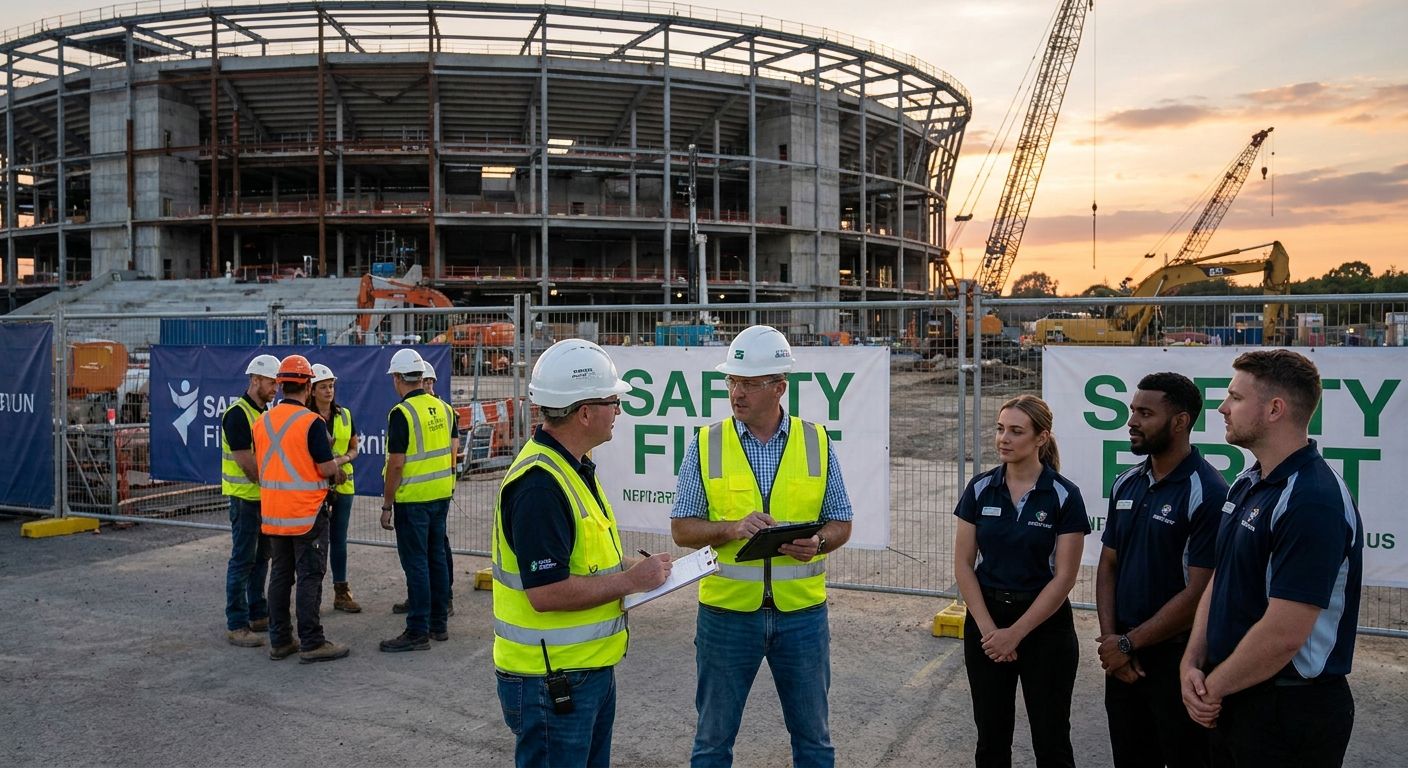
A large venue build — think a new arena, a convention center expansion, or the temporary infrastructure for a multi-day festival — stacks trades on top of each other in a compressed schedule. Riggers, electricians, welders, and crane operators are often working the same footprint at the same hour, and occupancy can swing from a few hundred workers during framing to several thousand once vendors, security, and event staff arrive for load-in.
That density is exactly why large venue construction safety staffing has become its own hiring category rather than a subset of general construction staffing. ResponsAble Staffing places EHS professionals who already understand crowd-adjacent job sites — fire watch, medical standby, confined space attendants, and safety coordinators who can flex between construction-phase rules and event-phase rules on the same property.
Getting this wrong doesn't just risk a citation. A single missed fire watch log during a hot-work permit, or an unattended confined space entry during rigging setup, can shut the whole site down days before a scheduled opening.
Who this is for
This guide is built for general contractors, event production companies, and venue owners staffing the safety side of a stadium build, arena renovation, convention center expansion, or a temporary structure erected for a festival, concert series, or sporting event. If your project mixes construction trades with public-facing event operations on a fixed opening date, the staffing math below applies directly to you.
What to look for in safety staffing for large venue construction
Credentials that match the actual hazard mix
A large venue site touches rigging, hot work, confined spaces, electrical, and often working at height simultaneously. Ask for proof of OSHA 30, current fire watch certification, and — if the build includes tunnels, catwalks, or mechanical rooms — confined space entry credentials, not just a generic "safety tech" title.
Scalability for load-in and event-day surges
Crew needs on these jobs spike hard during load-in, rigging, and pre-opening walkthroughs. A staffing partner that can flex from a 4-person safety team to 15+ within a week matters more here than on a flat-schedule commercial build.
Experience with dual-phase job sites
Venue builds shift from construction-rules compliance to public-assembly compliance almost overnight once event staff, vendors, and eventually the public enter the space. Safety staff who've worked this transition before catch gaps that construction-only hires miss.
Fast placement turnaround
Opening dates on stadiums and festival grounds don't move. A staffing partner needs a bench deep enough to place certified fire watch, EMT, or confined space attendants within days, not weeks, when a permit deadline moves up.
Union compatibility where it applies
Many large venue projects run under a project labor agreement. Safety staff placed on these jobs need to understand union jurisdiction rules so they don't create a labor dispute on top of a safety issue.
Documentation discipline
Hot-work permits, confined space entry logs, and toolbox talk records need to survive an audit. Safety staff who treat paperwork as an afterthought create liability that surfaces months after the ribbon-cutting.
Need certified safety staff fast?
Vetted EHS professionals ready for event and large-venue builds nationwide.
Top staffing roles to prioritize
Fire watch attendants — the compliance backbone
Any hot work on a large venue build — welding steel for a scoreboard truss, cutting rebar near combustibles, torch work on temporary structures — requires a dedicated fire watch under NFPA 51B and most local fire codes. Buy: this role is non-negotiable the moment a hot-work permit is pulled, and ResponsAble Staffing places certified attendants on project-based contracts.
EMT and medical standby — the safety net for peak crews
Once a job site's peak headcount pushes past a few hundred workers plus event vendors, on-site medical response time becomes a real liability question, not a nice-to-have. Buy: EMT staffing for job sites covers both the construction phase and the event-day walkthrough phase without a staffing gap.
Confined space attendants — the overlooked hire
Catwalks, mechanical rooms, and below-grade utility runs on arena and stadium builds create confined space entries that general laborers aren't certified to monitor. Consider: only needed if the build includes tunnels, tanks, or enclosed mechanical spaces — skip it for open-air festival grounds with no enclosed structures.
Behavior-based safety coaches — the crowd-control multiplier
Once multiple trades and event vendors share a footprint, a coach focused on near-miss reporting and behavior patterns catches the friction points that a compliance-only inspector misses. Consider: highest value on multi-trade builds running past 90 days, lower priority on short festival installs.
Union-affiliated safety coordinators — the labor-compliance pick
On a project labor agreement job, a safety coordinator unfamiliar with union jurisdiction can trigger a grievance faster than they catch a hazard. Buy for any large venue build running under a PLA; Skip the generalist coordinator option if the project has union trades on-site.
What to avoid
- Generalist staffing agencies without EHS specialization. They can fill a warm body labeled "safety tech," but they rarely verify HAZWOPER, confined space, or rigging credentials before placement.
- Single-source contractors with no bench depth. A fire watch attendant who calls in sick with no backup shuts down every hot-work permit on the site that day.
- Safety staff with no event-phase experience. Someone who's only worked construction-only sites often misses the transition rules once vendors, security, and the public start moving through the same footprint.
“If the general contractor can't produce a fire watch log for every hot-work permit, the job site is out of compliance the moment torches start.”
Verdict comparison
| Role | Certification to confirm | Best for | Verdict |
|---|---|---|---|
| Fire watch attendant | NFPA 51B / local fire code | Any hot work on site | Buy |
| EMT / medical standby | State EMT-B or higher | Crews over a few hundred workers | Buy |
| Confined space attendant | OSHA confined space entry | Enclosed structures, tunnels, tanks | Consider |
| Behavior-based safety coach | BBS coaching certification | Multi-trade builds past 90 days | Consider |
| Union safety coordinator | Union jurisdiction training | PLA-governed projects | Buy |
FAQ
What is large venue construction safety staffing?
It's the practice of placing certified EHS professionals — fire watch attendants, EMT standby, confined space attendants, safety coordinators — on stadium, arena, and event-site builds where construction trades and public-assembly rules overlap. It differs from general construction staffing because crews shift from construction-phase compliance to event-phase compliance on the same footprint.
How fast can a fire watch attendant be placed on a job site?
A staffing partner with a certified bench can typically place a fire watch attendant within days of a hot-work permit being scheduled. Agencies without a dedicated EHS bench often take a week or longer, which is too slow once torches are already scheduled.
Do festival and event builds need confined space attendants?
Only if the build includes enclosed structures like tunnels, mechanical rooms, or tanks. Open-air festival grounds with no enclosed spaces usually don't require this role, so it's a Consider rather than a Buy for that project type.
Is union safety staffing different from non-union staffing?
Yes. A safety coordinator working under a project labor agreement needs to understand union jurisdiction rules, or a safety intervention can trigger a labor grievance on top of the original hazard. Non-union jobs don't carry that risk layer.
What's the biggest safety staffing mistake on large venue builds?
Using a generalist labor agency that labels workers 'safety tech' without verifying OSHA 30, fire watch, or confined space credentials. That gap usually surfaces during an audit or after an incident, not before.
How many safety staff does a stadium or arena build need?
Crew size scales with peak headcount and hazard mix rather than a fixed ratio. A build with hot work, rigging, and confined spaces running simultaneously needs more dedicated roles than a single-trade phase of the same project.
Can safety staff transition from construction phase to event-day operations?
Experienced safety professionals can, but it requires familiarity with both construction-site rules and public-assembly code, which is why dual-phase experience is a key hiring criterion for these builds.
What certifications should a safety staffing agency verify before placement?
OSHA 30 at minimum, plus role-specific credentials: fire watch certification for hot work, EMT licensure for medical standby, and confined space entry training for enclosed structures. A vetted agency confirms these before a candidate ever reaches the site.
One last thing
The detail that trips up most large venue builds isn't the construction-phase safety plan — it's the day the site flips from construction rules to public-assembly rules and nobody updated the staffing plan to match. Build that transition into the safety staffing contract from day one, in 2026 and every project year after it, and the opening-day walkthrough stops being a scramble.