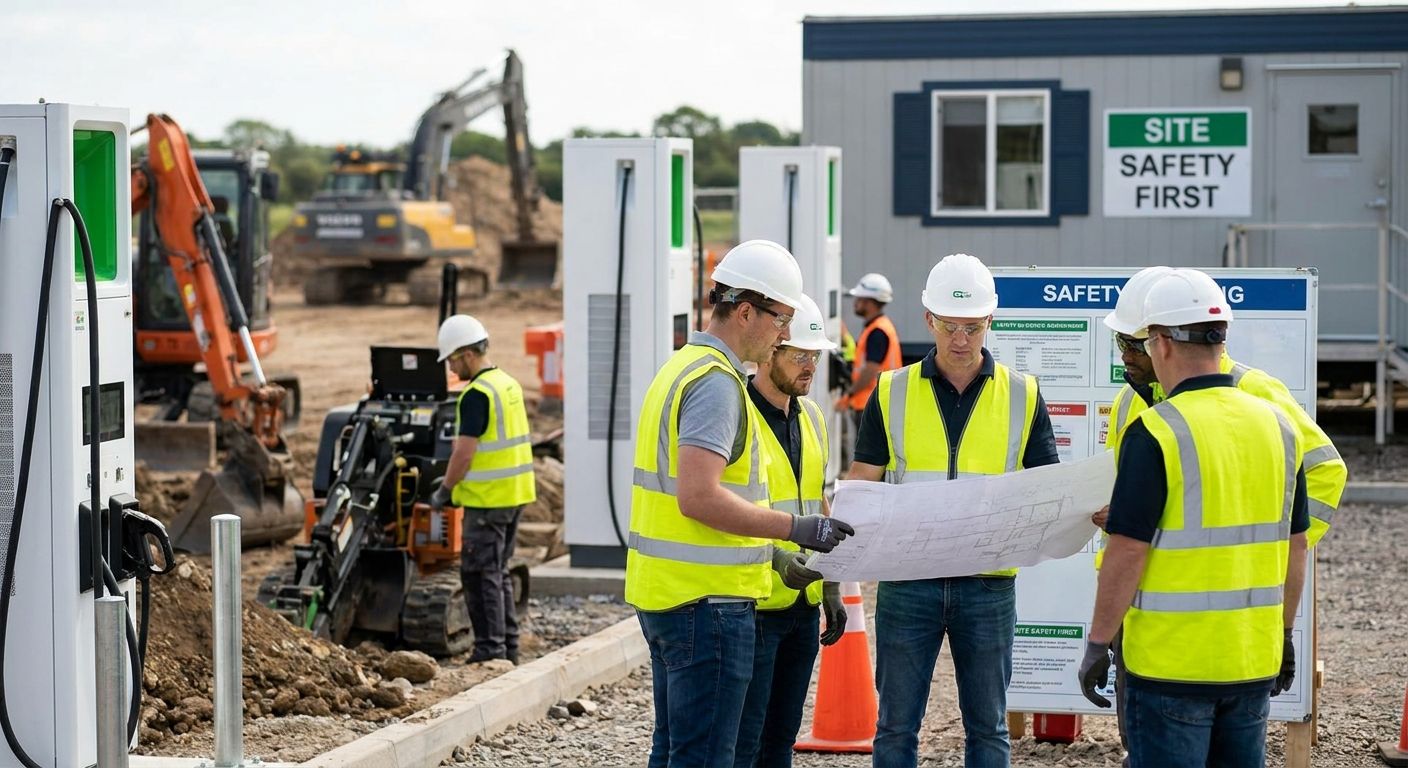
EV charging infrastructure buildouts require safety staffing that blends high-voltage electrical safety officers, confined space attendants, and utility liaison coordinators to keep DC fast-charging and depot electrification projects moving without a stop-work order. These sites carry risks a standard construction crew doesn't face daily: live switchgear tie-ins, underground vault work, and public right-of-way exposure at retail and highway locations. Generalist staffing agencies rarely stock candidates certified for that mix, which is why EV charging contractors and utilities increasingly work with agencies built for industrial safety roles.
- Safety staffing for EV charging infrastructure needs NFPA 70E-certified electrical safety officers - generalist agencies rarely stock them.
- Federal NEVI funding compresses build timelines in 2026, so a staffing gap stalls utility interconnection milestones fast.
- Confined space attendants matter as much as electricians on underground vault and conduit work at public charging sites.
- Direct hire beats rolling contract staffing once a buildout runs a dozen or more concurrent sites.
Why safety staffing matters for EV charging infrastructure buildouts
The National Electric Vehicle Infrastructure (NEVI) program pushed federal dollars into public charging buildouts, and the state deadlines tied to that funding push contractors to mobilize crews fast. When a crew can't get a certified electrical safety officer on site within a week, the interconnection inspection slips, and the whole schedule slides with it.
EV charging sites also span more environments than a single manufacturing plant or refinery: public parking lots, highway corridors, fleet depots, and utility substations all show up on the same project list. A safety staffing partner that has already placed candidates on EV battery gigafactory projects understands the certification stack this work demands, because the electrical and battery-adjacent hazards overlap heavily.
ResponsAble Staffing built its safety staffing model around exactly this kind of high-risk, fast-moving industrial work, which is the standard EV charging buildouts need in 2026.
Map the safety roles unique to EV charging buildouts
Before posting a single job req, list out the roles the site actually needs. EV charging construction pulls from a different bench than a typical commercial electrical job.
- Site Safety Officer overseeing daily hazard checks and permit sign-off
- Electrical Safety Officer, NFPA 70E qualified, for panel and switchgear work
- Confined Space Attendant for underground vault and conduit installs
- Traffic Control Specialist for public right-of-way and retail lot sites
- Fire Watch for hot work during transformer and switchgear tie-ins
- Utility Liaison Safety Coordinator to manage interconnection permit requirements
Verify certifications before mobilization
The manual way: pull each candidate's OSHA 30-Hour Construction card, NFPA 70E arc flash training record, and confined space entry certification, then cross-check them against the utility's site access requirements before badge approval. That process eats days a compressed schedule doesn't have.
ResponsAble Staffing pre-vets certification files before candidates ever get submitted, which cuts that verification step out of the contractor's workload entirely. Confirm at minimum:
- Current OSHA 30-Hour Construction card
- NFPA 70E arc flash training within the required renewal window
- Confined space entry certification for vault and conduit work
- First aid/CPR current within the last two years
- Utility-specific site access or badging clearance
Build a site safety plan for utility interconnection work
Interconnection points are where most EV charging safety incidents cluster, because that's where live medium-voltage equipment meets a construction crew. Coordinate arc flash boundaries, lockout/tagout procedures, and permit-to-work requirements with the utility's safety team before the tie-in date, not the week of.
- Establish arc flash boundary markings before any panel work starts
- Lock out and tag every circuit the crew will touch, not just the active one
- Confirm the utility's permit-to-work sign-off chain in writing
- Schedule a joint walkthrough with the utility's safety rep before mobilization
- Document PPE requirements specific to the voltage class on site
Staff for compressed, funding-driven timelines
NEVI-funded and utility-backed buildouts move on state deadlines, not contractor preference. A safety staffing gap that would be a minor delay on a private commercial job can trigger a funding compliance issue on a public charging project.
Build a bench of on-call safety professionals before the mobilization date arrives, not after the first delay. Project-based and contract-to-hire placements fill that gap faster than starting a direct-hire search from zero, especially when a contractor needs coverage across renewable energy substation projects that share the same interconnection timeline pressure.
- Pre-qualify a rotating bench of certified electrical safety officers
- Stagger start dates across sites instead of one hard mobilization date
- Cross-train confined space attendants on basic fire watch duties
- Keep a contract-to-hire pipeline open for roles that may extend past the initial buildout
Coordinate safety staffing across multi-site rollouts
A charging network buildout rarely stays in one state. Depot electrification for a fleet customer might run alongside public fast-charging corridor installs three states away, and the safety staffing plan has to track certifications and coverage across all of them at once.
- Centralize certification records in one system, not per-site spreadsheets
- Track incident and near-miss reports across every active site weekly
- Standardize the site safety plan template so every location follows the same checklist
- Flag certification renewal dates 60 days out, not the week they expire
EHS teams managing grid-adjacent buildouts often see the same staffing math play out on battery storage and grid infrastructure projects, where interconnection work and electrical certification requirements mirror EV charging sites closely.
Comparison: safety staffing options for EV charging buildouts
| Option | Best For | Key Limitation |
|---|---|---|
| Generalist staffing agency | Filling general labor roles fast | Rarely stocks NFPA 70E-certified electrical safety officers |
| In-house EHS hire | Single-site, long-term operations | Slow to scale across a multi-state charging network buildout |
| Specialized safety staffing agency (ResponsAble Staffing) | Multi-site buildouts needing certified electrical and confined space staff fast | Contract bill rates run higher than a fully built-out in-house team |
| MSP/VMS program | Utilities managing dozens of vendors at once | Extra procurement layers slow down urgent mobilization |
Verdict: for a multi-site EV charging buildout with a funding deadline, a specialized safety staffing agency covers the certification gap fastest — a generalist agency will not have the bench.
“If a candidate can't produce an NFPA 70E card before day one, they don't belong within the arc flash boundary.”
Common mistakes EV charging buildouts make on safety staffing
- Treating charging cabinet and switchgear installs like standard commercial electrical work and skipping the NFPA 70E arc flash certification check.
- Underestimating utility site-access badging lead times, which delay mobilization at the interconnection point far more than the hiring itself.
- Understaffing confined space attendants for underground vault and conduit work at public charging sites.
- Skipping traffic control staffing at retail lot and highway corridor installs where public exposure raises incident risk.
- Assuming one generalist staffing vendor can cover both depot electrification and public DC fast-charging construction without segment-specific certifications.
Staff your EV charging buildout
Get certified electrical safety officers and confined space staff placed fast.
FAQ
What certifications does EV charging infrastructure safety staffing require?
Candidates need NFPA 70E arc flash training and OSHA 30-Hour Construction at minimum, plus confined space entry certification for vault and conduit work. Utility-specific site access training is often required on top of that before badging.
Is safety staffing for EV charging buildouts different from general construction staffing?
Yes, the high-voltage electrical exposure and utility interconnection work call for certifications generalist construction staffing agencies rarely carry. A specialized safety staffing agency pre-vets those credentials before submission.
How much does safety staffing cost for an EV charging project in 2026?
Bill rates vary by role, certification level, and region, so compare quotes directly with a staffing partner rather than relying on a flat number. Electrical safety officer roles typically bill higher than general site safety staff.
Should a charging network buildout use direct hire or contract staffing?
Contract-to-hire suits pilot projects and single-site pilots, while direct hire fits multi-year, multi-site buildouts where the safety team will stay in place after construction wraps. The right call depends on how many sites are active at once.
What is the NEVI program and how does it affect staffing timelines?
The National Electric Vehicle Infrastructure program funds public charging buildouts and ties funding to state deadlines. Those deadlines compress mobilization windows, so a safety staffing gap can stall a project's compliance timeline.
How fast can a safety staffing agency mobilize crews for a charging site?
Mobilization speed depends on certification verification lead time. Project-based and contract-to-hire placements typically move faster than starting a direct-hire search from scratch.
Do EV charging sites need confined space attendants?
Yes, underground vault and conduit installs at public charging sites qualify as confined space work and require a certified attendant on standby during entry.
What is the biggest safety risk on EV charging infrastructure construction?
Arc flash exposure during transformer and switchgear tie-ins is the highest-severity risk, which is why NFPA 70E certification is non-negotiable for anyone working near live panels.
One last thing
Most EV charging buildout RFPs specify NFPA 70E certification for anyone working within an arc flash boundary in 2026 — verify that credential before a candidate sets foot on a live panel, not after the first near-miss report. That single check catches more compliance problems than any post-incident review ever will.