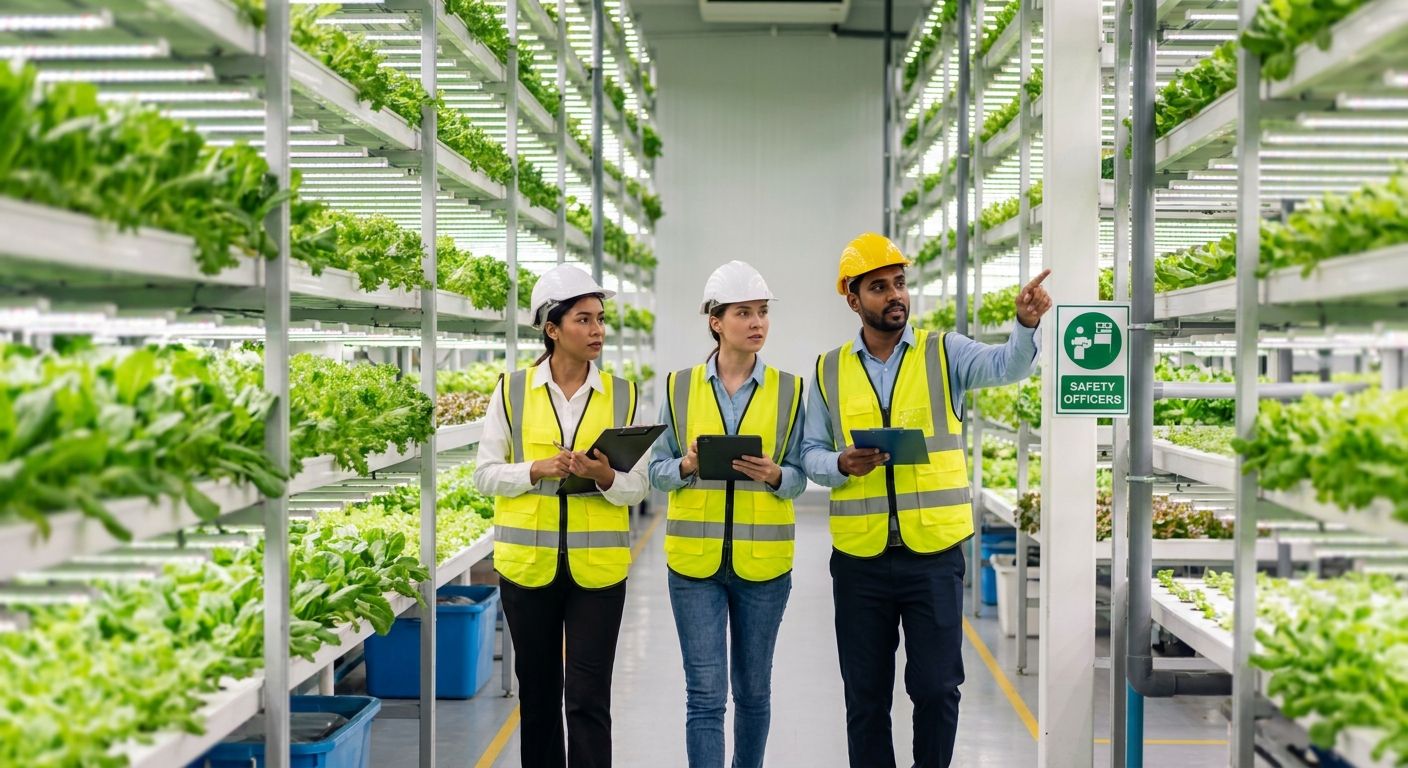
Safety staffing for vertical farming facilities means placing EHS professionals who understand three hazard categories at once: electrical systems, horticultural chemical handling, and confined space work inside multi-story grow towers and nutrient reservoirs. A vertical farm is not a warehouse and it is not a traditional agricultural operation, so a safety hire who only knows one of those worlds will miss the other two. The facilities that get this right hire specialists who cross-train across electrical, chemical, and confined-space risk before the grow lights ever turn on.
- Safety staffing for vertical farming facilities requires EHS pros trained across electrical, chemical, and confined-space hazards at once.
- Vertical farms often get misclassified as agriculture when OSHA applies general industry rules to powered indoor grow structures.
- Confined space attendants are frequently needed for nutrient reservoirs and grow tower access points, not just tanks.
- Direct hire works for permanent safety directors; contract and project-based staffing fits fast buildout timelines in 2026.
Why safety staffing matters for vertical farming operators
Vertical farming facilities compress hazards that used to live in separate industries into one building. LED grow racks stacked several stories high create fall exposure. Hydroponic and aeroponic nutrient systems introduce chemical handling and confined space entry into reservoirs and mixing tanks. High-density electrical loads for lighting and climate control raise arc flash and lockout/tagout stakes. Add ammonia-based refrigeration in cold-storage-adjacent post-harvest areas and you have a facility that doesn't map cleanly onto standard OSHA industry codes.
That mismatch is the core staffing problem. A safety generalist who has only worked traditional manufacturing floors won't know how to write a lockout procedure for a hydroponic pump system. A candidate with only agricultural field experience won't have arc flash training. The right hire for a vertical farm in 2026 has to bridge both worlds, and that talent pool is small.
Map the hazard profile before you post a job
Start with a written hazard inventory specific to your facility layout, not a generic manufacturing job description. Grow towers, mezzanine racking, and vertical conveyance systems each carry different fall and pinch-point risks.
- Fall protection needs for elevated grow racks and mezzanines
- Lockout/tagout scope for irrigation pumps, LED driver circuits, and HVAC
- Chemical exposure from nutrient solutions, pH adjusters, and pesticides
- Confined space classification for reservoirs, sumps, and mixing vessels
- Ammonia or CO2 enrichment monitoring in sealed grow rooms
- Ergonomic strain from repetitive harvesting and transplant tasks
Classify the facility correctly under OSHA
Many vertical farms default to an agricultural exemption mindset because the product is food. That's the wrong lens for an indoor, powered, multi-story structure. Get the classification right before you write a single job posting, because it determines which certifications your safety hire actually needs.
- Confirm whether your facility falls under General Industry (29 CFR 1910) rather than agriculture standards
- Document electrical and mechanical systems that trigger machine guarding and LOTO requirements
- Identify which areas meet the definition of a permit-required confined space
- Check state-level agricultural safety exemptions against your actual operations, not your industry label
- Loop in a third-party safety audit if classification is unclear before you scale headcount
Write job descriptions that name the exact certs and PPE required
Generic postings like "Safety Coordinator wanted" pull the wrong applicant pool. Vertical farming candidates need to see the specific hazard mix in the listing or they won't apply, and the ones who do apply won't be qualified.
- List required certifications: OSHA 30, confined space entry/attendant, arc flash/electrical safety, HAZWOPER if applicable
- Name the actual equipment: vertical conveyors, hydroponic pump systems, LED driver panels
- State PPE requirements tied to wet environments and chemical handling, not just hard hats and vests
- Specify shift structure if the facility runs 24/7 grow cycles
- Flag bilingual requirements if the harvest and production crew is multilingual
Source candidates who understand the electrical-chemical-confined space overlap
This is where most in-house recruiting stalls. Job boards return either industrial electricians or agricultural safety generalists, rarely both skill sets in one candidate. ResponsAble Staffing works from a vetted bench of EHS professionals placed across construction, manufacturing, and chemical-adjacent operations, which is the closer skill match for a vertical farm than a pure agriculture recruiter.
- Prioritize candidates with confined space attendant or entry supervisor experience, not just general safety credentials
- Look for arc flash and NFPA 70E familiarity given the electrical density of LED grow systems
- Weight chemical handling and HAZWOPER background for nutrient and pesticide areas
- Confirm prior experience in food-adjacent or pharmaceutical-adjacent facilities where sanitation and safety overlap
- Ask about multi-story or mezzanine work experience specifically, not just "heights" broadly
For a permanent safety leadership role rather than a contract fill, direct hire recruiting for safety managers is the faster path than running your own search from scratch, since the candidate pool for this cross-trained skill set is thin.
Vet certifications before placement, not after
A certification claimed on a resume and a certification verified against the issuing body are two different things. Verify before the candidate ever sets foot on your production floor.
- Confirm confined space entry/attendant training dates and issuing organization
- Verify OSHA 10/30 completion directly, not from a resume line
- Check electrical safety certifications against NFPA 70E requirements for your facility's voltage exposure
- Confirm HAZWOPER currency if the role touches nutrient chemical handling
- Cross-check any state-specific agricultural safety credentials your location requires
Build a fast-track hiring process for buildout phases
New vertical farm construction and retrofit projects move fast, and safety staffing often gets treated as an afterthought until a pre-startup safety review flags a gap. Build the hiring timeline into the construction schedule, not after it.
- Start safety staffing conversations at the same point you finalize construction milestones
- Use project-based or temporary placements to cover the buildout-to-startup window
- Reserve direct hire searches for the permanent safety director role once operations stabilize
- Plan for a transition period where contract safety staff train the permanent hire
- Budget lead time for certification verification so it doesn't delay your opening date
Get vertical farm safety staffing help
Talk through your grow facility's hazard mix and staffing timeline.
Comparing staffing options for vertical farming facilities
| Option | Best for | Engagement model | Key limitation |
|---|---|---|---|
| In-house recruiting | Single-site farms with time to spare | Full-time internal recruiter | Slow against a thin cross-trained candidate pool |
| General staffing agencies | Quick fills for basic warehouse-style roles | Temp-to-hire, hourly | Rarely screens for the electrical-chemical-confined space overlap |
| Specialized safety staffing | Facilities needing vetted EHS pros fast | Temporary, project-based, or direct hire | Bench depth varies by region and role scarcity |
| Direct hire search firms | Filling one permanent safety director role | Contingency or retained search | Longer placement timeline than contract staffing during buildout |
Verdict: a specialized safety staffing partner beats a general agency for vertical farming facilities in 2026 because the hazard mix demands cross-trained candidates that generalist job boards rarely surface.
Common mistakes vertical farming operators make
- Treating grow tower work like standard warehouse work. Fall protection, wet-environment electrical exposure, and elevated access combine differently than in a typical distribution center.
- Assuming agricultural OSHA exemptions apply. An indoor, powered, multi-story facility usually falls under General Industry standards, not agricultural exemptions.
- Underestimating confined space needs. Nutrient reservoirs, mixing tanks, and sumps often meet the permit-required confined space definition and get missed in early hazard assessments.
- Waiting until construction finishes to hire safety staff. Pre-startup safety reviews need a qualified EHS professional on site before commissioning, not after.
- Hiring generalists without ammonia or electrical exposure experience. A safety generalist without HAZWOPER or NFPA 70E background will miss hazards specific to CEA operations.
FAQ
What's the best staffing option for vertical farming safety roles in 2026?
Specialized safety staffing works best for vertical farming facilities in 2026 because it sources candidates cross-trained across electrical, chemical, and confined-space hazards rather than pulling from a single-industry talent pool.
Is vertical farming classified as agriculture or general industry under OSHA?
Most indoor, powered vertical farming operations fall under OSHA General Industry standards (29 CFR 1910) rather than agricultural exemptions, since the facility involves fixed electrical systems, mechanical equipment, and enclosed structures.
How much does safety staffing cost for a vertical farm?
Cost depends on the role type, certification level required, and whether you need temporary, project-based, or direct hire placement. Get a facility-specific quote rather than relying on general industry averages.
Do vertical farming facilities need confined space attendants?
Yes, most vertical farms have nutrient reservoirs, mixing tanks, or sumps that meet the permit-required confined space definition and require a trained attendant during entry work.
What certifications should a vertical farming safety hire have?
Look for OSHA 30, confined space entry/attendant training, and arc flash or NFPA 70E familiarity given the electrical density of LED grow systems. HAZWOPER matters for facilities handling nutrient chemicals.
How fast can you fill a safety manager role during a grow facility buildout?
Fill speed depends on how narrow the certification requirements are and whether you're running a contract, project-based, or direct hire search. Project-based placement generally moves faster than a full direct hire search for a permanent role.
Is direct hire or contract staffing better for a new vertical farm startup?
Contract or project-based staffing covers the buildout-to-startup window, while direct hire recruiting fits the permanent safety director role once operations stabilize. Most new facilities use both in sequence.
Can safety staffing agencies place bilingual safety staff for vertical farming crews?
Yes, bilingual safety staffing is a standard request for production and harvest crews, and specialized agencies typically maintain candidates who meet both language and certification requirements.
One last thing
The hardest vertical farming safety hire isn't the confined space attendant or the electrical safety officer individually. It's finding one person who can walk a facility and correctly flag risk in all three domains at once, because most safety careers specialize in only one. If your current candidate pipeline is only producing agricultural generalists or pure electricians, the pipeline itself is the problem, not the job market.