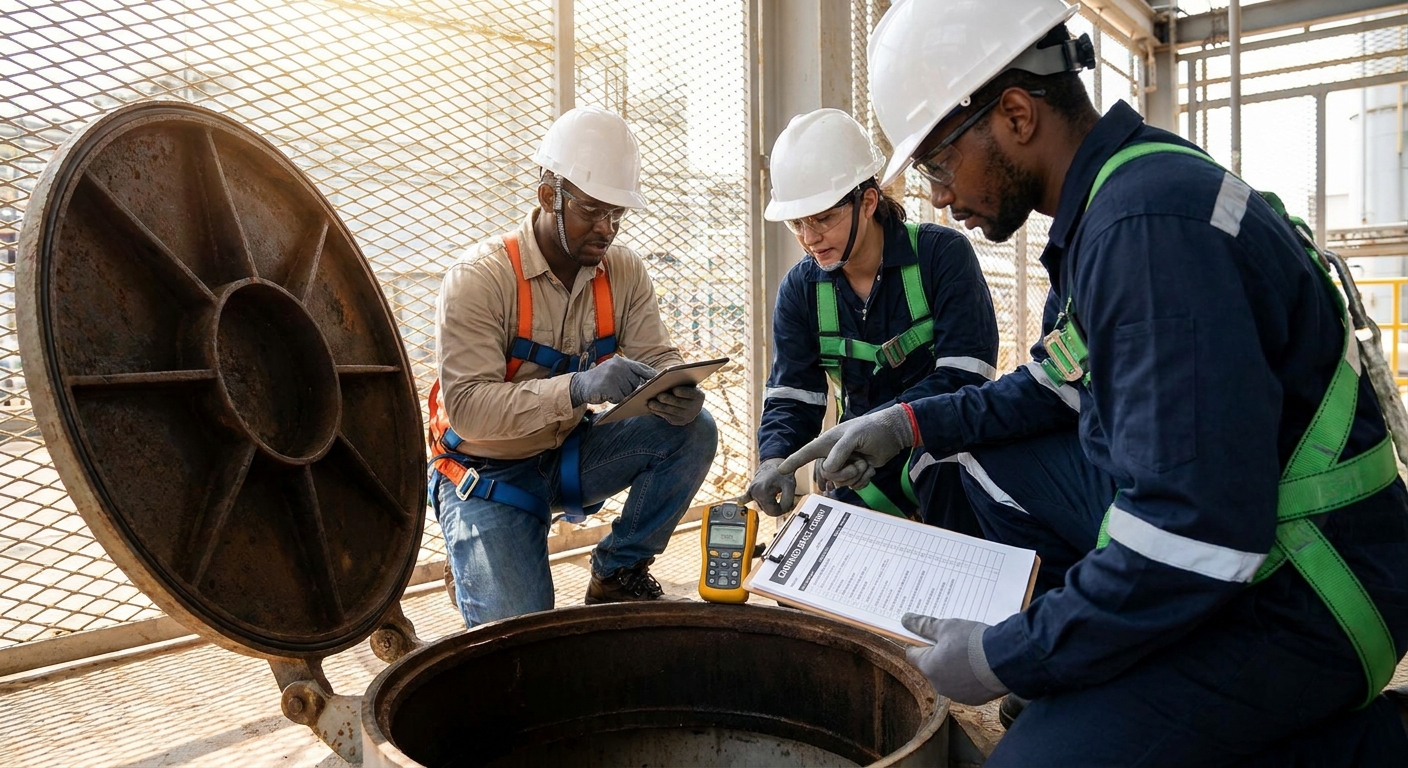
Confined space work fails compliance audits for one reason more than any other: the team on paper doesn't match the team on site. This guide walks through staffing a confined space entry team that satisfies OSHA 1910.146 (general industry) or 1926.1211 (construction) and actually functions when the atmosphere reads wrong at 2 a.m.
- A compliant confined space entry team needs four distinct roles: entry supervisor, attendant, entrant, and rescue service — never combine attendant and rescue duties.
- OSHA 1910.146 requires continuous atmospheric monitoring and a dedicated attendant who never leaves the space unattended, even for a radio call.
- Non-entry rescue equipment cuts response time versus waiting on a contracted rescue service, but only if the attendant is trained to use it.
- Temporary confined space attendant staffing fills gaps fast when a project ramps up or a certified attendant calls out mid-shift in 2026.
Why this matters
A missing or under-qualified attendant is one of the most cited failure points in confined space incident investigations. OSHA's general industry standard, 1910.146, and the construction-specific 1926.1211 both require a named entry supervisor, a dedicated attendant, and a documented rescue plan before anyone goes below grade or into a vessel.
Staffing shortfalls show up two ways: a company pulls a warehouse worker to "watch the hole" without atmospheric monitoring training, or a rescue plan lists a municipal fire department that has never walked the site. Both pass a paperwork check and fail a real emergency. Getting the roles right in 2026, before the permit gets signed, is cheaper than explaining a citation afterward.
What you'll need
- A written confined space program identifying permit-required vs. non-permit spaces
- A qualified entry supervisor authorized to cancel or suspend entry
- One dedicated attendant per entry point, stationed outside the space at all times
- One or more trained entrants with current atmospheric monitor calibration records
- A rescue service — in-house non-entry retrieval or a contracted team with a documented response time
- Calibrated multi-gas monitors (O2, LEL, CO, H2S at minimum) and communication equipment
- Current training certificates for every role, dated within the program's recertification window
If your bench doesn't cover all four roles for every shift, confined space attendant staffing for industrial sites exists specifically to fill that gap on short notice rather than leaving a permit unsigned.
The steps
1. Classify every space before you staff it
Walk the site and separate permit-required confined spaces from non-permit ones under 1910.146(c). This determines whether you need a full four-role team or a lighter staffing model. Skipping this step is why companies overstaff simple tank inspections and understaff genuinely hazardous vessels. Common mistake: reclassifying a space as "non-permit" to avoid staffing costs — inspectors check the atmospheric history, not the label on the permit form.
2. Assign a named entry supervisor per shift
The entry supervisor authorizes entry, verifies pre-entry conditions, and has the authority to cancel the permit if conditions change. This person signs the permit — it can't be a rotating duty with no accountability. On multi-shift jobs, staff a supervisor for every shift, not just days. Common mistake: leaving the night shift supervisor role vacant and routing decisions through a day-shift manager by phone, which violates the on-site authority requirement.
3. Staff a dedicated attendant for every open entry point
The attendant monitors conditions outside the space, tracks who's inside, and initiates non-entry rescue if needed — this is a full-time job with zero other duties assigned. One attendant cannot cover two entry points on opposite sides of a facility. Expect roughly one attendant per active permit, per OSHA guidance on attendant duties under 1910.146(i). Common mistake: pulling the attendant for a five-minute errand; the space must be evacuated the moment the attendant leaves post.
4. Verify entrant training and monitor calibration before badge-in
Every entrant needs documented confined space entry training and a calibrated gas monitor logged for that shift, not a monitor pulled from a truck bin. Atmospheric testing has to happen before entry and continuously during it — spot-checks don't satisfy the standard. Common mistake: trusting a monitor's factory calibration date instead of a daily bump test; sensors drift faster in humid or corrosive atmospheres common in petrochemical and wastewater sites.
5. Lock in rescue capability before the permit is signed
Decide whether rescue is non-entry retrieval (tripod, winch, attendant-operated) or a standby rescue team, and document the expected response time under 1910.146(k). A rescue plan that names "call 911" without confirming the local department can retrieve from a permit space has failed this step. Common mistake: assuming a contracted rescue service is available 24/7 without a signed service agreement covering the actual shift schedule.
6. Build shift coverage with backups, not single points of failure
If your attendant, entrant, or entry supervisor calls out, entry stops unless a qualified backup is staffed and briefed. This is where most sites get exposed: one certified attendant covering three shifts because the second hire fell through. For 24/7 operations, staff the full team roster for every rotation, and see night shift safety staffing for 24/7 operations if third-shift coverage is the recurring gap.
7. Brief the full team on the specific space, not the general program
A pre-entry briefing has to cover the hazards of that specific space — flammable atmosphere history, engulfment risk, mechanical hazards — not a generic safety talk. Document the briefing with sign-off from every role. Common mistake: running one briefing for a multi-day job and never re-briefing when conditions or crew members change.
8. Audit permits and requalify the team on a set schedule
Review closed permits monthly for gaps: missing signatures, monitor logs with skipped intervals, attendants who worked outside their certification window. Recertify attendants and entrants before their training lapses, not after an incident flags it. Fast onboarding matters here — how to onboard temporary safety professionals quickly covers getting a replacement attendant credentialed and site-ready inside days, not weeks.
Need a certified attendant this week?
Vetted confined space attendants and entry supervisors, temp or direct hire.
Troubleshooting
The attendant is doing double duty as fire watch on a hot work permit nearby. Split the roles — an attendant watching two hazards at once can't respond fully to either. Cross-trained staff for fire watch staffing for hot work permits should be a separate assignment, not a shared one.
Atmospheric readings pass at entry but drift mid-shift. This usually means continuous monitoring isn't actually continuous — check the monitor's data log for gaps longer than a few minutes and retrain on alarm response.
Rescue response time exceeds the documented plan. Time a mock rescue drill; if actual response beats the paper plan by more than a few minutes in the wrong direction, upgrade to non-entry retrieval equipment on site instead of relying on an external team.
Certified attendants keep rotating off the job mid-project. High turnover on a multi-week job usually means the staffing pipeline, not the workers, is the problem — a direct hire path for the permanent role plus temp coverage for the ramp keeps the permit signed without a gap.
Entry supervisors are inconsistent on when to cancel a permit. Standardize the go/no-go criteria in writing so authority doesn't depend on who's on shift that day.
Paperwork says the team is staffed, but the roster has been unfilled for weeks. This is the most common finding in post-incident reviews — a permit template isn't a staffed team, and an open requisition should trigger temporary coverage, not a delayed start date.
Tools and resources
- OSHA 1910.146 (general industry permit-required confined spaces) and 1926.1211 (construction)
- Calibrated multi-gas detector with daily bump-test log
- Written confined space program with space classification list
- Direct hire recruiting for safety coordinators for building a permanent entry supervisor bench
- Confined space attendant staffing for industrial sites for temp or project-based attendant coverage
What to do next
If the gap isn't attendants but the site safety manager writing and overseeing the whole program, how to interview candidates for a site safety manager role covers the vetting questions that separate a paper-qualified candidate from one who can run a confined space program under real conditions.
FAQ
How many people do you need to staff a confined space entry team?
A compliant team needs at minimum an entry supervisor, one attendant per entry point, at least one entrant, and a rescue capability — four distinct roles, though one person can hold supervisor and attendant duties on some non-permit spaces if certified for both.
Can the same person be the attendant and the rescue team?
No. OSHA 1910.146 requires the attendant to remain outside the space monitoring conditions; if that person enters to attempt rescue, the space has no attendant left, which is why non-entry retrieval equipment or a separate standby rescue team is required.
What certifications does a confined space attendant need?
An attendant needs documented training on space-specific hazards, atmospheric monitoring, communication procedures, and non-entry rescue equipment operation under 1910.146(g). There's no single national attendant license — training is program-specific and needs to be current for the exact space type.
Is temporary staffing compliant for confined space attendants?
Yes, as long as the temporary attendant receives the same space-specific training and briefing as a permanent employee before entry. A temp worker without that documentation creates the same citation risk as an untrained permanent hire.
How often do confined space monitors need calibration?
Multi-gas monitors need a daily bump test before each shift and full calibration on the manufacturer's schedule, typically every 30 to 180 days depending on sensor type and exposure conditions. Skipping the daily bump test is one of the most common findings in confined space citations.
What's the difference between 1910.146 and 1926.1211?
1910.146 covers general industry confined spaces; 1926.1211 is the construction-specific standard, added in 2015 to address the higher turnover and multi-employer coordination common on construction sites. Both require the same four core roles, but 1926.1211 adds stricter multi-employer information-sharing requirements.
How fast can you staff a confined space attendant if someone calls out?
Turnaround depends on the region and certification level required, but agencies specializing in confined space attendant staffing can typically place a vetted, pre-credentialed attendant within days rather than weeks, which matters when an open permit is stalling a project.
One last thing
The rescue plan is where most audits find the real gap, not the attendant roster. A signed permit with a fully staffed entry team still fails if the named rescue service has never actually walked the specific space it's supposed to retrieve someone from — confirm that response time in writing before 2026 project schedules lock in, not after an incident forces the question.