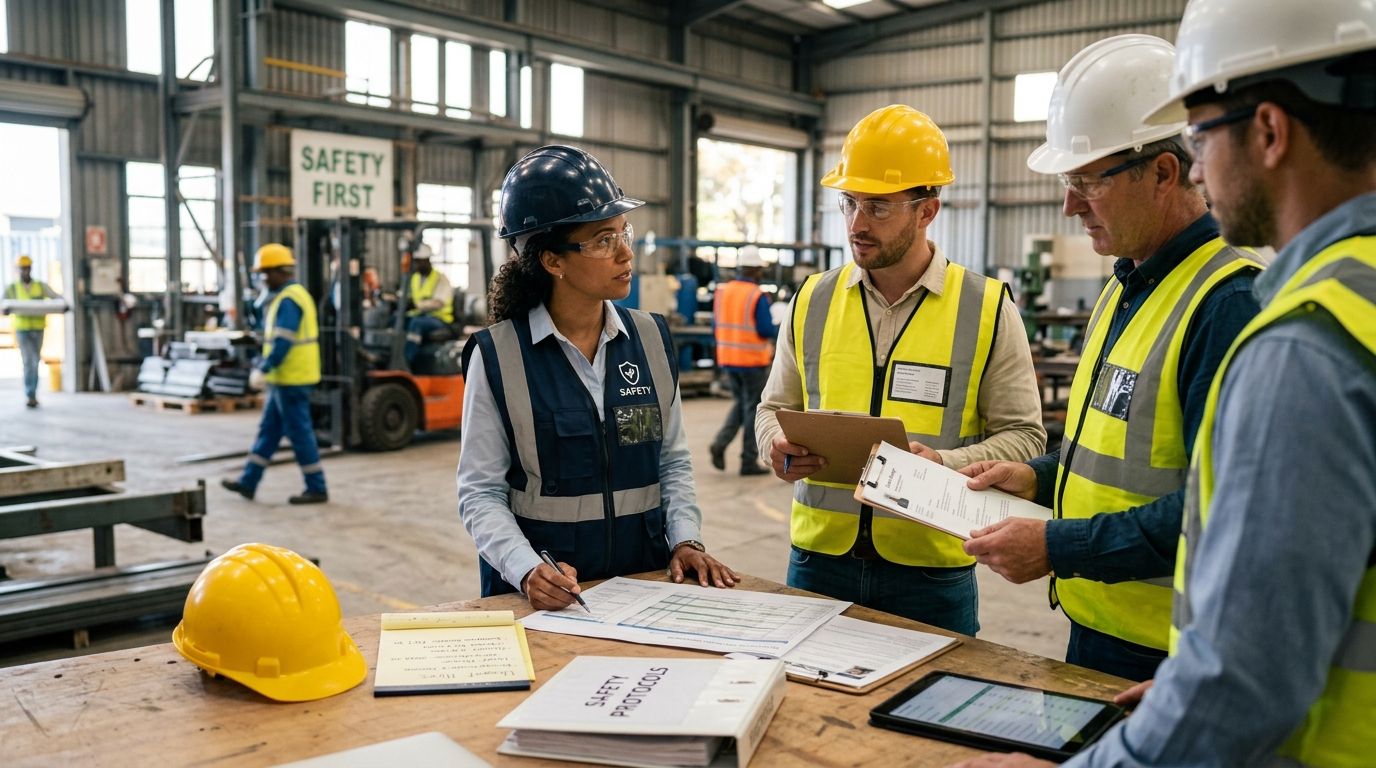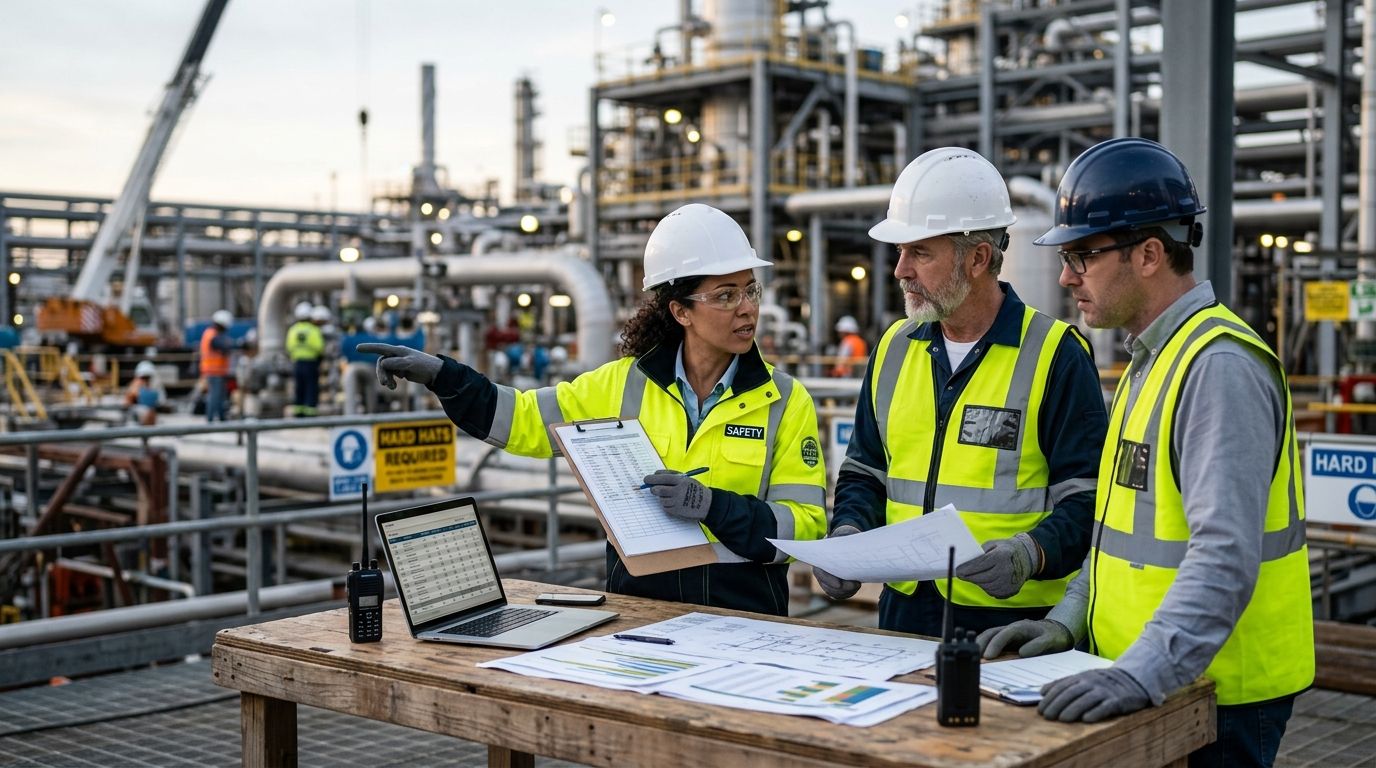
Hiring a site safety manager is not like filling a supervisor slot — get the pick wrong and someone gets hurt, get it right and your incident rate actually moves. This guide walks through exactly how to interview a site safety manager candidate: what to verify before the call, what to ask during it, and how to score the answers so the decision isn't a gut call.
- How to interview a site safety manager candidate starts with verifying OSHA 30, CHST, or CSP credentials before you schedule anything.
- Ask for one real stop-work order the candidate issued in 2026 — vague hypotheticals are a Skip.
- A candidate who blames the schedule for a skipped audit is a Skip; one who names the exact clause they cited is a Buy.
- Direct-hire recruiting for safety managers narrows the field before you sit down, so the interview tests judgment, not paperwork.
Why this matters
A weak safety manager doesn't show up as a bad hire right away — it shows up three months later as a near-miss nobody reported, or a citation with a six-figure price tag attached. The interview is the only chance you get to test judgment before that person has authority over your crews.
Most hiring managers screen for certifications and years of experience, then run out of questions. That gets you a resume match, not a safety culture match. Direct-hire recruiting for safety managers narrows the candidate pool on credentials before the interview even happens — your job in the room is to test how they think under pressure, not to re-verify what a background check already confirmed.
What you'll need
- A written job description with the specific site conditions (confined space, hot work, elevated work, chemical exposure)
- Credential verification in hand — OSHA 30, CHST, CSP, or equivalent, confirmed before the interview, not during it
- The candidate's last 12 months of incident or near-miss data, if they can share it without violating confidentiality
- A 2-3 person interview panel — operations lead, HR, and a current safety team member if you have one
- A written scoring rubric — 5-6 criteria, scored 1-5, before anyone talks about "gut feel"
- 45-60 minutes, plus 10 minutes after for panel scoring while the conversation is fresh
The steps
1. Verify credentials before you ever pick up the phone
This step happens before the interview, not during it. Confirm OSHA 30 (minimum for most industrial sites), and check for CHST or CSP if the role covers a high-hazard environment like refinery turnaround work or confined space entry.
Call the certifying body if the resume claim seems inflated — a candidate listing "CSP" without a current renewal date is a red flag, not a technicality. Skip anyone who can't produce a certificate number on request.
Common mistake: taking a LinkedIn credential badge at face value. Badges lapse; verify the renewal date.
2. Ask for one real stop-work order, not a hypothetical
Skip "what would you do if you saw an unsafe condition" — every candidate has a rehearsed answer. Instead ask: "Tell me about the last time you actually stopped work in 2026 or 2025. What was the condition, who pushed back, and what happened after?"
The answer tells you whether this person has actually exercised authority or just studied the regulation. A candidate who can name the specific hazard, the foreman they confronted, and the resolution is showing you real field judgment.
Common mistake: accepting "I would follow the JHA" as an answer. That's policy knowledge, not a demonstrated decision.
3. Test their authority under pressure with a scenario, not a quiz
Give them a realistic conflict: a project is two days behind schedule, and the superintendent wants to skip a permit-required confined space entry to save four hours. Ask them to walk through exactly what they'd say and do, in order.
What you're listening for is sequence and specificity — do they escalate, document, or fold? A candidate who says "I'd talk to the super and then go straight to the safety director if he pushed back" is naming an escalation path. That's what you want.
Common mistake: letting the candidate answer in generalities like "I'd handle it professionally." Push for the actual words they'd use.
4. Probe their audit and documentation habits
Ask how many site audits they ran per week in their last role, and what percentage turned up a finding that required follow-up. A number in the 10-20% range for an active industrial site is normal; a candidate claiming zero findings on every audit either wasn't looking hard enough or is telling you what they think you want to hear.
Ask to see a sample audit form or corrective action log (with identifying details redacted). Format and follow-through tell you more than the interview answer does.
Common mistake: accepting "I do walkthroughs daily" without asking what a walkthrough actually documents.
5. Check how they handle non-compliant senior staff
Ask about a time they had to write up or remove a superintendent, foreman, or other senior person for a safety violation. This is the single best predictor of whether a safety manager will actually enforce rules against people with more organizational power than them.
Candidates who dodge this question, or who say it "hasn't come up," have likely never been tested. A safety manager who can't push back on a superintendent is a paperwork role, not a safety role.
Common mistake: treating a diplomatic non-answer as a positive trait. Diplomacy without enforcement is the failure mode you're hiring against.
6. Run a mock toolbox talk on the spot
Give them two minutes' notice and a topic — fall protection, lockout/tagout, or heat stress depending on your site conditions — and have them deliver a 3-minute toolbox talk to the panel. This tests communication under mild pressure, which is exactly what they'll face on a crew of 30 people who'd rather be working.
Score for clarity, pace, and whether they invite questions instead of just reading a script. A safety manager who can't hold a crew's attention for three minutes will lose them for the other 40 hours a week.
Common mistake: grading on polish instead of substance. A rough delivery with correct, specific content beats a smooth delivery with generic filler.
7. Reference-check the last stop-work order specifically
When you call references, don't ask "was this person a good safety manager." Ask the reference to describe the same stop-work incident the candidate described to you. If the details line up, that's a strong signal. If they don't, or the reference can't recall a specific incident at all, treat the candidate's story as unverified.
This single cross-check catches more inflated resumes than any credential verification does.
Skip the guesswork on your next safety hire
Direct-hire recruiting for safety managers, pre-screened on credentials and field record.
8. Score against the written rubric before you compare notes
Every panelist scores all six criteria independently — credential verification, stop-work example, scenario response, audit habits, senior-staff enforcement, and communication — before anyone shares their opinion out loud. Talking first anchors the whole panel to whoever speaks loudest.
A candidate scoring 4 or higher on at least five of six criteria is a Buy. A 3-average with one standout weakness is a Consider, pending a second interview focused on that gap. Anything below a 3 average is a Skip, regardless of how the conversation felt in the room.
Troubleshooting
- Candidate talks entirely in generalities — reframe every question with "tell me about the specific time" and give them one more chance before scoring the criteria a 1 or 2.
- Credentials check out but there's no field time behind them — this is common with candidates who moved into safety from an office role; weight the scenario and audit questions heavier for this profile.
- Panel disagrees sharply on scoring — go back to the rubric definitions, not the gut reaction; disagreement usually means one panelist weighted charisma over substance.
- Every candidate in the pipeline feels the same — the job description is likely too generic; add the specific hazard class (confined space, hot work, elevated work) so screening filters harder before interviews start.
- The role has sat open for 60+ days — that's usually a sourcing problem, not an interview problem; a specialized safety staffing search reaches candidates a general job board never sees.
- Strong candidate, but the offer stalls on comp — benchmark against current market rate for the specific certification level (CHST commands more than OSHA 30 alone) before you lose them to a counteroffer.
Tools and resources
- OSHA's certifying body websites for credential verification (OSHA 30, CHST, CSP renewal lookup)
- A written scoring rubric, shared with the panel before the interview, not during it
- Direct-hire recruiting for safety directors if the role you're actually filling sits above the site manager level
- Your site's last 12 months of incident and near-miss log, referenced during the interview to test the candidate's diagnostic questions
What to do next
Once the interview and rubric confirm your top candidate, move fast — strong safety managers with a documented stop-work record don't stay on the market long in 2026. If the role is actually a coordinator or entry-level safety position rather than a full site manager, the interview questions shift toward mentorship and willingness to learn rather than independent enforcement authority.
FAQ
How do you interview a site safety manager candidate?
Verify OSHA 30, CHST, or CSP credentials before the call, then ask for one specific stop-work order the candidate issued rather than a hypothetical scenario. Score answers against a written rubric with the panel scoring independently before discussing.
What questions should you ask a safety manager candidate?
Ask about a real stop-work incident, how they've enforced safety against a senior superintendent, and their audit findings rate. Generic policy-recitation answers signal book knowledge without field authority.
Is OSHA 30 enough for a site safety manager role?
OSHA 30 is the baseline for most industrial sites in 2026, but high-hazard environments like refinery turnarounds or confined space work usually require CHST or CSP on top of it. Verify the renewal date, not just the certificate name.
How much does a site safety manager cost to hire?
Compensation varies by certification level and industry risk — a CHST-certified manager on an oil and gas turnaround commands more than a generalist OSHA 30 hire at a manufacturing plant. Benchmark against current market rate for the specific hazard class before making an offer.
What's a red flag in a safety manager interview?
A candidate who can't name a specific stop-work order, or who describes safety enforcement only in general policy terms, hasn't been tested in the field. Vague answers to "tell me about a time" questions are the clearest Skip signal.
Should a reference check confirm the candidate's stop-work story?
Yes — ask the reference to describe the same incident the candidate described, without prompting them with details. If the accounts don't match, treat the candidate's story as unverified rather than assuming dishonesty.
How long should a site safety manager interview take?
Plan for 45 to 60 minutes plus 10 minutes of independent panel scoring immediately after, while the conversation is still fresh. Rushing the scoring step is how panels default to gut feel instead of the rubric.
What's the difference between a safety coordinator and a safety manager interview?
A coordinator interview should test willingness to learn and attention to documentation, since the role has less independent enforcement authority. A safety manager interview needs to test authority under pressure — whether the candidate will actually stop work against a superintendent's objection.
One last thing
The single best predictor in this whole process isn't the credential check — it's whether the candidate can name the exact person they confronted during their last stop-work order. Candidates who've actually exercised authority remember the name, the date, and the outcome without hesitating. Candidates who haven't will reach for a policy quote instead. Score for that distinction before anything else on your rubric.