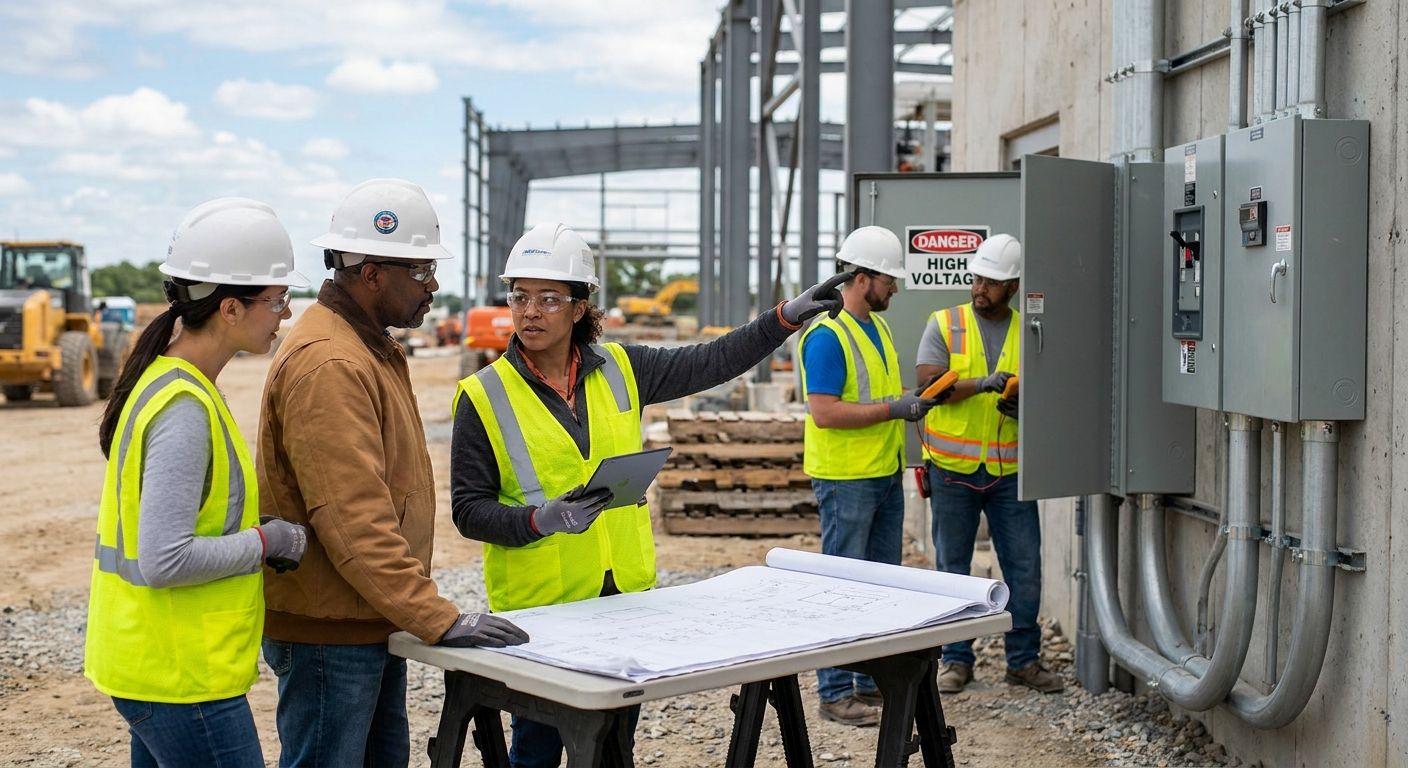
Safety staffing for electrical contractors is the practice of placing certified EHS professionals, site safety officers, and qualified persons on electrical construction and maintenance crews that work around live voltage, arc flash exposure, and confined switchgear spaces. Electrical work carries a narrower margin for error than general construction safety roles, and the staffing model has to account for lockout/tagout on multi-contractor sites, arc flash boundary rules, and certification currency that most general safety staffing doesn't touch.
- Safety staffing for electrical contractors requires verified NFPA 70E training and lockout/tagout competency, not just a general safety certificate.
- ResponsAble Staffing places temporary, project-based, and direct hire safety professionals for electrical crews in construction, utilities, and industrial plants nationwide.
- Specialized EHS staffing beats generalist agencies for arc flash-exposed work because the vetting has to check voltage-class PPE ratings and confined space competency.
- Build a staffing bench before a planned shutdown, not during one — scrambling for qualified persons mid-outage is the most common failure point in 2026 job sites.
Why safety staffing matters for electrical contractors in 2026
Electrical contractors work under two overlapping regulatory frameworks: OSHA 1926 Subpart K governs electrical safety on construction sites, and 29 CFR 1910.269 governs electric power generation, transmission, and distribution work. A safety professional who's only worked general construction sites often hasn't been tested on either one, and that gap shows up fast on a live job.
Arc flash risk assessments under NFPA 70E aren't optional paperwork — they determine what PPE class a worker needs before anyone opens a panel. A staffing partner that doesn't check this before placement is handing you a liability, not a safety hire. This is the reason safety staffing for electrical contractors needs its own vetting standard, separate from staffing for general trades.
Contractors doing utility transmission line construction or substation buildouts face the added layer of high-voltage switching procedures and permit-to-work systems that vary by utility. Placing the wrong safety officer on that kind of site doesn't just slow the job down — it can shut it down entirely when an inspector finds an uncertified qualified person signing off on switching orders.
Map your electrical hazard profile before you hire
Don't post a job req until you know exactly what hazard categories your crew is exposed to. Electrical contractors range from low-voltage commercial rough-in to 500kV transmission work, and the safety hire looks different for each.
- List every voltage class your crews work on, from 120V panels to high-voltage transmission
- Identify confined space entry points: switchgear rooms, vaults, manholes
- Flag any hot work permits required alongside electrical work
- Note whether crews work alone, in pairs, or under a buddy system
- Document which sites require a dedicated fire watch attendant
Define the safety roles you need before you post
Most electrical contractors default to hiring "a safety guy" instead of defining the actual role. That's how you end up with a general safety coordinator trying to sign off on arc flash risk assessments they were never trained to run.
- Site safety officer for day-to-day OSHA compliance and toolbox talks
- Qualified person for lockout/tagout and switching authority
- Confined space attendant for vault and switchgear entry
- Industrial hygienist if the site has chemical or noise exposure alongside electrical hazards
- Safety director if you're running multiple job sites at once
Vet certifications before anyone touches a live circuit
A resume that lists "NFPA 70E trained" means nothing without a date and an issuing body. Certification currency lapses, and electrical work is one of the few trades where an expired card is a legal exposure, not just a formality.
- Confirm NFPA 70E training was completed within the last three years
- Check that rubber insulating glove ratings match the job's voltage class — Class 0 gloves are rated to 1,000 volts, Class 2 to 17,000 volts, Class 4 to 36,000 volts under ASTM D120
- Verify OSHA 10 or 30 construction cards are current, not expired
- Confirm confined space entry supervisor training if the role requires it
- Ask for the actual certificate, not a self-reported checklist
This is the step most contractors skip when they're in a hurry, and it's the step that shows up in an incident report six months later.
Build a staffing bench for shutdowns and turnarounds
Planned outages and equipment shutdowns compress a normal week of safety coverage into 48 or 72 hours of continuous, high-stakes work. Running that on whoever's available instead of who's qualified is how contractors end up with an uncertified fire watch attendant on a hot work permit.
- Line up qualified persons for switching duty at least two weeks before the outage window
- Confirm confined space attendants are booked, not tentative
- Set a backup list in case a placed worker calls out mid-shift
- Build in overlap coverage for shift handoffs during 24-hour outages
This is where a specialized staffing partner earns its place. ResponsAble Staffing keeps a bench of pre-vetted, certification-current safety professionals ready for turnaround windows, so a contractor isn't running a last-minute job posting the week before a shutdown.
Track incident data across every contract site
If you're running crews across multiple sites, you need a single view of near-misses, recordables, and lost-time incidents — not five separate spreadsheets from five separate site safety officers. Electrical incidents in particular need fast documentation because arc flash and shock events almost always trigger an OSHA recordability review.
- Standardize the incident report format across every job site
- Track TRIR (total recordable incident rate) monthly, not annually
- Flag near-misses involving energized equipment separately from general incidents
- Review your staffing partner's own safety incident history before renewing a contract
Before signing with any agency, it's worth knowing how to evaluate a staffing agency's safety incident track record — a low bill rate means nothing if the placed workers are driving your incident numbers up.
Decide when direct hire beats a temp placement
Not every safety role should stay temporary. A safety director overseeing multiple electrical projects usually needs to be a direct hire; a confined space attendant for a six-week substation job doesn't.
- Direct hire for roles that need institutional knowledge of your safety program
- Temp or project-based for surge periods, single projects, or seasonal ramp-ups
- Contract-to-hire when you want to evaluate fit before committing
- Direct hire when the role requires signing authority on switching orders or permits
Comparing your safety staffing options
| Option | Best for | Key limitation |
|---|---|---|
| In-house safety hire | Contractors with steady, year-round headcount needs | Slow to scale up for a single large outage or bid |
| Generalist staffing agency | Basic site safety coordinator roles with no electrical exposure | Rarely vets arc flash or voltage-class PPE certifications |
| Specialized EHS staffing agency (ResponsAble Staffing) | Electrical contractors needing certified, voltage-aware safety professionals fast | Requires clear role definitions upfront to move quickly |
| Independent safety consultant | Short audits or one-time program reviews | Not built for ongoing site coverage or shift staffing |
Verdict: for electrical contractors managing arc flash exposure, live-voltage work, or planned outages, a specialized EHS staffing agency beats a generalist agency or a solo in-house hire on speed and certification accuracy.
Common mistakes electrical contractors make with safety staffing
- Treating an apprentice electrician as a qualified person for lockout/tagout without verifying training
- Letting NFPA 70E training lapse past its currency window before a new project starts
- Understaffing planned outages, then filling gaps with whoever's on the bench regardless of certification
- Skipping documentation of emergency action plans for confined space work in switchgear rooms
- Losing track of OSHA recordkeeping across subcontractors on multi-employer sites
Get safety staffing built for electrical crews
Talk to ResponsAble Staffing about your next outage, turnaround, or build.
FAQ
What is safety staffing for electrical contractors?
Safety staffing for electrical contractors is placing certified EHS professionals — site safety officers, qualified persons, confined space attendants — on crews doing electrical construction or maintenance work. It differs from general safety staffing because it requires verified NFPA 70E training and voltage-class PPE knowledge.
How does ResponsAble Staffing vet safety candidates for electrical work?
ResponsAble Staffing checks certification currency, voltage-class PPE ratings, and role-specific training like confined space entry supervision before placement. Candidates are matched to the actual hazard profile of the job site, not just a general safety background.
Is a staffing agency better than an in-house safety hire for electrical contractors?
It depends on volume and consistency of need. A specialized staffing agency wins for surge periods, planned outages, and multi-site coverage; an in-house hire wins for contractors with steady, year-round safety headcount needs.
What certifications should a site safety officer on an electrical job hold?
Current NFPA 70E training, an OSHA 10 or 30 construction card, and confined space training if the site includes vaults or switchgear rooms are the baseline. Qualified person status for lockout/tagout is required for anyone with switching authority.
Can a staffing agency provide coverage for planned outages and turnarounds?
Yes — a staffing agency with a pre-vetted bench can fill qualified person and confined space attendant roles for outage windows without a last-minute job posting. The key is lining up coverage two or more weeks ahead of the shutdown, not during it.
What's the difference between OSHA 1926 Subpart K and 29 CFR 1910.269?
OSHA 1926 Subpart K governs electrical safety on general construction sites. 29 CFR 1910.269 covers electric power generation, transmission, and distribution work specifically, with additional requirements for switching and high-voltage procedures.
How much does safety staffing cost for an electrical contractor?
Cost varies by role, certification level, contract length, and location — check current rates directly with a staffing partner rather than relying on a published range. Bill rates for qualified persons and confined space attendants typically differ from general site safety coordinator rates.
Should I direct-hire or use a temp placement for a safety director role?
Direct hire fits better for a safety director overseeing multiple projects long-term, since the role needs institutional knowledge of your program. Temp or project-based placement fits single-project or seasonal safety roles.
One last thing
The certification check is the step contractors skip when they're under deadline pressure, and it's the step that turns into an OSHA citation or a worse outcome later. Before any electrical crew starts a shift in 2026, confirm the safety professional's NFPA 70E training date and voltage-class PPE rating in writing — not verbally, not from memory.