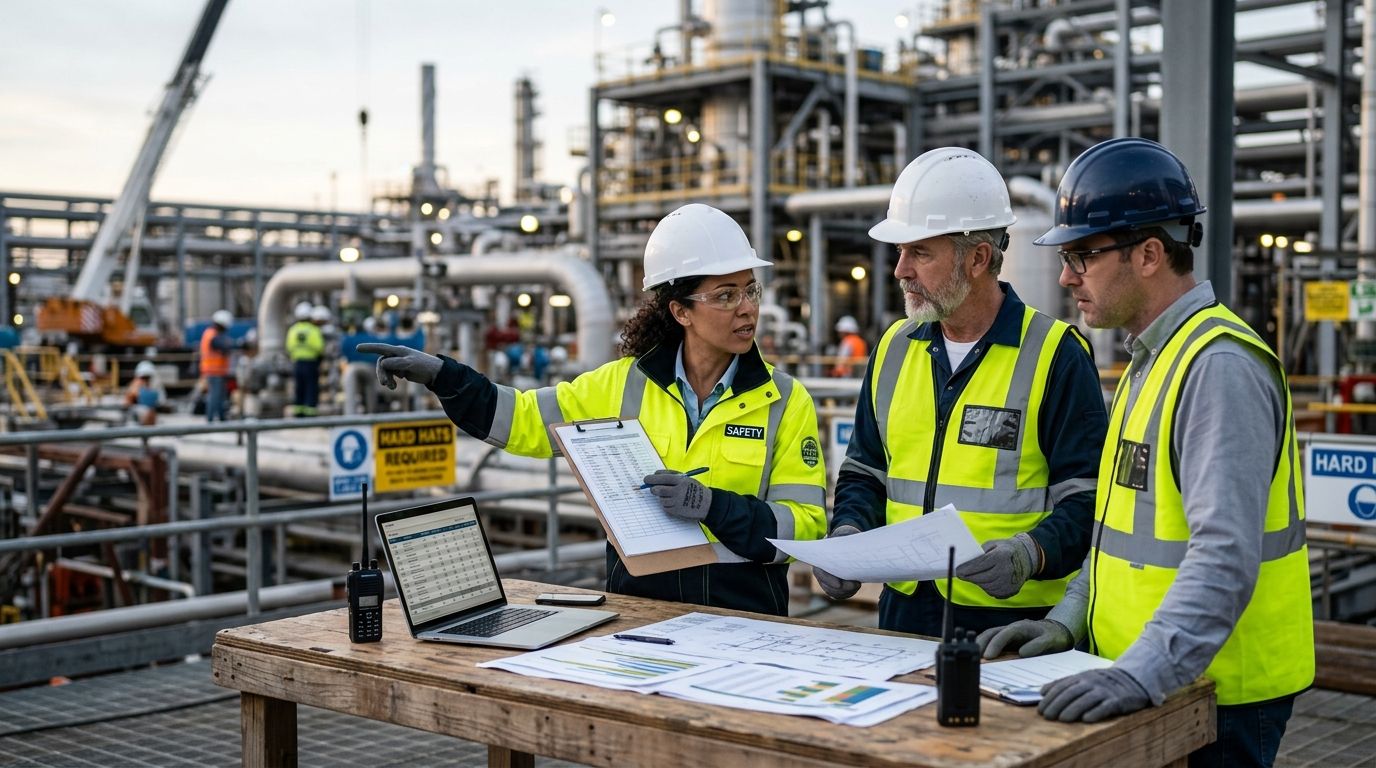
Hiring an HSE advisor or safety consultant on a deadline is different from hiring almost any other role — the wrong credential on a job site is a compliance exposure, not just a bad fit. This guide breaks down what to check before you sign a contract, four engagement models ranked by fit, and the one vetting question most employers skip in 2026.
- HSE advisor staffing works only when credentials match your hazard class, not a generic OSHA card on a resume.
- ResponsAble Staffing's direct hire recruiting for safety managers fits permanent EHS leadership roles opening in 2026 — Buy for programs built to last.
- Turnaround safety staffing for oil & gas refinery projects covers 30 to 90-day outages without adding headcount you don't need year-round.
- Skip any agency that can't produce OSHA 10-hour, OSHA 30-hour, or CSP documentation before day one on site.
- Direct hire recruiting for safety coordinators moves faster than open-market hiring when the role reports to an existing safety manager.
Why this matters
An HSE advisor's job is to catch the thing that gets someone hurt before it happens, and that only works if the person actually has field time in your kind of hazard environment. A generalist with an OSHA 10-hour card is not the same hire as a Certified Safety Professional with refinery turnaround hours. Employers who treat HSE advisor staffing as a resume-matching exercise end up with advisors who write good reports and miss the actual risk on the floor.
The fix is matching the engagement model to the job, not just the resume. Some roles need a permanent leader who builds the program from scratch — that's a fit for direct hire safety manager recruiting. Others need coverage for 60 days during a shutdown. Getting that distinction right in 2026 is the single biggest driver of whether an HSE advisor placement actually reduces incidents or just adds a line item.
Who this is for
This guide is for safety directors, EHS managers, plant operations leaders, and project managers at construction firms, oil & gas operators, and manufacturing plants who need a qualified HSE advisor on site — whether that's for a 90-day project, a seasonal surge, or a permanent leadership seat. If you're evaluating whether to staff internally, use a general-purpose staffing firm, or work with a specialized safety recruiter, this is the comparison you need before you sign anything.
What to look for in HSE advisor staffing
Certifications that match your actual hazard class
An OSHA 10-hour card is entry-level. An OSHA 30-hour, HAZWOPER 40-hour, or Certified Safety Professional (CSP) credential signals someone who has handled higher-consequence environments. Match the certification to the job, not the job title — a construction site advisor and a confined space attendant need different paperwork behind them.
Field experience in your specific vertical
An advisor who spent five years in food and beverage manufacturing does not automatically transfer to a pipeline construction site. Ask for vertical-specific placement history, not just years of experience. The hazard profile in a refinery turnaround has nothing in common with a semiconductor cleanroom.
Speed to deployment
A surge, an outage, or a fast-track construction job doesn't wait for a six-week hiring process. Ask any staffing partner directly how fast they can put a credentialed advisor on site and what bench of pre-vetted professionals they already carry for your industry.
Compliance documentation and audit trail
Every placement should come with a paper trail: certification copies, background check results, and drug screening records ready before the first shift. If an agency can't produce that on request, that's the vetting failure that shows up during an audit, not before.
Engagement flexibility
Some roles need temporary coverage, some need project-based staffing tied to a specific job, and some need a permanent hire. An HSE advisor staffing partner should offer all three without steering you toward whichever model is easiest for them to fill.
Top picks by engagement model
The surge pick — turnaround and project-based staffing. Turnaround safety staffing for oil & gas refinery projects covers the 30 to 90-day window most outages run without committing to a full-time headcount you don't need in the off-season. This model works when the job has a fixed end date and the hazard exposure is high but temporary. Buy if your 2026 turnaround schedule has a hard start date and no internal bench to cover it.
The permanent-hire pick — safety coordinators. Safety coordinator direct hire placement fits a plant or job site that already has a safety manager in place and needs a coordinator reporting into that structure long-term. This isn't a stopgap — it's a career-track hire meant to stay. Buy if you have budget for a permanent seat and an existing safety leader to manage them.
The specialist pick — industrial hygiene. An HSE advisor with an industrial hygiene background handles air monitoring, exposure assessments, and chemical hazard programs that a generalist safety coordinator isn't trained for. This fits chemical, pharmaceutical, and battery manufacturing environments where exposure limits carry regulatory weight. Consider this route specifically when your compliance exposure is chemical or airborne, not just physical hazard.
The compliance-support pick — confined space and hot work coverage. Confined space attendants and fire watch staff are narrow, credential-specific roles that don't need a full HSE advisor title but do need documented training. This is a lighter-weight engagement than a full advisor placement and shouldn't be priced or staffed like one. Consider for a single-permit job; Skip trying to bundle it into a broader HSE advisor contract if the scope doesn't call for it.
Get an HSE advisor matched to your site
Vetted credentials, industry-specific experience, ready before day one.
What to avoid
- A generalist staffing firm with no safety-specific vetting process. They can fill a title but can't verify whether the OSHA 30 card is current or the CSP is active — that gap shows up during your next audit, not during onboarding.
- An agency that won't share its documentation process before you sign. Vet a safety staffing agency on paperwork and background-check standards before you commit to a contract, not after the advisor is already on site.
- A cheap hourly rate with no bench depth. A low rate with a two-week time-to-fill on a project starting in ten days is not a discount, it's a delay you'll pay for in schedule slip.
Verdict comparison
| Model | Best for | Time commitment | Verdict |
|---|---|---|---|
| Turnaround safety staffing | Refinery outages, planned shutdowns | 30-90 days | Buy for fixed-date projects |
| Direct hire safety coordinator | Ongoing plant or site programs | Permanent | Buy for existing safety structure |
| Industrial hygiene specialist | Chemical, pharma, battery plants | Project or permanent | Consider for exposure-heavy sites |
| Confined space / hot work support | Single-permit jobs | Days to weeks | Consider narrow scope only |
FAQ
What's the best staffing model for HSE advisor coverage in 2026?
It depends on your timeline: turnaround safety staffing fits fixed-date projects like refinery outages, while direct hire recruiting fits ongoing plant programs that need a permanent safety leader. Match the model to whether the need ends or continues.
Is direct hire better than temporary HSE advisor staffing?
Direct hire is better when the role reports into an existing safety structure and needs to stay long-term. Temporary or project-based staffing is better for outages, surges, or fixed-scope jobs with a clear end date.
How much does HSE advisor staffing cost?
Cost varies by certification level, industry, and engagement length, with specialist credentials like CSP or industrial hygiene experience commanding higher rates than entry-level OSHA 10 coverage. Ask any staffing partner for a rate breakdown tied to the specific hazard class before comparing quotes.
What certifications should an HSE advisor have?
At minimum, expect OSHA 10-hour or OSHA 30-hour training depending on role level, with HAZWOPER 40-hour or Certified Safety Professional (CSP) credentials for higher-hazard environments like refineries or chemical plants. Match the certification to the actual hazard class of your site, not just the job title.
How fast can an HSE advisor be placed on site?
Placement speed depends heavily on whether the staffing partner already carries a pre-vetted bench for your industry and region. An agency with active industrial safety candidates on hand moves faster than one building a search from scratch.
Can HSE advisor staffing cover confined space or hot work permits specifically?
Yes, but that's a narrower engagement than a full HSE advisor placement. Confined space attendants and fire watch staff need documented, permit-specific training rather than a broad advisor credential.
What's the difference between an HSE advisor and a safety coordinator?
An HSE advisor typically has broader program-building authority and higher-level certification, while a safety coordinator often reports into an existing safety manager and handles day-to-day compliance tasks. The right fit depends on whether you're building a program or supporting one already in place.
Do HSE advisors need industry-specific experience?
Yes. A hazard profile in a refinery turnaround has little overlap with a food manufacturing plant or a semiconductor cleanroom, so vertical-specific placement history matters more than total years of experience.
One last thing
The single question employers forget to ask in 2026: what happens if the placed advisor doesn't work out in the first two weeks. A staffing partner with a real replacement process will answer that before you ask. One that hesitates on it is telling you something about how carefully they vetted the placement in the first place.