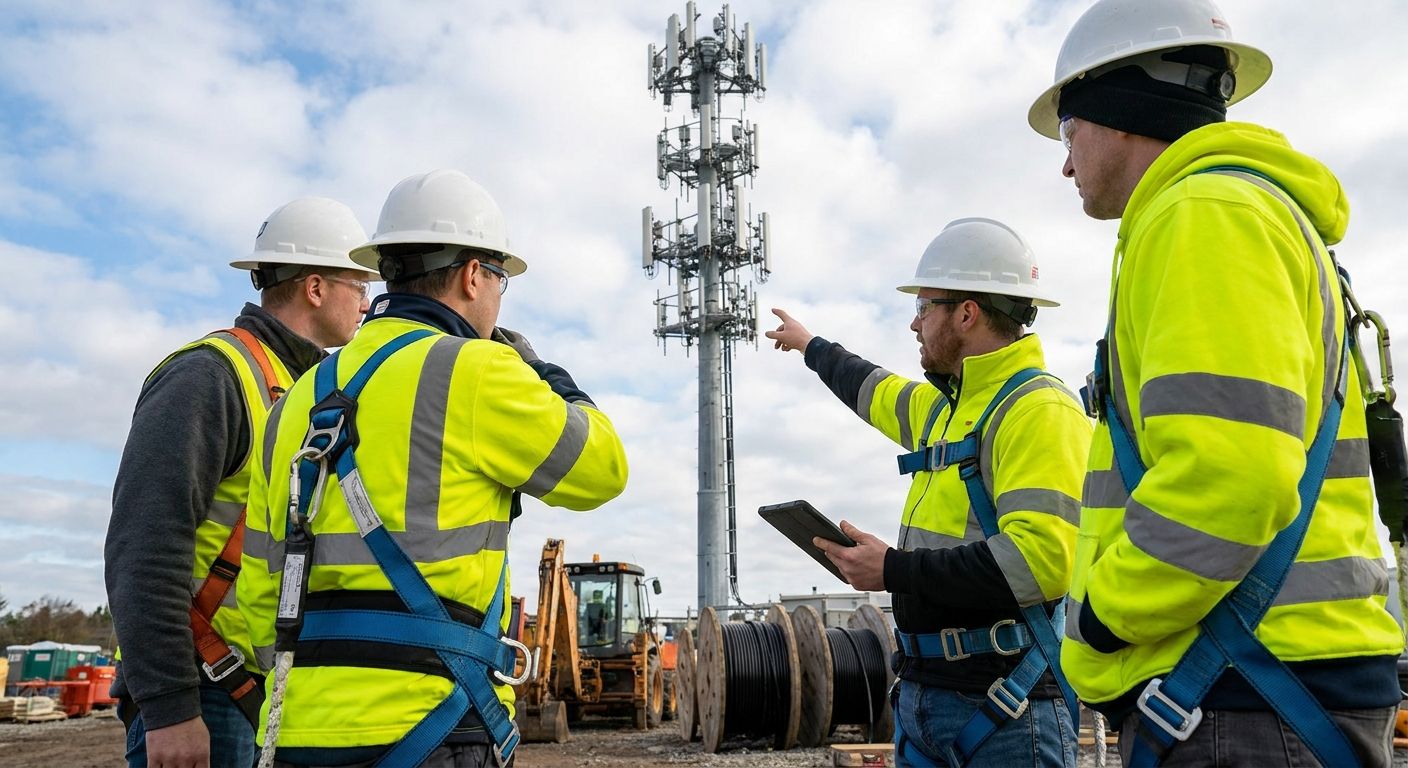
Telecom infrastructure projects move on compressed timelines and put safety crews in unusual hazards: tower climbs above 300 feet, splice vaults, RF exposure zones, and small-cell installs on live utility poles. Telecom infrastructure safety staffing means finding safety professionals who already know these hazards, not generalists learning on your dime.
- Telecom infrastructure safety staffing works best when crews arrive with tower, RF, and confined-space credentials already verified.
- ResponsAble Staffing places rigging-certified safety techs and fast-track surge crews for 5G and fiber builds nationwide in 2026.
- Direct-hire safety managers make sense for multi-year builds; project-based techs make sense for single-tower or single-segment work.
- Generalist staffing agencies without OSHA 1926.1207-level tower knowledge are the number one source of onboarding delays in 2026.
Why this matters
Tower and telecom construction fatalities have drawn enough federal attention that OSHA and the FCC issued a joint safety alert on communication tower work back in 2014, and the underlying hazards haven't changed: falls, struck-by incidents, and confined-space entry into equipment vaults. A telecom build that runs on a 90-day 5G rollout schedule doesn't have room for a safety hire who needs two weeks of onboarding.
The safety staffing agency you choose determines whether your crews start on day one or day fourteen. That gap costs more in 2026 than it did five years ago, because carrier penalties for missed small-cell deployment windows have gotten steeper and subcontractor bench depth has gotten thinner.
Who this is for
This guide is for project managers, EHS directors, and general contractors staffing tower construction, fiber build-outs, small-cell installations, or fixed wireless access rollouts in 2026. If you're managing a single tower crew or a 40-site multi-state deployment, the staffing calculus below applies either way — only the volume changes.
What to look for in telecom infrastructure safety staffing
Fast turnaround without skipped credential checks
A compressed 5G or fiber schedule means a safety tech has to be site-ready inside days, not weeks. But speed that skips OSHA 10/30, fall protection, or competent-climber verification just moves the risk from the staffing agency to your job site. Ask for proof of credential verification timestamps, not just a resume.
Tower climbing and rigging credential depth
Tower work requires ANSI/TIA-222 familiarity and documented rigging competency, not a generic construction safety background. A tech who's worked scaffolding on a commercial build hasn't automatically worked a monopole climb. Confirm climb-specific experience, not just years in safety.
RF exposure and confined-space awareness
Telecom sites put workers near active RF emitters and inside splice vaults and equipment shelters. Safety staff need documented RF awareness training and confined-space entry certification, because a missed lockout on an active antenna sector is a federal incident, not a near-miss.
Direct-hire versus project-based flexibility
A single-tower job needs a project-based tech for six to ten weeks. A multi-year fiber build across three states needs a direct-hire safety manager who can build the compliance program from the ground up. Matching the staffing model to the project length keeps your cost per site predictable.
Multi-state and multi-site consistency
A 12-site rollout across four states means four sets of state-specific OSHA plan requirements. A staffing partner with a bench that spans regions keeps your safety documentation consistent instead of stitched together from four different local hires.
Top staffing solutions for telecom infrastructure work
Tower climbing and rigging safety techs — the safe pick
These are safety professionals with documented ANSI/TIA-222 rigging competency and fall protection certification specific to structures over 50 feet. Scaffolding and rigging crew staffing covers this exact skill set for tower and monopole work. If your build involves any climb above 6 feet without a bucket truck, this is the non-negotiable hire. Staff now.
Fire watch and confined-space attendants for splice vaults — the overlooked pick
Splice vaults, manholes, and equipment shelters require a dedicated confined-space attendant, not a shared duty added to a foreman's plate. A fiber build with 30 vault entries a week needs a rotating attendant schedule, and skipping it is the fastest way to draw an OSHA citation in 2026. Staff now if your build includes underground vault work.
Fast-track surge crews for compressed 5G rollouts — the wildcard
Carrier deployment windows compress fast when a market accelerates. Fast-track construction safety staffing solves the problem of scaling from three crews to twelve in under 30 days without dropping credential verification. This is the pick for the rollout that got moved up a quarter with no warning. Consider it when your timeline shrank after the contract was already signed.
Direct-hire safety managers for multi-year builds — the long game
A multi-year fiber-to-the-home rollout or a statewide small-cell densification project needs someone who owns the safety program end to end, not a rotating cast of project techs. Direct-hire recruiting for safety managers fills that seat with someone accountable for the full program lifecycle. Buy in for builds running longer than 12 months.
Need vetted safety staff fast?
Get pre-screened tower, RF, and confined-space safety professionals for your next telecom build.
What to avoid
- Generalist construction staffing agencies that list "safety" as one of ten trades they cover. They rarely carry tower-specific rigging credentials on file, which means your site foreman ends up vetting climb competency in the field instead of before mobilization.
- Skipping RF awareness training because "the tower company handles that." Carrier RF training and OSHA-compliant safety staffing are two different things, and a gap between them is exactly where incidents happen.
- Treating confined-space attendants as an optional add-on instead of a staffed position. A vault entry without a dedicated attendant is a compliance gap the first time an inspector walks the site.
“The safest telecom site is built by people who show up ready, not people you're breaking in.”
Verdict comparison
| Staffing Type | Typical Turnaround | Best Fit | Verdict |
|---|---|---|---|
| Tower climbing/rigging techs | 3-10 days | Single tower or monopole builds | Staff Now |
| Fire watch / confined-space attendants | 3-7 days | Fiber vaults, splice pits, hot work | Staff Now |
| Fast-track surge crews | 5-14 days for volume ramp | Accelerated 5G/small-cell rollouts | Consider |
| Direct-hire safety managers | 30-60 days to place | Multi-year, multi-site programs | Buy In |
FAQ
What is telecom infrastructure safety staffing?
Telecom infrastructure safety staffing places safety professionals with tower, RF, and confined-space credentials on fiber, small-cell, and wireless build projects. It differs from general construction safety staffing because of the climb heights and RF exposure zones unique to telecom sites.
How fast can a telecom project get safety staff on site?
Project-based tower climbing safety techs typically staff in 3 to 10 days when credentials are pre-verified. Direct-hire safety manager placements for multi-year programs run 30 to 60 days in 2026.
Do telecom tower jobs require confined-space certified staff?
Yes, splice vaults and equipment shelters on fiber and 5G builds qualify as confined spaces under OSHA rules. A dedicated confined-space attendant is required for entries, not a shared duty assigned to a site foreman.
Is direct hire or project-based staffing better for telecom builds?
Project-based staffing fits single-tower or short fiber segments lasting weeks. Direct-hire safety managers fit multi-year or multi-state rollouts where one person needs to own the compliance program long term.
What credentials should a telecom safety tech have?
Look for OSHA 10/30, ANSI/TIA-222 tower rigging competency, fall protection certification, and RF awareness training. A general construction safety background alone does not cover tower-specific hazards.
How much does telecom infrastructure safety staffing cost?
Cost varies by role, region, and whether the placement is temporary, project-based, or direct hire. Request a quote scoped to your specific build timeline and site count rather than relying on a flat rate.
Can one staffing agency cover a multi-state telecom rollout?
A staffing partner with a bench spanning multiple regions keeps documentation and credential standards consistent across states. Stitching together local hires per state creates compliance gaps between markets.
One last thing
The builds that stay on schedule in 2026 are the ones where the safety hire shows up already knowing the difference between a monopole climb and a scaffold job. That distinction sounds small until a crew loses two days waiting on a climb-competency verification that should have happened before the tech left the last site. Vet that timing before mobilization, not during it.