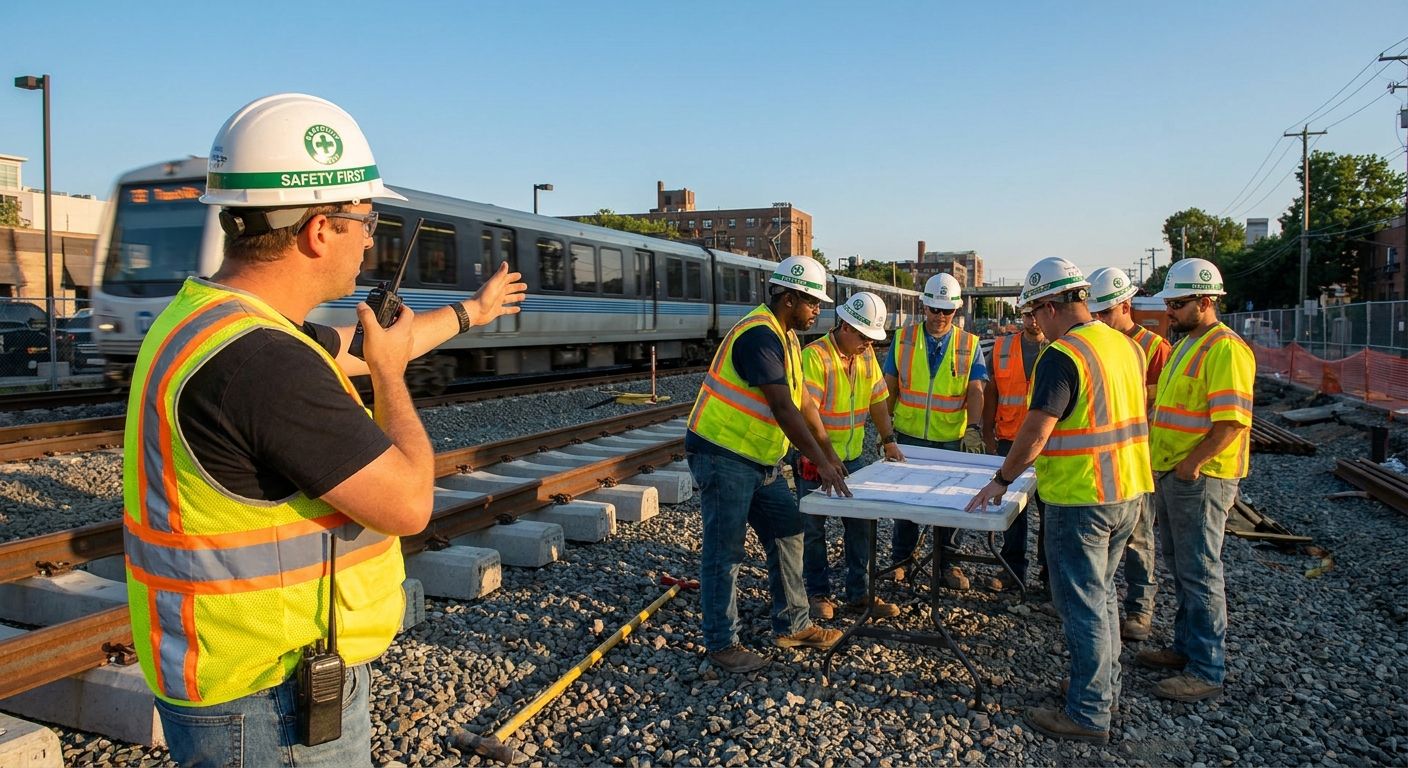
Rail and transit infrastructure work runs on tighter clearances, higher consequence errors, and more overlapping regulators than almost any other construction sector — and rail transit safety staffing exists because most general safety recruiters can't keep up with that mix.
- ResponsAble Staffing places FRA/FTA-aware safety professionals for rail and transit projects — Buy for teams facing a hard track possession deadline.
- Night shift and 24/7 track access windows demand dedicated safety coverage, not a single flagger stretched thin.
- Direct-hire safety managers make sense for multi-year transit programs; temporary rail transit safety staffing fits single possessions and surges.
- Vet any agency's roadway worker protection credentialing before signing — a lapsed OSHA 10 or 30 card stops a possession cold.
Why this matters
A transit authority or rail contractor that understaffs safety on a live corridor isn't just risking an OSHA citation — it's risking a shutdown of an active rail line, which cascades into liquidated damages and rider disruption that no general contractor safety hire is trained to prevent.
General construction safety recruiting firms rarely carry a bench of professionals who understand roadway worker protection under 29 CFR 1926.201, FRA track authority rules, or the choreography of a possession window that opens at 11 p.m. and closes at 4 a.m. Rail transit safety staffing has to solve for both OSHA compliance and railroad operating rules at the same time, in 2026 conditions where transit capital programs keep expanding faster than the certified safety labor pool.
Who this is for
This guide is for transit authority project managers, rail construction general contractors, and EHS directors staffing light rail extensions, commuter rail rehabilitation, subway signal upgrades, or freight-to-transit corridor conversions who need certified safety coverage on a possession schedule, not a nine-to-five job site clock.
What to look for in rail transit safety staffing
Roadway worker protection (RWP) fluency
A safety professional who only knows OSHA general industry rules will miss the railroad-specific on-track safety protocols that govern when workers can be foul of the track. Ask any candidate whether they've worked under an employee-in-charge (EIC) structure, because that single question separates rail-ready staff from generalist hires.
Current certification stack
OSHA 10-hour and OSHA 30-hour cards are table stakes, but rail work layers on flagging certification, confined space entry training, and often a railroad's own contractor orientation that expires and requires renewal roughly every 12 months. A staffing partner who tracks expiration dates for you saves a possession from being cancelled over a lapsed card.
Night and weekend availability
Most rail and transit work happens during track outages, which means late-night and weekend shifts are the norm, not the exception. Staff who can't commit to a recurring overnight schedule create gaps exactly when risk is highest.
Multi-agency compliance awareness
A transit project can answer to FTA, FRA, a state DOT, and the transit authority's own safety department simultaneously. Safety staff need to know which rulebook governs which task, and a staffing partner should be able to explain that distinction without hesitation.
Speed to deploy
Track possessions get scheduled months out but staffing gaps often surface with days of notice — an injury, a no-show, a scope change. The ability to source and credential-check a replacement fast matters more here than in almost any other industrial sector.
Direct-hire vs. temporary flexibility
Some programs need one safety manager for a three-year signal modernization project; others need six temporary flaggers for a single 72-hour weekend possession. A partner offering both models without pushing you toward one structure is worth more than one that only sells project labor.
Top picks: rail transit safety staffing roles that solve real gaps
Certified track safety watch / flagger crews — the essential pick. These are the professionals who physically protect the work zone during a possession, trained under roadway worker protection standards and current OSHA 10-hour credentials. Verdict: Buy if you have any possession window scheduled in 2026 without dedicated on-track protection already staffed.
Night shift and 24/7 safety coverage — the wildcard that prevents the 2 a.m. gap. Transit possessions frequently run overnight, and a single day-shift safety officer can't legally or practically cover a 24-hour operation. Night shift safety staffing fills the coverage window contractors most often overlook when they build the project safety plan. Verdict: Buy for any project running consecutive overnight possessions.
Direct-hire safety managers — the safe pick for multi-year programs. A permanent safety manager embedded in a multi-phase rail modernization program builds institutional knowledge of the corridor, the EIC relationships, and the authority's own safety culture over time. Direct hire safety managers make sense once a program runs past a single fiscal year. Verdict: Buy for programs longer than 12 months; Consider for shorter scopes.
Confined space attendants for tunnel and vault work — the specialist pick. Subway and commuter rail work regularly involves vaults, culverts, and tunnel segments that trigger permit-required confined space rules. A generalist flagger cannot legally serve as a confined space attendant without specific training. Verdict: Buy for any scope touching tunnel, vault, or below-grade signal work.
Temporary surge crews for weekend-only possessions — the wildcard. Some transit rehab work compresses into two or three weekend windows a month, and carrying full-time staff for that cadence wastes budget. Temporary rail transit safety staffing scales up for the possession and scales back down after. Verdict: Consider for programs with fewer than eight possessions scheduled across the year; Skip carrying permanent headcount for that cadence.
What to avoid
- General laborers with an OSHA 10 card and nothing else. A basic OSHA credential does not qualify anyone to serve as an on-track safety watch or confined space attendant — the paperwork looks compliant but isn't.
- Staffing agencies that can't name your EIC structure. If a recruiter can't explain how their candidate fits into your employee-in-charge protocol, they haven't placed rail workers before.
- A single safety hire covering a 24-hour possession. Fatigue rules and basic coverage math make this a liability, not a cost saving — split the shift or bring on a second credentialed professional.
Before signing with any provider, it pays to vet a safety staffing agency on exactly these points rather than assuming a general staffing background transfers to rail work.
Verdict comparison
| Staffing model | Best fit | Certification depth needed | Verdict |
|---|---|---|---|
| Track safety watch / flagger crew | Any active possession | OSHA 10 + RWP + flagging cert | Buy |
| Night shift / 24-7 coverage | Overnight possessions | OSHA 10/30 + fatigue-aware scheduling | Buy |
| Direct-hire safety manager | Multi-year programs | OSHA 30 + program-level experience | Buy for 12+ month scopes |
| Confined space attendant | Tunnel/vault work | Permit-required confined space training | Buy |
| Temporary weekend surge crew | Fewer than 8 possessions/year | OSHA 10 + flagging cert | Consider |
Need certified rail safety staff fast
Talk through your next possession window and staffing gap with ResponsAble Staffing.
FAQ
What is rail transit safety staffing?
Rail transit safety staffing is the placement of certified safety professionals — track safety watches, confined space attendants, safety managers — on rail and transit construction or maintenance projects. It differs from general construction staffing because it requires roadway worker protection knowledge alongside standard OSHA credentials.
How is rail safety staffing different from construction safety staffing?
Rail safety staffing adds railroad-specific rules like employee-in-charge protocols and on-track possession windows that general construction sites never encounter. A safety professional needs both OSHA compliance training and roadway worker protection knowledge to work on active track in 2026.
What certifications should a track safety watch have in 2026?
A qualified track safety watch typically holds an OSHA 10-hour or 30-hour card, current flagging certification, and roadway worker protection training under 29 CFR 1926.201. Some transit authorities also require their own contractor orientation, renewed roughly every 12 months.
Can ResponsAble Staffing provide safety staff on short notice for transit projects?
ResponsAble Staffing places temporary and project-based safety professionals for rail and transit contractors facing possession windows and staffing gaps. Direct outreach is the fastest way to confirm current availability for a specific possession date.
Is direct hire or temporary staffing better for a rail expansion?
Direct hire fits multi-year rail programs where institutional knowledge of the corridor and safety culture builds value over time. Temporary staffing fits single possessions, surge periods, or projects running fewer than eight possessions a year.
Does ResponsAble Staffing cover night shift and 24/7 transit operations?
Yes, night shift and 24-7 coverage is a core part of rail transit safety staffing since most possessions happen overnight or on weekends. Splitting overnight coverage across two credentialed professionals avoids the fatigue risk of a single safety watch covering a full 24-hour window.
What does a confined space attendant do on a rail project?
A confined space attendant monitors permit-required confined spaces like tunnel segments, vaults, and culverts during rail construction, tracking who enters, air conditions, and emergency response readiness. General flaggers are not trained or authorized to fill this role.
How much lead time do you need to staff a rail safety team?
Possession schedules are often set months in advance, but staffing gaps from injuries or scope changes can surface with only days of notice. A staffing partner that pre-screens and credential-checks candidates ahead of time closes that gap fastest.
One last thing
The most overlooked line item on a rail transit safety plan isn't the flagger headcount — it's the recertification calendar. A crew that passed every audit in January can lose its roadway worker protection standing by October if nobody tracks the 12-month renewal cycle, and that's the gap that stalls a possession faster than a staffing shortage ever does.