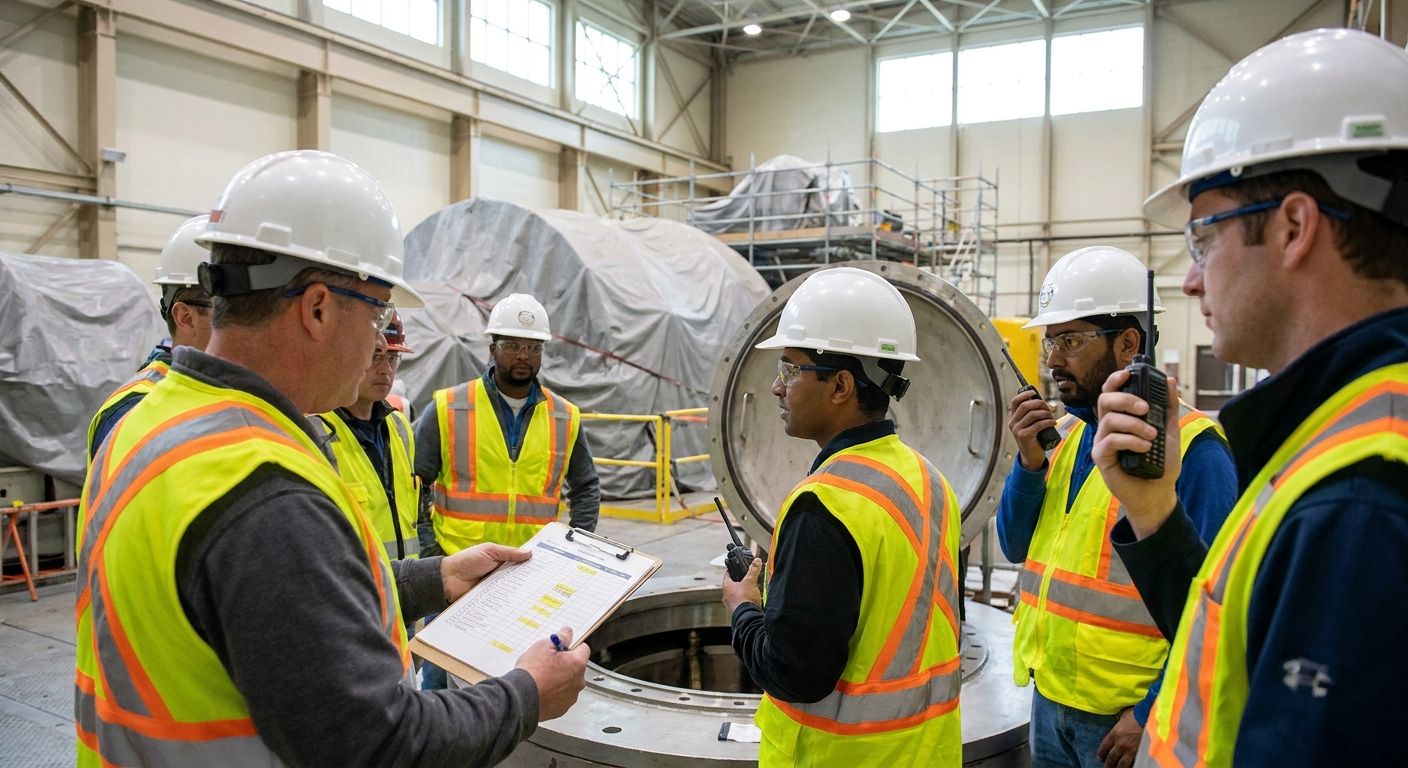
A nuclear refueling outage compresses months of maintenance into roughly 30 days, and a missing radiation safety officer or confined space attendant on day one is what turns a tight schedule into a blown one. This guide covers which roles to staff first for safety staffing for nuclear power plant outages in 2026, what separates a qualified candidate from a liability, and where ResponsAble Staffing sends people first when a plant calls.
- Safety staffing for nuclear power plant outages starts with Radiation Safety Officers and confined space attendants — both are Buy verdicts for 2026.
- U.S. refueling outages now average close to 30 days, so mobilization speed matters more than a low bill rate.
- Fire watch coverage under NFPA 51B and 24/7 night shift staffing are the gaps that most often stall an outage schedule.
- Direct hire safety managers make sense for utilities running outages every 18-24 months, not one-off projects.
- ResponsAble Staffing places vetted safety professionals across construction, oil and gas, and nuclear-adjacent industrial sites nationwide.
Why this matters
Every day a refueling outage runs past schedule, the plant buys replacement power instead of generating it, and utilities have long reported that cost running into the millions per day. The safety staff on site control that clock more than almost anyone else on the outage team — a missing radiation safety officer stops containment entry, a missing confined space attendant stops a vessel inspection, and a missing fire watch stops hot work entirely.
ResponsAble Staffing built its safety staffing process around exactly this kind of high-stakes, high-risk environment, matching vetted professionals to outages, turnarounds, and plant startups nationwide. Get the staffing plan wrong and the outage stretches. Get it right in 2026 and the crews move at the pace the schedule needs.
Who this is for
This is for outage planners, EHS managers, and staffing coordinators at nuclear plants, EPC contractors, and specialty outage service firms who need certified safety professionals on site for a defined refueling or maintenance window, not a year-round headcount. It's built for the person staffing a 20- to 35-day outage window who has to have radiation-trained personnel, confined space attendants, and fire watch coverage locked in before the outage start date, not scrambling on day three. ResponsAble Staffing places these roles as temporary, project-based, or direct hire, depending on your outage cycle.
What to look for in safety staffing for nuclear power plant outages
Radiation and dosimetry training
A safety professional who has never worked inside a radiologically controlled area is a liability the moment containment opens. Look for candidates with documented dosimetry training and prior nuclear site access — general industrial safety experience does not transfer directly to a radiologically controlled work environment.
Mobilization speed
Outages run on a fixed calendar, and the U.S. nuclear fleet's average refueling outage now sits close to 30 days, down from more than 100 days in past decades. A staffing partner that takes two weeks to source a confined space attendant has already cost you a tenth of the schedule.
Confined space and fall protection certification
Containment work, vessel entries, and elevated platform work under OSHA 1910.146 require attendants and entry supervisors who can produce current certification, not a resume that lists it. Ask for the certificate, not the claim.
24/7 shift coverage
Outages typically run two or three shifts around the clock, and safety coverage has to match. A staffing bench that's deep on day shift and thin on nights leaves the riskiest hours — night work, fatigue, reduced visibility — with the least oversight.
Contract flexibility and conversion path
Some outages need one radiation safety officer for three weeks. Others need a safety manager who sticks around for the next outage cycle too. Look for a staffing partner that handles temporary, project-based, and direct hire placement without forcing you into one model.
Documented safety track record
Ask how the agency vets incident history before it vets availability. A staffing partner that can't produce a candidate's prior incident record or certification history is asking you to take on that risk yourself.
Top roles to staff first for a nuclear outage
Radiation Safety Officers / Health Physics Techs — the non-negotiable pick. These are the professionals who control containment access and dosimetry monitoring, and without one credentialed and on site, entry work doesn't start. Radiation safety officers with documented RCA experience should be the first role locked in, typically 30 to 45 days ahead of outage start. Verdict: Buy.
Confined Space Attendants — the compliance backbone. Vessel entries, tank inspections, and containment penetrations fall under OSHA's permit-required confined space rule, and every entry needs a dedicated attendant who isn't doubling as anything else. Confined space attendants staffed on a per-shift basis keep entries moving instead of waiting on one overworked attendant. Verdict: Buy.
Fire Watch Attendants — the hot work safeguard. Any welding, cutting, or grinding inside containment during the outage window triggers a hot work permit, and NFPA 51B calls for fire watch personnel to stay on station for 30 minutes after work stops. Fire watch staffing built around the outage's actual hot work schedule, not a general labor pool, is what keeps permits moving. Verdict: Buy.
Night Shift Safety Coordinators — the coverage gap-filler. Outages that run three-shift rotations lose oversight quality fast once the sun goes down, and incident reporting on the night shift tends to lag without a dedicated coordinator. This role earns its spot once the outage runs past a single shift cycle, but it isn't always the first hire. Verdict: Consider.
Direct-Hire Safety Manager for the next cycle — the long game. Utilities running outages every 18 to 24 months get more value converting a strong contract EHS lead into a permanent hire than restarting the search each cycle in 2026 and again in 2028. Verdict: Consider.
Staff your next outage window
Get vetted radiation and confined space safety pros before your outage start date.
What to avoid
- General industrial safety generalists with no nuclear site history. A resume heavy on OSHA general industry experience but light on radiologically controlled area work looks fine on paper and stalls on day one of containment access.
- A single point of contact for the whole outage. If one recruiter is sourcing your radiation safety officer, your confined space attendants, and your fire watch, you don't have a bench — you have a bottleneck.
- Certifications you haven't verified yourself. A staffing agency that hands you a resume with certifications listed but no documentation attached is asking you to find out the hard way, mid-outage.
How the roles stack up
The safety staffing bench at ResponsAble Staffing covers roles like these across outages, turnarounds, and plant startups nationwide in 2026:
| Role | Lead time needed | Key certification | Shift coverage | Verdict |
|---|---|---|---|---|
| Radiation Safety Officer | 30-45 days | RCA / dosimetry training | Day + night | Buy |
| Confined Space Attendant | 2-3 weeks | OSHA 1910.146 | Per shift, per entry | Buy |
| Fire Watch Attendant | 1-2 weeks | NFPA 51B hot work | Matches hot work schedule | Buy |
| Night Shift Safety Coordinator | 2-3 weeks | Site safety orientation | Night shift only | Consider |
| Direct-Hire Safety Manager | Ongoing search | CSP/CIH preferred | Salaried, year-round | Consider |
FAQ
What is safety staffing for a nuclear power plant outage?
It's the temporary, project-based, or direct hire placement of certified safety professionals — radiation safety officers, confined space attendants, fire watch — for the fixed window of a refueling or maintenance outage. Most outages run close to 30 days in 2026, so staffing has to move on the same compressed timeline as the outage itself.
How fast can a staffing agency mobilize safety professionals for an outage?
A staffing partner with an active bench should source radiation-trained and confined space certified professionals within 2-3 weeks of a request, sometimes faster for repeat outage cycles. Waiting until the outage start date to begin sourcing is the most common reason plants run short-staffed.
What certifications does a radiation safety officer need for outage work?
A radiation safety officer needs documented dosimetry training and prior experience working inside a radiologically controlled area, on top of general industrial safety credentials. General OSHA certifications alone don't cover RCA access requirements.
Should outage safety staffing be contract or direct hire?
Contract staffing fits a single outage window, while direct hire makes more sense for utilities running outages every 18-24 months who want a safety manager carrying institutional knowledge across cycles. Most plants use a mix of both in 2026.
How many confined space attendants does an outage need?
Every permit-required confined space entry under OSHA 1910.146 needs its own dedicated attendant, so the number scales with how many simultaneous vessel or containment entries the outage schedule requires. A plant running four concurrent entries needs four attendants, not one rotating between them.
What happens to the outage schedule if fire watch coverage is missing?
Missing fire watch coverage stops every hot work permit on the spot, since NFPA 51B requires a dedicated fire watch during and for 30 minutes after welding or cutting work. One missing fire watch attendant can idle an entire crew waiting on a permit.
Is it better to use one staffing agency for all outage safety roles?
It's usually better to use an agency with genuine bench depth across radiation, confined space, and fire watch roles rather than splitting the search across three vendors. One qualified point of contact who actually has candidates ready beats three agencies each promising availability.
One last thing
The outages that run smoothest in 2026 aren't the ones with the most safety staff — they're the ones where the radiation safety officer and confined space attendants were locked in 30 to 45 days out, before the schedule got tight enough to panic. Book the non-negotiable roles first, add night shift and direct hire pieces once the core team is set, and the rest of the outage schedule tends to take care of itself.