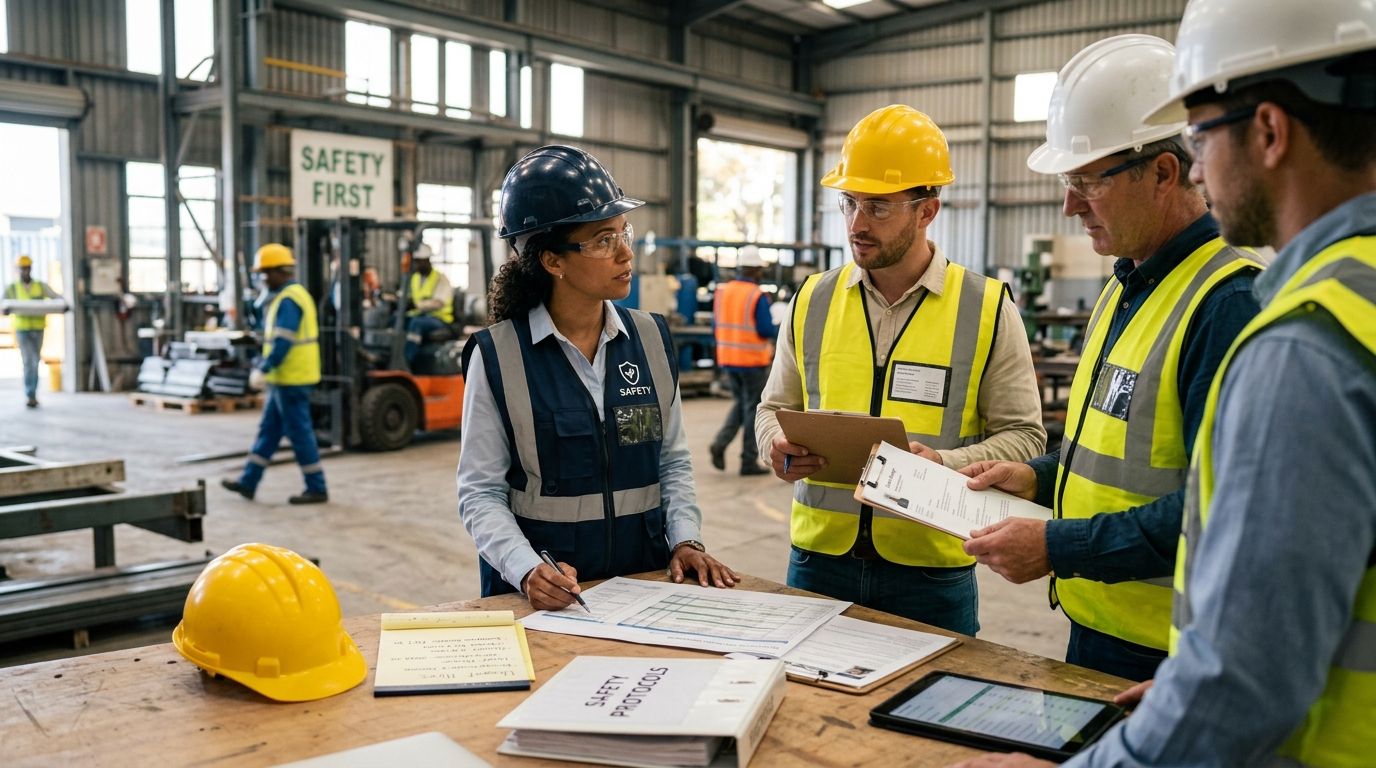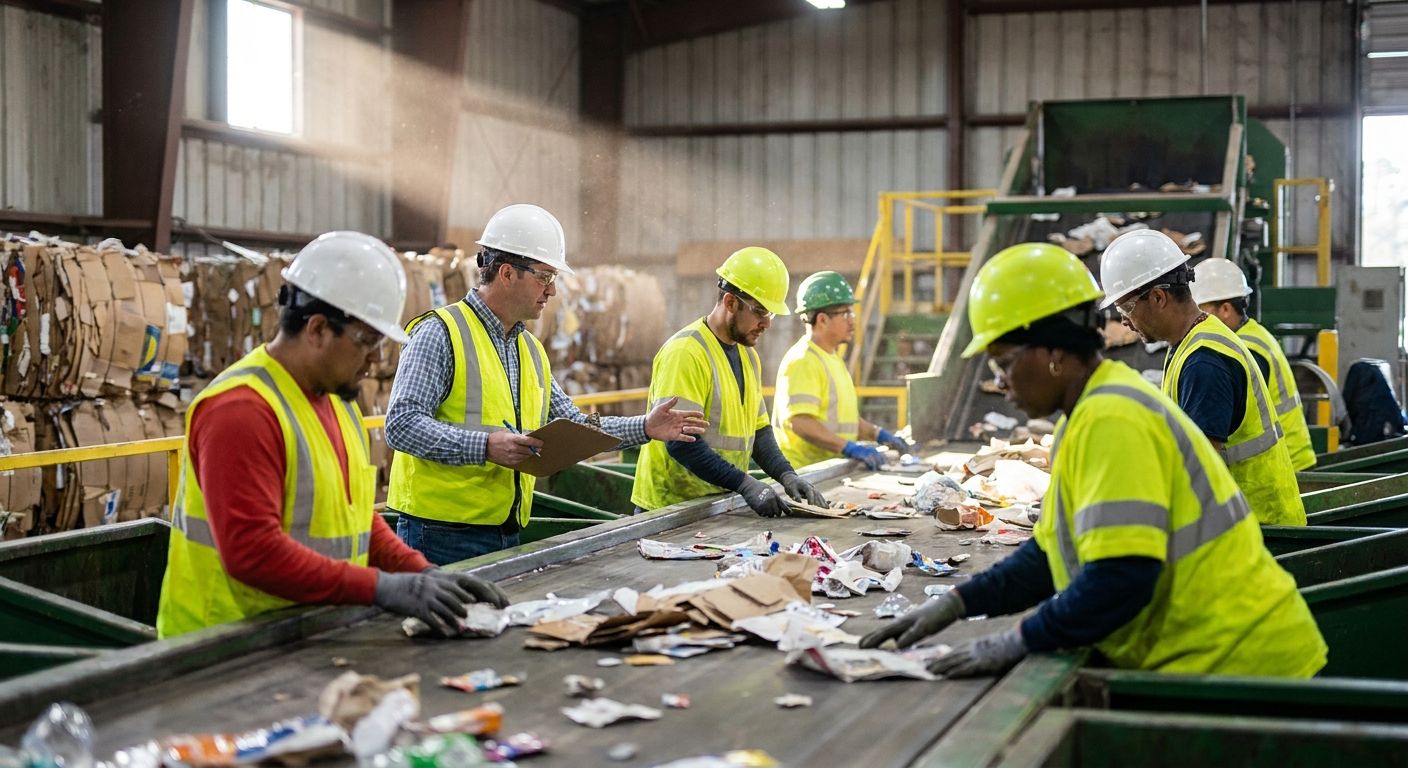
Material recovery facilities run some of the highest-risk floor operations in waste management, and generic temp labor doesn't hold up on a tip floor with balers, sorting lines, and lithium-ion batteries hiding in the mixed stream. This guide breaks down what a facility manager should demand from a safety staffing partner and which roles matter most in 2026.
- Safety staffing for material recovery facilities requires HAZWOPER-trained technicians, not general laborers in a hard hat.
- Confined space entry teams and fire watch coverage for battery fires are the two most common MRF safety gaps in 2026.
- ResponsAble Staffing places direct-hire safety managers and contract-to-hire technicians for MRFs nationwide.
- 40-hour HAZWOPER training and NFPA 484 combustible dust awareness separate qualified candidates from resume padding.
Why this matters
Refuse and recyclable material collection consistently ranks among the most dangerous occupations tracked annually by the U.S. Bureau of Labor Statistics, and material recovery facilities carry that risk indoors: moving conveyors, baler crush zones, and a waste stream that increasingly includes damaged lithium-ion batteries. A facility that staffs safety roles like it staffs a sort line - warm bodies, fast fill - ends up with citations, downtime, or worse.
ResponsAble Staffing places vetted EHS professionals into construction, oil and gas, manufacturing, and waste operations, and the same standards that keep a refinery turnaround compliant apply directly to an MRF floor. Safety staffing for material recovery facilities isn't a generic hire - it's a specific set of certifications matched to a specific set of hazards.
Who this is for
This guide is for MRF operations managers, plant safety directors, and regional EHS leads who need to fill confined space attendants, fire watch personnel, or a full-time safety manager without lowering the bar just to hit a start date. It's also for facilities scaling up sort capacity in 2026 and realizing their current safety headcount can't cover a second shift.
What to look for in safety staffing for material recovery facilities
Confined space certification, not just a checkbox
MRFs have permit-required confined spaces under bunkers, pits, and enclosed conveyor housings covered by 29 CFR 1910.146. A candidate who has read the standard once isn't the same as one who has run atmospheric monitoring and rescue standby on an active entry. Ask for documented entries, not a certificate date.
Fire and combustible dust awareness
Lithium-ion battery fires starting in the tip pile or on the belt line are a well-documented and growing cause of MRF incidents. Staff who understand NFPA 484 combustible dust hazards and know when to pull a fire watch shift, rather than reach for an extinguisher and hope, are worth more than a resume full of unrelated certifications.
HAZWOPER training level matched to exposure
Not every MRF role needs the full 40-hour HAZWOPER course - some occasional-exposure roles only need the 24-hour version plus an annual 8-hour refresher. A staffing partner who doesn't know the difference will either overstaff (and overbill) or understaff (and expose you) on this line item.
Lockout/tagout competency on balers and conveyors
Baler jams and conveyor entanglements are two of the most common serious-injury categories in recycling operations. Anyone stepping onto the floor needs demonstrated 1910.147 lockout/tagout competency, and that competency needs to be verified before day one, not discovered after an incident report.
Speed of placement without a drop in vetting
MRFs run lean crews, and one open safety seat on nights is a real exposure gap, not a scheduling inconvenience. A partner who can fill a confined space attendant or fire watch role in days instead of weeks - while still verifying certifications - is doing the actual job of a staffing agency.
Direct-hire pipeline for the safety manager seat
Temporary coverage solves a gap. A facility that keeps churning through interim safety managers has a bigger problem. Look for a partner that also recruits for the permanent safety director or manager role, so the temporary bridge leads somewhere.
Top picks: staffing models that actually fit an MRF
Confined space entry team staffing - the safe pick. This covers attendants, entrants, and standby rescue personnel certified under 29 CFR 1910.146 for bunker and pit work. The number that matters: entries without a trained attendant present are a direct violation, full stop, no gray area. Confined space attendant staffing for industrial sites covers exactly this role. Verdict: Buy.
Fire watch coverage for hot work and battery incidents - the underrated pick. Most MRFs think about fire watch only during welding or cutting jobs, but a dedicated fire watch presence near sort lines catches battery ignition before it spreads to the baler. NFPA 51B governs the hot-work side of this, and a facility running any grinding or cutting maintenance without a fire watch on standby is one spark away from a shutdown. How to hire a fire watch attendant for hot work jobs walks through staffing this correctly. Verdict: Buy.
Landfill and waste-management-specific EHS coordination - the wildcard. MRFs sit adjacent to landfill and transfer operations more often than people admit, and a coordinator who understands both sides of that fence line catches cross-contamination and traffic hazards a pure-manufacturing safety hire would miss. Safety staffing for landfill and waste management sites is built for exactly this crossover. Verdict: Consider.
Direct-hire safety manager placement - the long-game pick. Temp coverage buys time. A permanent safety manager who knows your equipment, your shift patterns, and your near-miss history builds the culture that actually reduces incident rates over multiple years, not just one audit cycle. Direct-hire recruiting for safety managers is the right starting point once you're ready to stop patching the seat. Verdict: Buy.
Generalist temp labor with a safety title tacked on - the skip. A warehouse-generalist temp agency that adds "safety technician" to a job title without HAZWOPER, confined space, or lockout/tagout verification isn't a safety hire, it's a liability with a badge. Verdict: Skip.
What to avoid
- Certification claims without dates or documentation. "OSHA certified" means nothing without a course name, completion date, and issuing body attached.
- One-size-fits-all safety generalists. A candidate who's worked general construction safety may not know what a bunker pit or a picking station actually demands.
- Agencies that can't explain bill-rate breakdowns. If a staffing partner can't show what portion of the rate covers training verification versus placement margin, you're negotiating blind.
Fill your next MRF safety role
Vetted confined space, fire watch, and safety manager candidates, nationwide.
Verdict comparison
| Staffing model | Best for | Key certification | Verdict |
|---|---|---|---|
| Confined space entry team | Bunker/pit access | 29 CFR 1910.146 | Buy |
| Fire watch coverage | Hot work + battery risk | NFPA 51B | Buy |
| Landfill/waste EHS coordinator | Adjacent landfill/transfer ops | Waste-specific compliance | Consider |
| Direct-hire safety manager | Long-term culture and compliance | Multi-year OSHA experience | Buy |
| Generalist temp labor | Nothing on an MRF floor | None verified | Skip |
FAQ
What certifications should MRF safety staff have in 2026?
MRF safety staff generally need HAZWOPER training scaled to exposure level (24 or 40 hour), 1910.146 confined space competency, and 1910.147 lockout/tagout training. Combustible dust and fire watch awareness under NFPA 484 and 51B are increasingly expected given lithium-ion battery risks in the waste stream.
Is temporary or direct-hire safety staffing better for a material recovery facility?
Temporary staffing covers immediate gaps like confined space attendants or fire watch during a maintenance window. Direct-hire fits the ongoing safety manager or coordinator seat, since a permanent hire builds facility-specific knowledge that a rotating temp roster cannot.
How much does safety staffing for material recovery facilities typically involve?
Cost depends on role, certification level, and shift coverage needed, so facilities should request a detailed bill-rate breakdown rather than a flat quote. Confined space and fire watch roles carry different pricing than a direct-hire safety manager search.
Why do MRFs need fire watch staffing specifically?
Lithium-ion batteries entering the waste stream ignite unpredictably on belts and in bunkers, and hot work like cutting or grinding adds a second fire source. Dedicated fire watch personnel trained under NFPA 51B catch ignition before it reaches the baler.
What's the difference between 24-hour and 40-hour HAZWOPER training?
The 40-hour course applies to workers with regular hazardous waste exposure, while the 24-hour course fits occasional or support-level exposure roles. Both require an annual 8-hour refresher to stay current.
Can a staffing agency place both temporary technicians and a permanent safety director?
Yes, agencies that run both contract and direct-hire desks can bridge a temporary confined space attendant into a permanent safety role once the facility is ready to commit. ResponsAble Staffing runs both models for waste and industrial operations.
What's the most overlooked safety staffing gap at MRFs?
Fire watch coverage during routine maintenance, not just formal hot-work permits, is the most overlooked gap. Grinding or cutting near sort lines without a dedicated fire watch presence is a common and preventable exposure.
One last thing
The facilities that avoid the worst incidents aren't the ones with the thickest safety manual - they're the ones where the confined space attendant actually knows the atmospheric monitor readings by heart and the fire watch person has run a real drill, not just read the procedure once. Staffing that reality takes more vetting than filling a shift, but it's the difference between a near-miss report and a shutdown. If your current safety roster can't answer a direct question about their last confined space entry, that's the fresh start conversation worth having in 2026.