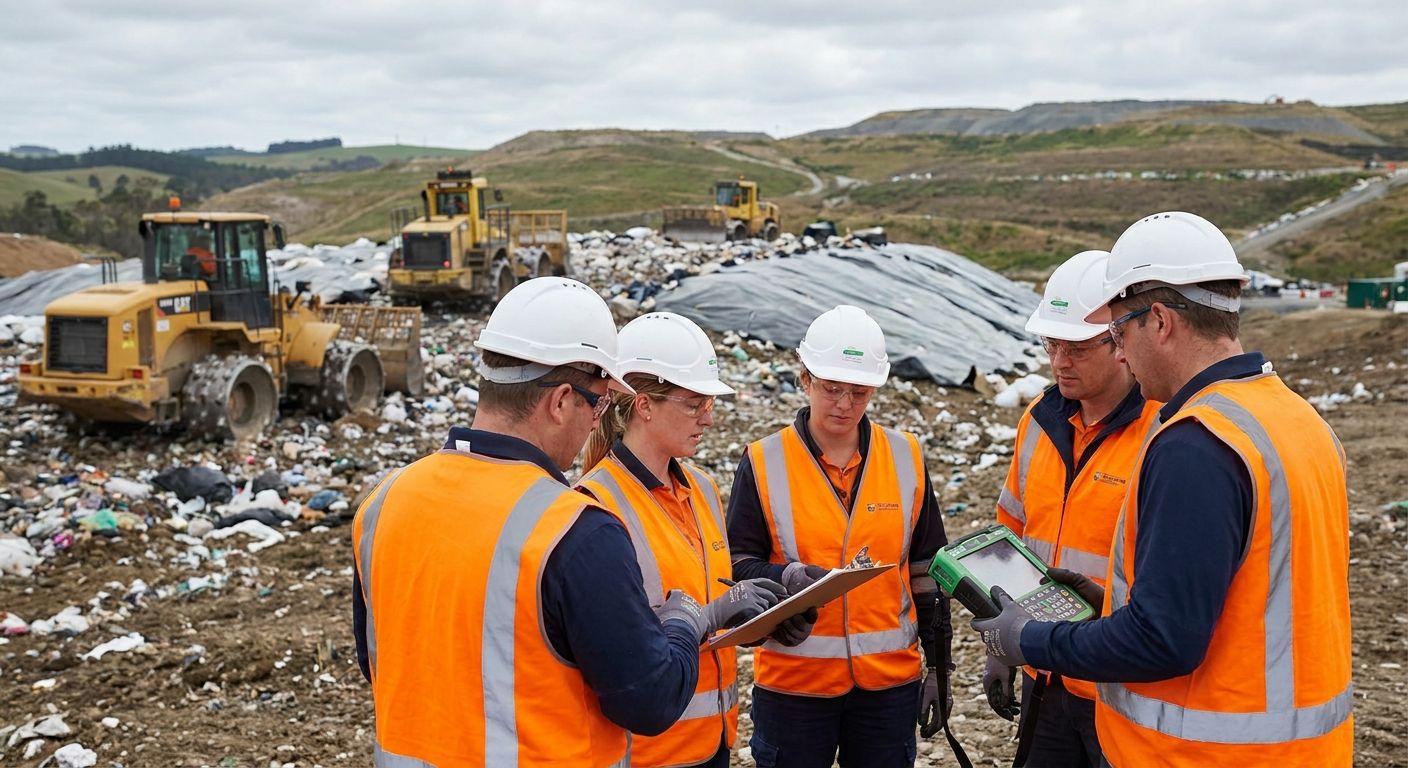
Landfill and waste management sites carry hazards most staffing agencies never screen for — methane pockets, unstable working faces, and heavy equipment moving in tight quarters. This guide covers what actually matters in landfill safety staffing for 2026, who needs it, and which roles to fill first before your next inspection or expansion.
- ResponsAble Staffing places HAZWOPER-certified hazmat technicians and confined space attendants for landfill sites nationwide in 2026.
- Confined space attendant staffing closes the gap OSHA cites most often on landfill inspections — prioritize it before expansion season.
- Generic labor staffing without gas-monitoring experience is a Skip for active cell operations.
- Direct hire recruiting fits environmental compliance managers; temporary placement covers surge work and turnarounds.
Why this matters
A landfill isn't a warehouse with a bad smell — it's an active industrial site with combustible gas, unstable slopes, and heavy machinery running near workers on foot. OSHA has flagged confined space and gas-monitoring violations at waste facilities repeatedly, and a single missed methane reading can end a shift in a hospital visit or worse.
Staffing a landfill or transfer station with unvetted labor isn't a shortcut — it's a liability sitting on your books. Landfill safety staffing exists precisely because generalist agencies don't screen for HAZWOPER certification, confined space experience, or gas detection competency. Getting this right protects your crew and your compliance record in the same move.
Who this is for
This guide is built for landfill operators, municipal waste management departments, and environmental services contractors running active cells, transfer stations, or material recovery facilities who need safety professionals who already understand methane migration, leachate systems, and confined space entry protocols — not generalist labor that needs a full year to catch up.
If you're managing a landfill safety staffing agency partnership for the first time, the criteria below apply whether you're filling one confined space attendant role or building out a full safety team for a multi-cell facility.
What to look for in landfill safety staffing
HAZWOPER and confined space certification
Any candidate stepping onto an active cell needs current HAZWOPER certification — 24-hour or 40-hour depending on exposure level — plus documented confined space entry training. Without it, they're not qualified to be there, and your site logs will show it during an audit.
Gas monitoring and methane hazard experience
Landfills generate methane and hydrogen sulfide as waste decomposes, and gas levels shift by section and by weather. A safety professional who has actually logged hours with a four-gas monitor on a live cell reads those numbers instinctively — someone who hasn't will miss the warning signs until it's too late.
Heavy equipment traffic control experience
Compactors, dozers, and haul trucks move constantly across uneven working faces, and foot traffic near that equipment is where most landfill injuries happen. Candidates need real experience directing pedestrian flow around heavy equipment, not a classroom certificate.
Credentialing and onboarding speed
Waste management sites can't wait three weeks for a background check to clear. A staffing partner that pre-vets HAZWOPER cards, medical clearances, and drug screens before presenting candidates gets your crew on-site in days, not weeks.
Temporary vs direct hire flexibility
Some facilities need coverage for a seasonal surge in tonnage; others need a permanent environmental compliance manager who'll be there in 2027 and beyond. Your staffing solution should offer both models without forcing you into a one-size-fits-all contract.
Roles to prioritize first
Hazmat Technicians — the frontline defense. These are the people handling leachate incidents, chemical spills, and gas venting issues on an active cell, and they need current 40-hour HAZWOPER training as a baseline. Hazmat technician staffing through ResponsAble Staffing screens for exactly this exposure history before a candidate is ever presented. Buy if your site handles any hazardous material intake or leachate management.
Confined Space Attendant Staffing — the compliance safeguard. OSHA's permit-required confined space standard is one of the most-cited rules at waste facilities, and an attendant who's actually monitored a live entry knows the difference between a routine reading and an evacuation trigger. Confined space attendant staffing fills this role with candidates who carry current gas-monitoring hours, not just a training certificate. Buy for any facility running permit-required entries in 2026.
Environmental Remediation Staffing — the long-game hire. Closed cells, groundwater monitoring, and soil remediation work run on a different timeline than daily operations, often 12 to 18 months per project. Environmental remediation staffing matches candidates to that longer arc instead of treating it like a 90-day temp assignment. Consider if you're closing or capping a cell this year.
Safety Auditors and Inspectors — the second set of eyes. A dedicated auditor who isn't buried in daily operations catches the compliance gaps your on-site team stops seeing after month six. Consider for facilities that haven't had an outside safety review in over a year.
First Aid and EMT Staffing — the on-site medic. Landfill injuries from equipment contact or heat stress need faster response than a 20-minute ambulance wait allows. Consider for larger multi-shift operations; Skip if your site already runs under 15 workers per shift with a certified first responder on the clock.
“If a candidate has never worn a gas monitor on a live cell, they don't belong on your landfill.”
What to avoid
- Generic labor staffing without EHS vetting. A background check for warehouse work isn't the same as verifying HAZWOPER hours and confined space logs — don't let a recruiter tell you otherwise.
- Skipping reference checks on gas-monitoring experience. A certificate on paper doesn't confirm someone has actually read a monitor under pressure; ask for the last site they worked and call it.
- Treating direct hire and temporary staffing as interchangeable. A 90-day surge hire and a permanent safety director need entirely different vetting timelines, and mixing them up costs you turnover.
Verdict comparison
| Role | Certification baseline | Typical deployment | Verdict |
|---|---|---|---|
| Hazmat Technician | 40-hour HAZWOPER | 3-5 days | Buy |
| Confined Space Attendant | HAZWOPER + confined space entry | 3-5 days | Buy |
| Environmental Remediation Specialist | Site-specific certification | 12-18 month project | Consider |
| Safety Auditor/Inspector | OSHA outreach or CSP | Project-based | Consider |
| First Aid/EMT | Current EMT or first aid cert | Shift-based | Consider |
Need a landfill safety crew staffed fast?
ResponsAble Staffing pre-vets HAZWOPER and confined space credentials before candidates ever reach you.
FAQ
What is landfill safety staffing?
Landfill safety staffing places EHS professionals — hazmat technicians, confined space attendants, environmental remediation specialists — who are already trained for methane, leachate, and heavy equipment hazards specific to waste facilities. It differs from general labor staffing because candidates carry HAZWOPER and confined space credentials before they're placed.
How fast can a landfill fill a confined space attendant role?
Pre-vetted staffing partners typically place a credentialed confined space attendant in 3 to 5 days in 2026 because certifications and background checks are cleared before the candidate is presented. Generic staffing agencies without EHS pre-screening often take two to three weeks.
Do landfill workers need HAZWOPER certification?
Workers handling hazardous waste, leachate, or gas venting on an active cell need at least 24-hour HAZWOPER training, with 40-hour certification required for higher-exposure roles. Certification level depends on the specific hazard exposure at your site.
Is direct hire or temporary staffing better for a landfill safety manager?
Direct hire fits permanent roles like safety directors or environmental compliance managers who need to build long-term site knowledge. Temporary staffing works better for seasonal tonnage surges, capping projects, or short-term compliance gaps.
How much does landfill safety staffing cost in 2026?
Costs vary by role, certification level, and whether the placement is temporary or direct hire, so get a facility-specific quote rather than relying on a flat industry number. Confined space and hazmat roles typically carry a premium over general labor due to certification requirements.
What's the biggest safety gap at waste management sites?
Confined space entry violations are among the most frequently cited OSHA issues at landfills and transfer stations, usually tied to inadequate gas monitoring or missing attendant coverage. Staffing a dedicated, credentialed confined space attendant closes this gap fastest.
Can one staffing agency cover both hazmat and confined space roles?
Yes, agencies specializing in industrial EHS staffing typically vet candidates across multiple certification tracks, including hazmat, confined space, and gas monitoring, so you're not managing three separate vendor relationships.
One last thing
Staffing a landfill isn't just filling a shift — it's deciding whose safety you're responsible for tomorrow morning. Treat the confined space attendant role like the foundation it is, not an afterthought you fill last, and the rest of your 2026 compliance record takes care of itself.