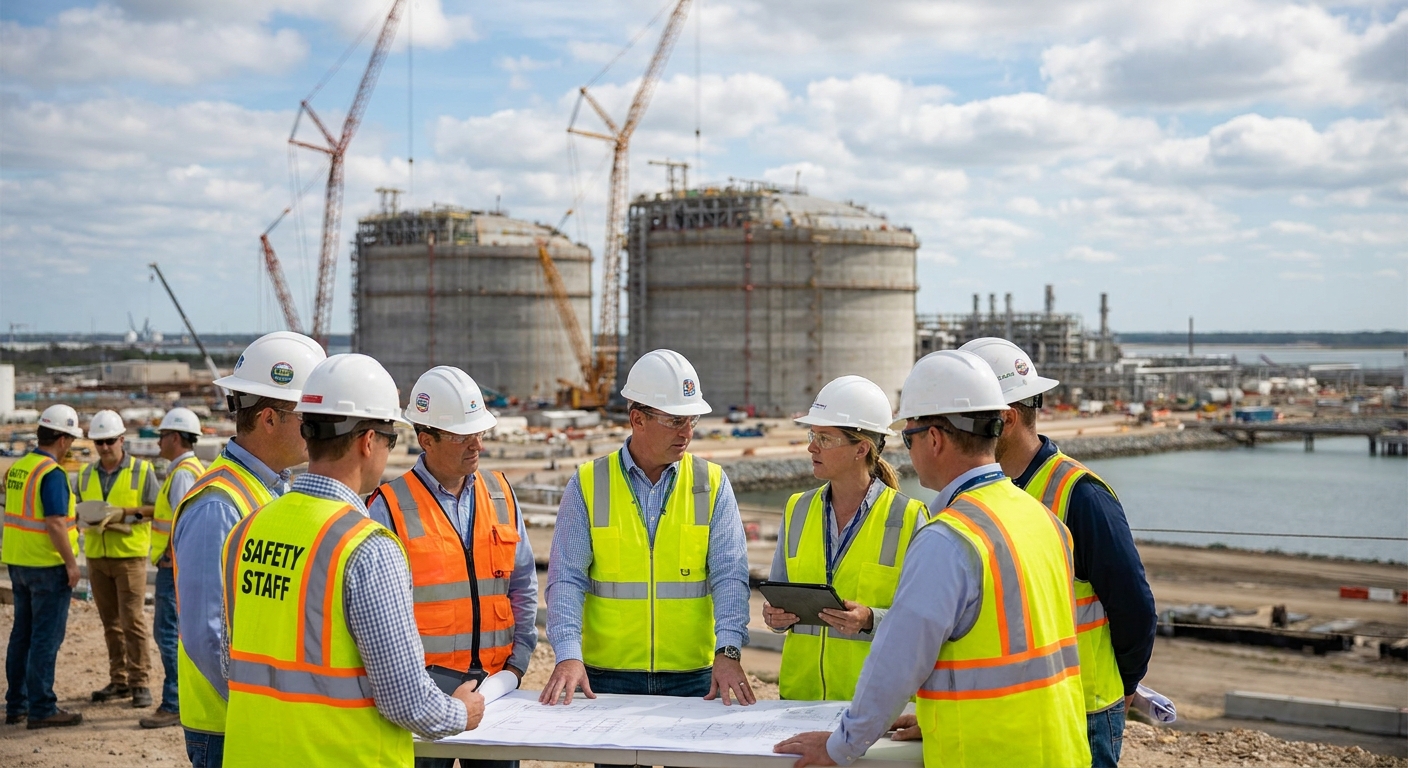
LNG terminal construction runs on cryogenic process risk, marine loading operations, and a workforce that swells from a few hundred to several thousand in a matter of weeks — safety staffing for LNG terminal construction has to match that pace without dropping the specialized coverage the site actually needs. Generalist safety techs pulled from a residential or light-industrial pool will not cut it once you're running hot work near a cryogenic tank farm.
- ResponsAble Staffing's turnaround model is the strongest fit for safety staffing for LNG terminal construction surges — Buy for mobilizations under 90 days.
- Marine terminal safety coverage matters as much as onsite construction safety once a jetty or loading dock is part of the scope.
- Skip generalist safety staffing vendors with no NFPA 59A or PSM background — they show up trained on the wrong standard.
- Petrochemical EHS recruiting overlaps heavily with LNG process safety needs and is worth Considering for PHA and MOC support.
Why this matters
An LNG terminal build is not a standard heavy-industrial job. You've got cryogenic storage, high-pressure piping, marine loading arms, and often a co-located regasification or liquefaction train, all under NFPA 59A and Coast Guard jurisdiction where the site touches water. A safety professional who's spent a career on commercial construction sites has never dealt with any of that.
Miss the specialization and you don't just get a weaker safety program — you get schedule delays. A safety tech who can't read a cryogenic P&ID or doesn't know what a Coast Guard Captain of the Port requires for marine transfer operations will slow down permitting, inspections, and hot work approvals. On a 24-36 month build with liquidated damages on the line, that's real money in 2026.
Who this is for
This guide is for EHS managers, project controls leads, and construction executives staffing an LNG terminal, export facility, or import regasification project — whether you're standing up a new greenfield terminal or expanding an existing one. It applies whether you need three safety professionals for a six-month scope package or forty for a full EPC mobilization. If you're staffing a pipeline tie-in or a standalone marine terminal instead of a full LNG facility, the criteria below still apply, but check the pipeline construction safety staffing page for scope specific to linear projects.
ResponsAble Staffing places vetted industrial safety professionals — temporary, project-based, and direct hire — into construction, oil and gas, and other high-risk environments nationwide. That's the home page if you want the full picture of what's covered before you get into terminal-specific criteria.
What to look for in safety staffing for LNG terminal construction
Cryogenic and process safety experience
A safety professional working an LNG terminal needs to understand cold flow, brittle fracture risk, and vapor cloud behavior — not just generic hot work permitting. Ask any candidate directly how many cryogenic or LNG-adjacent projects they've staffed; if the answer is zero, that's a mobilization risk, not a training opportunity you can absorb mid-build in 2026.
Marine and jetty operations knowledge
Most LNG terminals load or offload by ship, which means marine transfer arms, mooring operations, and Coast Guard-regulated safety zones. A safety tech who's never worked a jetty will miss hazards that a construction-only background doesn't cover, and that gap shows up during Coast Guard inspections.
PSM, PHA, and MOC fluency
Process Safety Management applies to LNG facilities under OSHA's covered process rules, and your safety staff need to participate in Process Hazard Analyses and Management of Change reviews, not just walk the site with a clipboard. This is where petrochemical-trained EHS professionals often transfer well, since EHS recruiting for chemical and petrochemical plants draws from a similar talent pool.
Rapid mobilization capacity
LNG terminal builds surge fast — a 90-day ramp from ten safety personnel to forty is common once major construction phases overlap. A staffing partner needs a bench that's already credentialed, not a recruiting cycle that starts the day you call.
Credential and site-access readiness
Any safety professional working near marine terminal infrastructure typically needs a TWIC card, which stays valid for five years but takes weeks to process for someone starting from scratch. Confirm upfront whether candidates already hold current TWIC, OSHA 30-hour, and HAZWOPER 40-hour credentials, or you'll lose your first two weeks to paperwork.
Surge and turnaround flexibility
LNG terminal schedules shift — weather delays, equipment delivery slips, and commissioning windows all move the safety staffing need up or down. Look for a partner that staffs project-based and temporary roles, not just permanent placements, so you're not locked into headcount that doesn't match the phase you're actually in.
Top picks for LNG terminal safety staffing
1. Turnaround and project-based safety staffing — the safe pick. Built for oil and gas and refinery projects that need to scale a safety team fast and scale it back down when the phase ends. The relevant benchmark: staffing turnarounds under a 90-day mobilization window, which matches the surge pattern most LNG terminal builds hit during major construction milestones. Buy for any terminal project with a defined construction phase and a hard completion date. See turnaround safety staffing for oil, gas, and refinery projects.
2. Marine terminal and shipyard safety staffing — the piece most builds underspec. Covers the jetty, loading arm, and vessel-side safety coverage that a construction-focused safety team usually doesn't carry in-house. If your LNG terminal includes a marine loading facility — and most do — this is not optional coverage. Buy if your scope includes any dock, berth, or marine transfer infrastructure. See safety staffing for marine terminals and shipyards.
3. Chemical and petrochemical EHS recruiting — the crossover pick. Petrochemical-trained EHS recruits bring PSM, PHA, and MOC experience that transfers directly to an LNG process environment, even though the commodity is different. Consider this track specifically for PSM compliance roles and process safety engineers, not for general site safety headcount. See EHS recruiting for chemical and petrochemical plants.
4. Pipeline construction safety staffing — the adjacent-scope pick. Strong fit if your LNG terminal project includes a feed-gas pipeline tie-in or a linear right-of-way component running to the facility, since that scope behaves more like pipeline construction than terminal construction. Consider only if pipeline scope is a meaningful share of the project; Skip if your build is terminal-only with no linear component.
What to avoid
- Generalist commercial construction safety staff with no energy-sector background. They look qualified on paper — OSHA 30, solid resume — but they've never worked around cryogenic process equipment and will need weeks of onboarding you don't have time for in 2026.
- Vendors that only staff permanent roles. LNG terminal construction is phase-driven. A partner locked into direct-hire-only placements can't flex when your safety headcount needs to double for a 60-day window and then drop back down.
- Safety staff without current TWIC credentials for marine-adjacent roles. If the terminal has any water-side infrastructure, a safety professional who needs to start the TWIC process from scratch will sit on the bench for weeks before they can badge onto the marine side of the site.
Staff your LNG terminal safety team
Talk through your mobilization timeline and credential needs before you're behind schedule.
Verdict comparison
| Staffing track | Best for | Mobilization speed | Verdict |
|---|---|---|---|
| Turnaround / project-based | Construction phase surges | Under 90 days | Buy |
| Marine terminal & shipyard | Jetty, dock, loading arm scope | Project-dependent | Buy |
| Chemical/petrochemical EHS | PSM, PHA, MOC roles | Standard recruiting cycle | Consider |
| Pipeline construction | Feed-gas tie-in / ROW scope | Project-dependent | Consider |
| Generalist commercial safety | Not recommended for LNG terminals | N/A | Skip |
FAQ
What is safety staffing for LNG terminal construction?
It's the practice of placing vetted EHS and safety professionals — temporary, project-based, or direct hire — onto LNG terminal builds who understand cryogenic hazards, marine loading operations, and process safety management. Generalist construction safety staff typically lack this background.
How fast can safety staffing scale for an LNG terminal surge?
Turnaround-style staffing models are built to mobilize within roughly a 90-day window, matching the pace most LNG terminal builds need during major construction phases. Ask any staffing partner directly what their bench-to-badge timeline looks like before you commit.
Do LNG terminal safety staff need a TWIC card?
Yes, if the role involves access to marine terminal infrastructure, which most LNG facilities include. TWIC cards stay valid for five years once issued, but processing a new applicant takes weeks, so confirm credential status before mobilization.
Is petrochemical EHS staffing a good fit for LNG terminal projects?
It's a strong fit for Process Safety Management, PHA, and MOC roles because the compliance framework overlaps closely with LNG process safety. It's a weaker fit for general site safety headcount that doesn't require PSM-level expertise.
What's the difference between staffing an LNG terminal and a pipeline project?
LNG terminal construction centers on cryogenic process equipment and marine loading, while pipeline construction centers on linear right-of-way work and excavation safety. A project with both scopes needs staff experienced in each, not one team covering both.
How much does specialized LNG safety staffing cost compared to generalist staffing?
Costs vary by project scope and credential requirements, so get a specific quote based on your mobilization timeline and headcount. Generalist staffing usually costs less upfront but risks delays that cost more once hot work or Coast Guard approvals stall.
Can safety staffing flex up and down during an LNG terminal build?
Yes, project-based and temporary staffing models are built for that, letting you scale headcount to match construction phases instead of carrying flat headcount for a 24-36 month build. Direct-hire-only vendors can't offer that flexibility.
One last thing
The single biggest mobilization delay on LNG terminal builds isn't finding safety candidates — it's finding ones who already hold a current TWIC card. Ask about TWIC status before you ask about experience; a five-year-valid card in hand beats a stronger resume that needs six weeks to badge onto the marine side of the site in 2026.