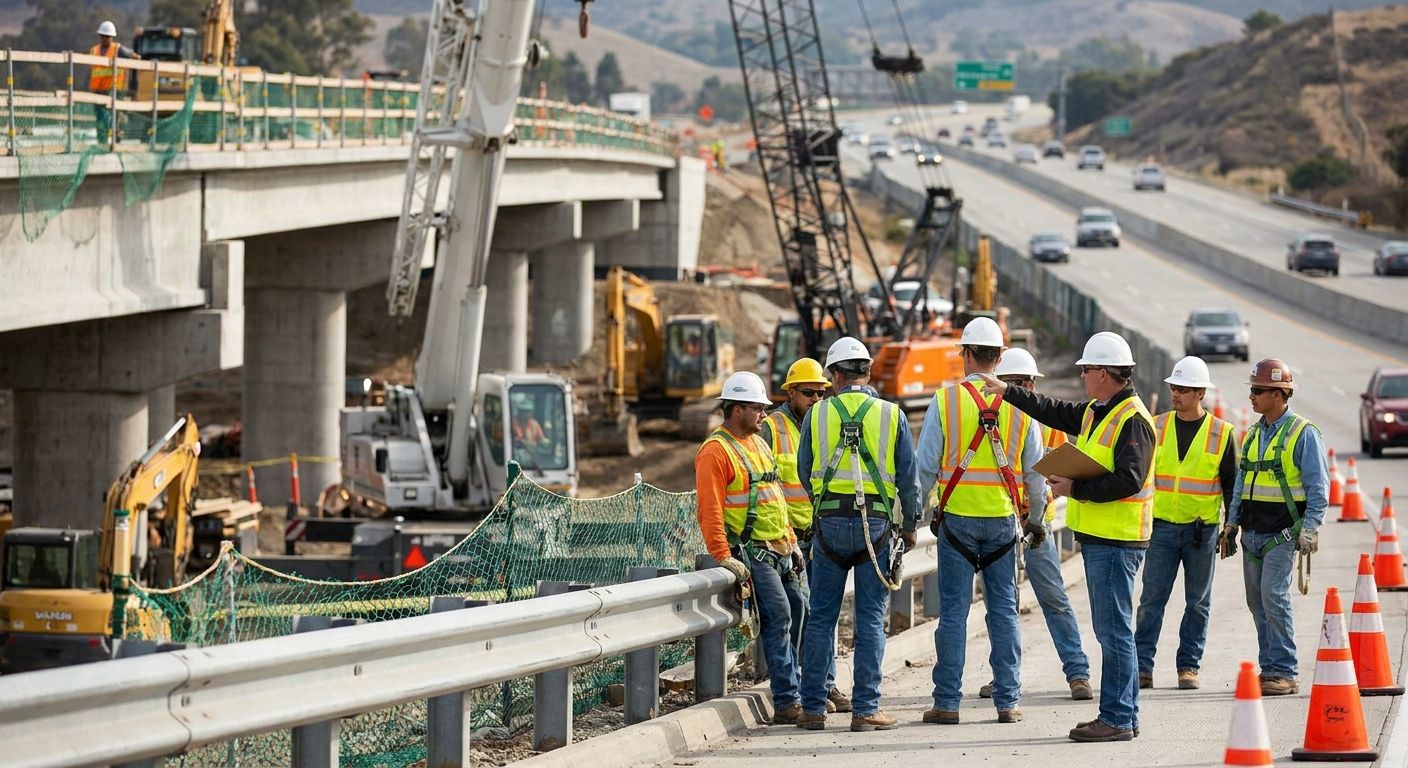
Highway and bridge construction runs on a tighter safety margin than almost any other build type: live traffic lanes next to the crew, deck pours over water, confined spaces inside box girders, and DOT inspectors who don't accept a paper-only safety plan. Getting the right safety staff on site, fast, is the difference between a project that stays on schedule and one that gets shut down mid-pour.
- Highway bridge construction safety staffing works best when Site Safety Officers are direct hire first, not temp-only — Buy that role.
- Fire watch and hot work coverage on bridge decks in 2026 is non-negotiable — treat it as a Buy, not an option.
- Confined space attendants for pier footings and box culverts get overlooked on GC staffing plans — Consider one per active crew.
- Union craft safety coordinators matter on prevailing-wage DOT jobs — Consider adding one before mobilization, not after a citation.
Why this matters
DOT and FHWA-funded projects carry safety documentation requirements most commercial GCs never see: daily inspection logs tied to federal funding, OSHA 10-hour and 30-hour outreach cards for every worker in the work zone, and a named site safety officer the state can call by phone. Miss one of those pieces and the project doesn't just get flagged — it can get a stop-work order that costs the GC more in delay claims than the safety hire would have cost all year.
Bridge and highway sites also stack hazards that don't show up on a typical building site: excavation and shoring near live traffic, work-at-height over water or roadway, hot work on structural steel, and confined entry into culverts and box girders. A safety recruiting companies for construction firms partner that only places general laborers isn't built for that stack. Highway bridge construction safety staffing in 2026 has to be role-specific, not generalist.
Who this is for
This guide is for general contractors, DOT prime contractors, and construction managers staffing highway widening, bridge replacement, interchange, and rail-overpass projects — anyone who has to prove compliance to a state DOT or FHWA auditor while keeping a paving or steel crew moving. If your project has a federally funded contract number attached to it, the staffing bar is higher than a standard commercial job, and your safety hires need to be sourced that way from day one.
What to look for in safety staffing for highway and bridge construction
Credential depth, not just a resume
A safety professional on a bridge job needs more than a generic OSHA 10 card — look for 30-hour construction outreach, confined space entry/attendant training, fall protection competent-person status, and, on federally funded work, familiarity with FHWA and state DOT documentation formats. A candidate missing any one of these on a bridge deck job is a liability, not a hire.
Speed to placement
Bridge and highway schedules move around weather windows and traffic control permits, so a safety hire that takes three weeks to source is functionally useless. The right partner fills a site safety role in days, not weeks, because they keep a bench of pre-vetted professionals rather than starting the search cold.
Confined space and over-water competency
Pier footings, box culverts, and drainage structures put crews into confined spaces regularly on bridge jobs. A safety hire who has never run an entry permit or atmospheric test on a real confined space job is going to learn on your project — that's the wrong place for on-the-job training.
Federal and prevailing-wage familiarity
Many highway and bridge jobs run on federal funding or state prevailing-wage rules, which means certified payroll, EEO compliance tracking, and specific reporting formats layer on top of standard safety duties. A safety officer who has worked government and federal contractor sites before adapts faster than one who hasn't.
Fit for shift and crew structure
Bridge work often runs night lane closures to avoid daytime traffic, and a safety professional who can't work nights doesn't cover the highest-risk hours on the project. Match the hire to the actual shift pattern before you sign, not after.
Top picks: the roles that carry the most weight on a bridge job
Site Safety Officer (direct hire) — the anchor role. This is the person the DOT inspector calls by name, and turnover in this seat during a multi-year bridge project creates a documentation gap that auditors flag immediately. Direct hire keeps continuity across the full project life, sometimes 18-36 months on a major span replacement. Verdict: Buy. Source this role through direct hire recruiting for safety managers.
Fire Watch / Hot Work Attendant — the non-negotiable. Any welding, cutting, or grinding on structural steel or rebar cages needs a dedicated fire watch under a hot work permit, and skipping this role is one of the most common OSHA citations on bridge steel jobs. Verdict: Buy. Fill it through fire watch staffing for hot work permits rather than pulling a laborer off another task.
First Aid / EMT Coverage — the safety net. Highway and bridge sites sit far from urgent care in a lot of rural DOT corridors, and response time to a fall or struck-by incident matters more than on an urban commercial site. Verdict: Buy. First aid and EMT staffing for job sites covers this without pulling a safety officer off their primary duties.
Confined Space Attendant — the overlooked hire. Pier footing work and box culvert inspection require a dedicated attendant every time a crew enters, and GCs often assume the site safety officer can cover it. One person can't run entry permits and monitor the whole site at the same time. Verdict: Consider — add one per active confined-space crew, not one per project.
Union Craft Safety Coordinator — the wildcard. On prevailing-wage DOT jobs with union crews, a coordinator who understands both the craft agreements and the safety program prevents friction between the safety team and the trades. This role isn't needed on every job, but it pays off fast on multi-trade union bridge sites. Verdict: Consider.
“If your bridge safety plan names roles the staffing agency can't fill in 72 hours, the plan is aspirational, not real.”
Staff your bridge project safety team
Get vetted safety professionals matched to your DOT timeline.
What to avoid
- Generic staffing agencies with no EHS specialty. A firm that places forklift drivers and safety officers off the same list rarely vets for confined space or hot work competency the way a specialized agency does.
- Safety officers with only office-building or retail experience. Fall protection and excavation hazards on a bridge job are a different world from a strip mall build-out, and the learning curve shows up in near-misses, not in the resume.
- Contract-to-hire promises with no bench depth. If a staffing partner can't name a backup candidate for a role, they don't have a real bench — they have one resume and a hope.
Verdict comparison across the criteria
| Criteria | Site Safety Officer | Fire Watch | First Aid/EMT | Confined Space Attendant |
|---|---|---|---|---|
| Speed to fill | Days for direct hire pipeline | Same-week temp fill | Same-week temp fill | Days, project-based |
| Credential bar | 30-hr OSHA, DOT reporting | Hot work permit trained | EMT-B minimum | Confined space entry/attendant cert |
| Typical term | 18-36 month direct hire | Daily/per-task | Full project duration | Per crew, per entry |
| Verdict | Buy | Buy | Buy | Consider |
FAQ
What is highway bridge construction safety staffing?
Highway bridge construction safety staffing is the practice of placing vetted EHS professionals — site safety officers, fire watch attendants, confined space attendants, and EMTs — on DOT and FHWA-funded road and bridge projects. It covers temporary, project-based, and direct hire placements matched to the credential and documentation requirements of federally funded infrastructure work.
Do bridge projects need a dedicated site safety officer?
Yes, most DOT and FHWA-funded bridge projects require a named site safety officer the state can contact directly. Direct hire is the stronger option here because continuity across an 18-36 month project matters more than on shorter commercial jobs.
How fast can a safety staffing agency fill a highway project role?
Agencies with a pre-vetted bench typically fill site safety, fire watch, and EMT roles within days rather than weeks. A firm that needs three weeks to source a candidate doesn't have real bench depth in 2026.
Is confined space attendant staffing necessary for bridge work?
Yes, whenever crews enter pier footings, box culverts, or drainage structures. A dedicated attendant per active crew is the safer standard rather than expecting the site safety officer to cover entries on top of general duties.
What credentials should a bridge construction safety hire carry?
Look for OSHA 30-hour construction outreach, confined space entry or attendant training, fall protection competent-person status, and experience with FHWA or state DOT documentation. A candidate missing confined space or fall protection training is a liability on bridge decks and pier work.
Do union highway projects need different safety staffing?
Prevailing-wage and union bridge jobs benefit from a coordinator who understands both craft agreements and the safety program, which reduces friction between trades and the safety team. It's a Consider, not a mandatory hire, but it pays off on multi-trade sites.
What's the biggest safety staffing mistake on highway projects?
Using a generalist staffing agency that doesn't specialize in EHS roles. Generalist firms often can't vet confined space or hot work competency, which shows up as near-misses once the crew is already on site.
One last thing
The project that gets a stop-work order rarely fails on a big, obvious gap — it fails on the small one, like a fire watch attendant pulled to run material for an hour during a welding pass. Build redundancy into the roles that carry the highest citation risk, fire watch and confined space entry specifically, and the rest of the safety program holds together even on a bad week.