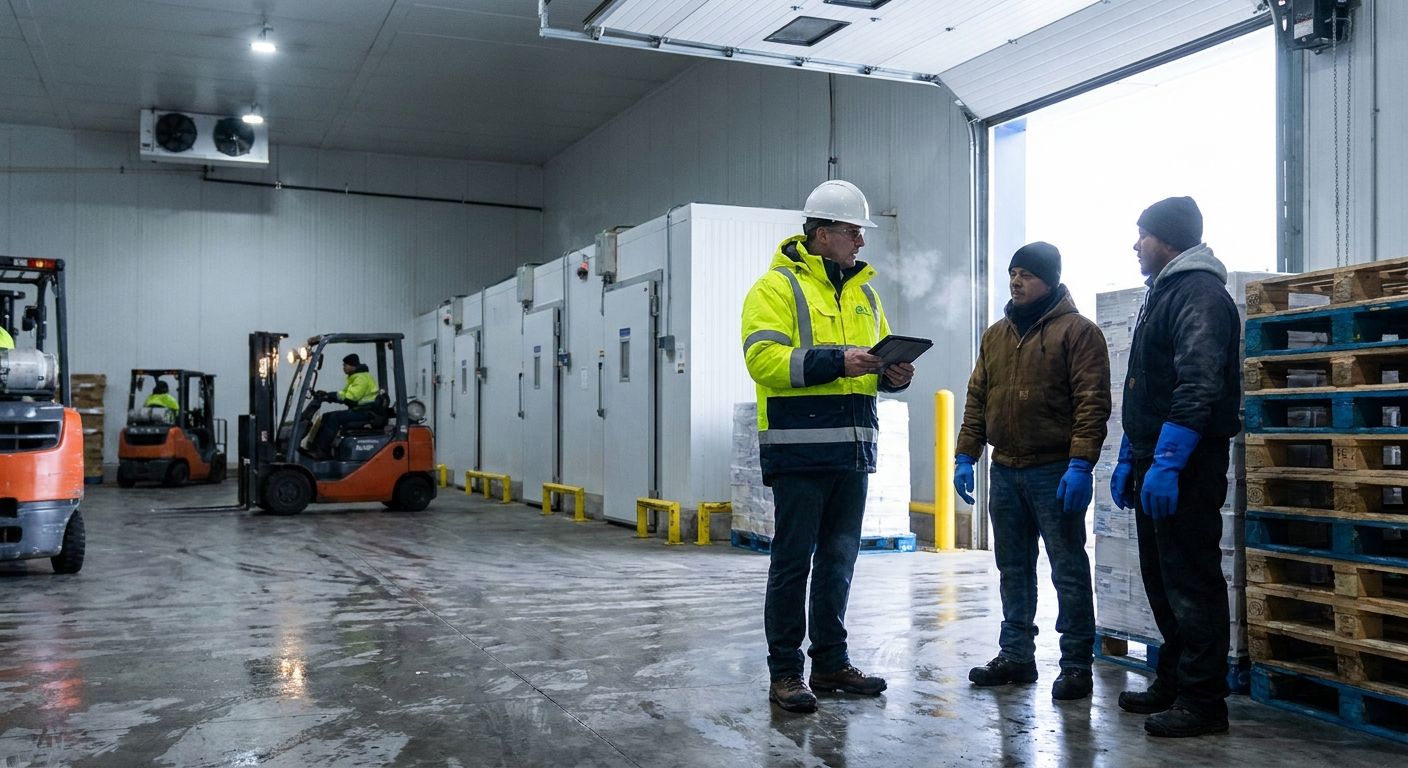
Safety staffing for cold chain logistics operations means placing certified EHS professionals — site safety officers, industrial hygienists, confined space attendants — into refrigerated warehouses, cold storage distribution centers, and reefer trucking terminals, with the goal of cutting incident rates while keeping product moving through freezer, cooler, and dock zones. Cold chain sites carry hazards a general warehouse doesn't: sustained cold stress exposure, ammonia refrigeration systems, and blast freezers that OSHA classifies as confined spaces. A safety hire who's never worked below 0°F is a liability, not a solution.
- Safety staffing for cold chain logistics needs pros certified in confined space entry and ammonia refrigeration, not generic warehouse temps.
- ResponsAble Staffing places site safety officers and industrial hygienists for refrigerated DCs on temporary, contract, and direct-hire terms nationwide.
- OSHA's Process Safety Management standard applies at 10,000 lbs of anhydrous ammonia, and most cold storage refrigeration systems clear that line.
- 24/7 cold chain sites need staggered safety coverage, not one safety manager stretched across three shifts.
- Peak season surges are the top reason cold chain sites run understaffed on safety in 2026 — plan the surge before it hits.
Why safety staffing matters for cold chain logistics
A refrigerated distribution center runs three risk categories a dry warehouse doesn't touch: extreme cold exposure, ammonia or CO2 refrigeration systems, and confined spaces created by blast freezers and mechanical rooms. Layer on 24/7 shift schedules, high seasonal turnover in warehouse labor, and forklift traffic on frost-slick floors, and the safety role stops being a checkbox — it's the thing standing between the site and an OSHA citation or a worse outcome.
Most anhydrous ammonia refrigeration systems used in cold storage carry more than the 10,000-pound quantity that triggers OSHA's Process Safety Management standard (29 CFR 1910.119). That single fact changes who you need on-site: a safety generalist can't run PSM compliance, but a safety professional with process safety or industrial hygiene background can. ResponsAble Staffing vets for that distinction before a resume ever reaches you.
Build the plan for your cold chain site
Map the safety roles the site actually needs
Don't start with a job title. Start with the hazard list, then match roles to it.
- Site safety officer for daily floor coverage and OSHA recordkeeping
- Industrial hygienist if the site runs ammonia, CO2, or glycol refrigeration
- Confined space attendant for blast freezer and mechanical room entries
- Fire watch attendant if the site does hot work near refrigeration piping
- Behavior-based safety coach for high-turnover dock and pick crews
Vet certifications specific to refrigerated environments
A generic OSHA 30 card doesn't cover cold chain risk. Screen for the credentials that map directly to the hazards on-site.
- Confined space entry supervisor or attendant certification
- Ammonia refrigeration safety training (RETA or equivalent)
- Cold stress and hypothermia recognition training
- Powered industrial truck certification specific to cold-storage forklifts
- First aid/CPR current within the last two years
Build a shift coverage plan for 24/7 cold storage operations
Most refrigerated DCs run around the clock, and safety coverage that stops at 5pm leaves the night shift exposed. Night shift safety staffing for 24-7 operations has to be built into the staffing plan from day one, not bolted on after an incident.
- Staggered safety officer shifts covering all three rotations
- On-call escalation path for after-hours ammonia alarms
- Handoff documentation between shift safety leads
- Separate cold stress monitoring protocol for overnight crews
Train for cold stress and confined space hazards before day one
Onboarding a safety hire without cold-specific orientation is how mistakes happen in week one, not month six.
- Site-specific cold stress thresholds and buddy-check intervals
- Blast freezer confined space entry permits and atmospheric testing
- Frost and ice slip-hazard walkthroughs by zone
- Emergency egress routes from sub-zero storage areas
Coordinate with plant safety on ammonia and refrigerant systems
If the site's refrigeration load crosses the PSM threshold, the safety hire needs to work directly with whoever owns process safety management documentation, not around them.
- Process hazard analysis participation and sign-off
- Mechanical integrity inspection scheduling for ammonia piping
- Emergency response plan alignment with local fire departments
- Refrigerant leak detection system audit cadence
Plan for peak season staffing surges
Cold chain volume spikes around produce season and holiday retail, and safety headcount that was right in March is short by June. Sites handling food product should look at how safety staffing for food and beverage manufacturing scales for seasonal production runs — the same surge logic applies to cold storage throughput.
- Temporary safety officer coverage for 60-90 day surge windows
- Pre-vetted candidate bench ready before peak hits
- Contract-to-hire terms for standout temporary placements
- Overtime and fatigue monitoring during extended peak shifts
Track incident and compliance data across every site
A single-site view hides the pattern. Multi-site cold chain operators need incident data rolled up so a slip-and-fall trend in one DC gets caught before it repeats in another.
- OSHA 300 log consistency across all locations
- Near-miss reporting culture, not just recordable tracking
- Quarterly safety audit cadence per facility
- Vendor or staffing agency incident history review before renewal
Comparison: staffing models for cold chain safety roles
| Option | Best for | Key limitation |
|---|---|---|
| Temporary/contract staffing | Peak season surges, project-based cold storage builds | Requires re-onboarding each contract cycle |
| Direct hire recruiting | Permanent safety manager or director roles | Longer time-to-fill than contract placements |
| Contract-to-hire | Testing fit before committing to a permanent safety leader | Adds a conversion step to the hiring process |
| In-house recruiting | Companies with existing EHS recruiting capacity | Slower for specialized certifications like ammonia safety |
Contract-to-hire wins for most cold chain operators — it lets a facility confirm a safety officer handles sub-zero conditions and shift rotation before making a permanent offer.
Staff your cold chain safety team
Temporary, contract, or direct hire — nationwide placement for refrigerated operations.
Common mistakes cold chain operators make
- Treating cold storage like a standard warehouse. Cold stress, confined space blast freezers, and ammonia systems need staffing decisions general warehouse safety hiring doesn't require.
- Skipping ammonia-specific vetting. A safety hire without process safety or industrial hygiene background can't run PSM documentation on a system over 10,000 lbs.
- No staffing plan for peak season. Waiting until produce season or holiday volume hits to start recruiting means the safety gap opens right when incident risk is highest.
- Ignoring night shift coverage. A safety officer who works days only leaves the overnight crew — often the least experienced shift — without direct safety oversight.
- No bilingual coverage in high-turnover roles. Cold storage dock and pick crews often run high Spanish-speaking staff ratios; safety communication gaps here are a documented compliance risk.
FAQ
What's the best staffing model for cold chain safety roles?
Contract-to-hire works best for most cold storage operators in 2026 because it lets the facility confirm a safety officer handles sub-zero conditions before converting to a permanent role. Straight temporary staffing fits peak season surges better than year-round coverage.
Is a general OSHA 30 certification enough for cold chain safety roles?
No, an OSHA 30 card alone doesn't cover confined space entry into blast freezers or ammonia refrigeration hazards. Cold chain sites need additional certifications like confined space attendant training and ammonia safety training.
How much does safety staffing for cold chain logistics cost?
Costs vary by role, certification level, and whether the placement is temporary, contract, or direct hire. Check current bill rates directly with a safety staffing agency for your specific facility needs.
Do cold storage facilities need ammonia-specific safety training?
Facilities with more than 10,000 lbs of anhydrous ammonia fall under OSHA's Process Safety Management standard (29 CFR 1910.119). Safety staff at these sites need process safety or industrial hygiene training beyond general warehouse certification.
Are blast freezers considered confined spaces under OSHA?
Blast freezers and refrigeration mechanical rooms commonly meet OSHA's confined space criteria under 29 CFR 1910.146. Entry requires trained attendants and atmospheric testing protocols.
How do 24/7 cold chain operations staff safety coverage?
Round-the-clock cold storage sites need staggered safety officer shifts across all three rotations, not one safety lead covering days only. Night shift coverage matters most because turnover and experience levels tend to be lowest overnight.
What's the biggest safety staffing mistake at cold storage sites?
Treating cold storage staffing the same as general warehouse staffing is the most common mistake. Cold stress exposure, confined space blast freezers, and ammonia refrigeration systems all require certifications a standard warehouse safety hire won't have.
Can temporary safety staff convert to permanent roles at cold chain sites?
Yes, contract-to-hire arrangements are common in cold chain logistics and let facilities evaluate a safety officer's performance in sub-zero conditions before making a permanent offer.
One last thing
Most cold chain safety failures don't happen on the floor — they happen in the ammonia mechanical room, where a facility assumed its refrigeration system stayed under the OSHA PSM threshold and never actually confirmed the number. Pull the ammonia charge documentation before the next audit, not after.