Airport construction and expansion projects run on FAA clearance windows, TSA badging rules, and a jet bridge schedule that doesn't wait for a staffing gap. Getting airport construction safety staffing right means matching credentialed EHS professionals to badge timelines, night shutdown windows, and multi-year expansion scopes before ground breaks.
- Airport construction safety staffing in 2026 hinges on SIDA badging turnaround, not just OSHA cards.
- Fast-track terminal and runway projects need safety officers who can mobilize inside 48-72 hours after credential clearance.
- Night shift and 24/7 coverage is not optional on active airfields — most tarmac work happens during shutdown windows. Buy that capability up front.
- Direct hire safety managers make sense once an expansion project runs past 12 months — temp staffing alone gets expensive at that length.
Why this matters
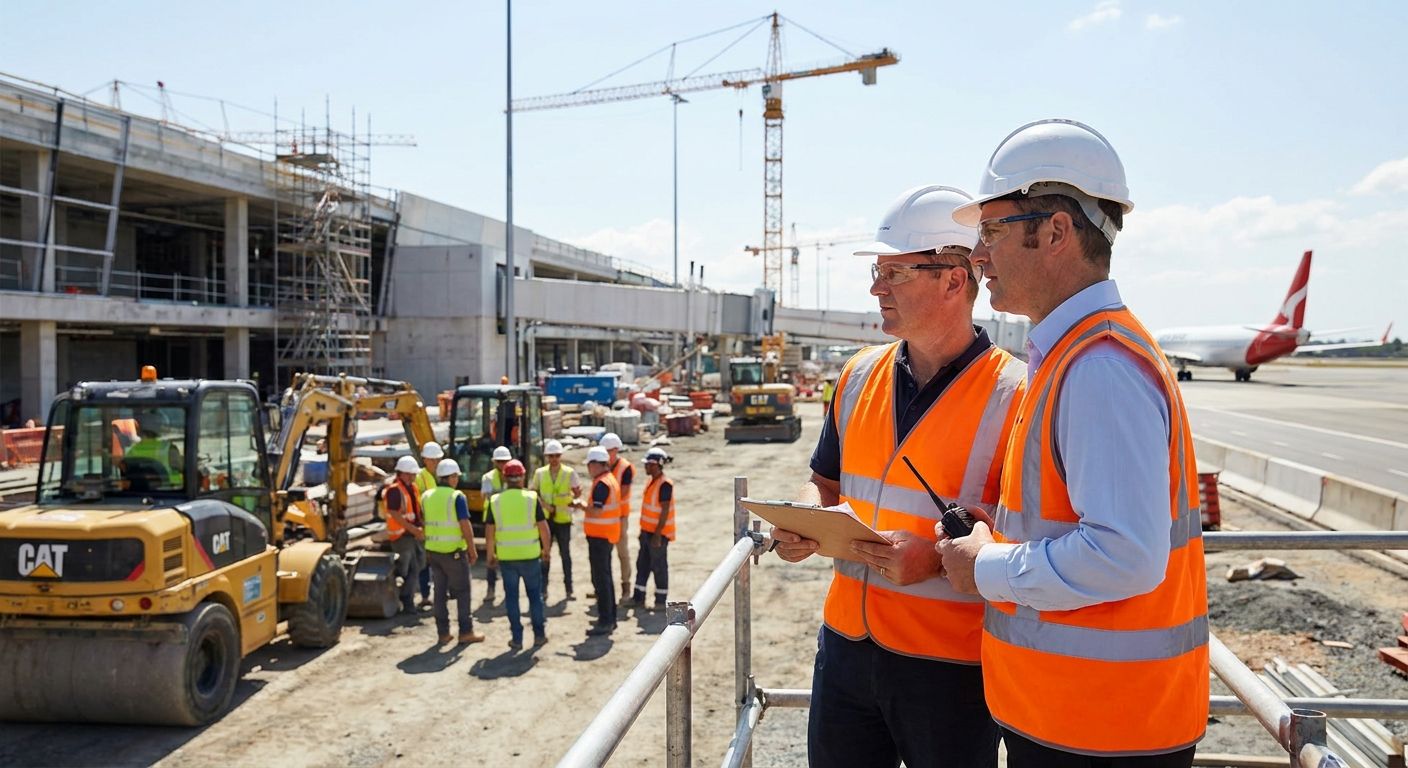
An airport isn't a construction site with a fence around it — it's a federally regulated operating facility that happens to have construction happening inside it. Every safety hire needs a SIDA badge, airfield driving clearance, or an escort, and none of that shows up on a standard OSHA 10-hour card.
Miss that distinction and you get safety staff who pass the interview but can't get past the guard shack for two weeks. On a fast-track terminal expansion or a runway rehab with a hard reopening date, that gap costs the project real money, not just inconvenience.
2026 airport capital programs are running longer and more concurrently than in prior cycles, which means safety staffing plans need to cover overlapping phases — demolition, fuel farm work, jet bridge installation — often on the same footprint at the same time.
Who airport construction safety staffing is for
This guide is built for general contractors, aviation construction managers, and airport authority project leads staffing FAA Part 139-regulated construction, terminal expansions, runway rehabs, or cargo facility builds. If your project touches an active airfield, a fuel farm, or anything inside the AOA (air operations area), the staffing rules below apply directly to you. Firms that also build outside airports will recognize a lot of overlap with general construction safety recruiting — the difference here is badging, escort logistics, and a client (the airport authority) that has final say over who's allowed on the ramp.
What to look for in airport construction safety staffing
FAA and TSA badging experience
A safety professional who's never navigated SIDA (Security Identification Display Area) training or airfield driving certification will slow your mobilization down, not speed it up. Ask any staffing partner how many airport-badged safety hires they've placed in the last 12 months — a vague answer is your signal to keep looking.
Fast mobilization inside phased shutdown windows
Runway and taxiway work happens in tight, FAA-approved shutdown windows, often overnight or over a single weekend. Staffing partners who specialize in fast-track construction safety staffing can get a qualified safety officer credentialed and on-site inside 48-72 hours once badging clears — generalist agencies routinely take a week or more longer.
Confined space and fall protection credentials
Fuel farms, utility tunnels, and jet bridge mechanical rooms are confined spaces by OSHA's definition, and control tower and gate canopy work carries fall protection exposure most commercial builds don't. Your safety hires need documented confined space entry and fall protection training before day one, not a promise to get certified later.
Night shift and around-the-clock depth
Most airfield-adjacent construction — paving, lighting, drainage tie-ins — happens during off-peak or overnight windows when flight operations pause. A staffing bench that can't cover nights leaves half your project uncovered on safety compliance, which is the fastest way to get a stop-work order from the airport authority.
Direct hire bench strength for multi-year timelines
Terminal expansions in 2026 commonly run 3-5 years from groundbreaking to gate opening. Temporary safety staffing works for the first 12-18 months, but past that point, direct hire safety managers who know the project's specific phasing become more cost-effective and more accountable to the airport authority long term.
Staff your airport project right
Get badged, credentialed safety professionals matched to your project phase.
Top staffing approaches for airport projects
The safe pick: temporary site safety officers with airfield badging
OSHA 30-hour certification is table stakes; the differentiator is a safety officer who already understands airside escort rules and can pass SIDA vetting without hand-holding. Expect 5-10 business days for badge clearance once paperwork is submitted. Verdict: Buy — this is your baseline hire for any airport construction scope in 2026.
The wildcard: night shift and 24/7 EMT/first aid coverage
Most project leads plan day-shift safety staffing first and treat nights as an afterthought — that's backwards on an airport project where a large share of ramp-adjacent work happens after hours. Night shift safety staffing built around 24/7 coverage catches the incidents that day-only staffing misses entirely. Verdict: Buy if your project has any overnight shutdown windows — and most airport projects do.
The long game: direct hire safety managers for post-expansion operations
Once a terminal or runway project passes the 12-month mark, a direct hire safety manager embedded with the project team costs less per year than rotating temp staff and builds airport authority relationships that outlast any single contractor. Verdict: Consider for projects scoped past 18 months; Skip for shorter fast-track jobs where the overhead of a direct hire search doesn't pay off in time.
The specialist pick: fire watch and confined space crews for fuel farm and tarmac work
Hot work near fuel infrastructure and confined entry into utility tunnels each carry their own permit requirements — a generalist safety hire covering both roles at once is a compliance gap waiting to surface during an FAA inspection. Dedicated fire watch and confined space attendants, staffed as separate roles, keep permit documentation clean. Verdict: Buy for any project with active fuel farm or tunnel scope; Skip trying to double these roles up with a single generalist.
What to avoid
- Generalist temp agencies with no airfield credential track record. If they can't quote you a realistic SIDA badging timeline off the top of their head, they haven't staffed an airport before.
- Single-source staffing with no backup bench. A badge denial or a no-show two days before a shutdown window shouldn't stall your entire safety coverage plan.
- Agencies that skip hazmat and confined space verification to fill a role faster. A body on-site that isn't actually credentialed for fuel farm or tunnel work is worse than an open req — it's a walk-off-the-job liability the day OSHA or the airport authority shows up.
“If a staffing agency can't tell you how fast SIDA badging clears, they haven't staffed an airport before.”
Verdict comparison
| Staffing approach | Best for | Mobilization | Verdict |
|---|---|---|---|
| Badged site safety officer | Baseline coverage, every project | 5-10 days (badging) | Buy |
| Night shift / 24/7 EMT coverage | Overnight shutdown windows | 48-72 hrs post-badge | Buy |
| Direct hire safety manager | Projects past 12-18 months | 4-8 week search | Consider |
| Fire watch / confined space crew | Fuel farm, tunnel, hot work scopes | 48-72 hrs post-badge | Buy |
Before signing with any agency on this list, run through a quick checklist on how to vet a safety staffing agency before a contract is in place — badging delays and bench depth are the two questions that separate agencies that know airports from ones that are learning on your project's dime.
FAQ
What is airport construction safety staffing?
Airport construction safety staffing places EHS professionals — site safety officers, fire watch, confined space attendants, safety managers — on FAA-regulated construction and expansion projects who also hold or can obtain TSA airfield badging. It differs from general construction staffing because every hire needs security clearance to work airside.
How long does TSA SIDA badging take for temporary safety staff?
SIDA badge clearance typically takes 5 to 10 business days in 2026, depending on the airport authority's vetting backlog. Staffing plans should account for this lead time before mobilization, not after.
Do airport expansion projects need OSHA 30-certified safety officers?
Yes, OSHA 30-hour certification is standard baseline for site safety officers on airport construction, and it's a minimum, not a ceiling. Confined space, fall protection, and hazmat endorsements are typically layered on top depending on project scope.
Can a staffing agency provide direct hire safety managers for airport projects?
Yes, direct hire safety manager placement is common on multi-year airport expansions, usually once a project timeline passes 12 to 18 months. Shorter fast-track projects are typically better served by temporary or project-based safety staffing.
Is night shift safety staffing necessary for airport construction?
Yes, on nearly every active airfield project, because runway, taxiway, and ramp-adjacent work is scheduled during overnight shutdown windows when flight operations pause. Day-only safety coverage leaves a real compliance gap during those hours.
What's the difference between fire watch and confined space attendant staffing on airport sites?
Fire watch staff monitor hot work permits near fuel infrastructure, while confined space attendants oversee entry into utility tunnels, fuel farm vaults, and mechanical rooms. Both roles carry separate permit and documentation requirements and are best staffed as distinct positions.
How fast can a safety staffing agency mobilize for a fast-track airport project?
Once badging clears, a specialized agency can typically get a credentialed safety officer on-site within 48 to 72 hours. The bottleneck is almost always the TSA vetting timeline, not the staffing search itself.
One last thing
The single biggest airport staffing mistake in 2026 isn't finding qualified safety professionals — it's underestimating badging lead time. Projects that build a 10-business-day SIDA buffer into their staffing plan almost never hit a mobilization gap; the ones that don't are the ones calling agencies in a panic the week before a runway shutdown.