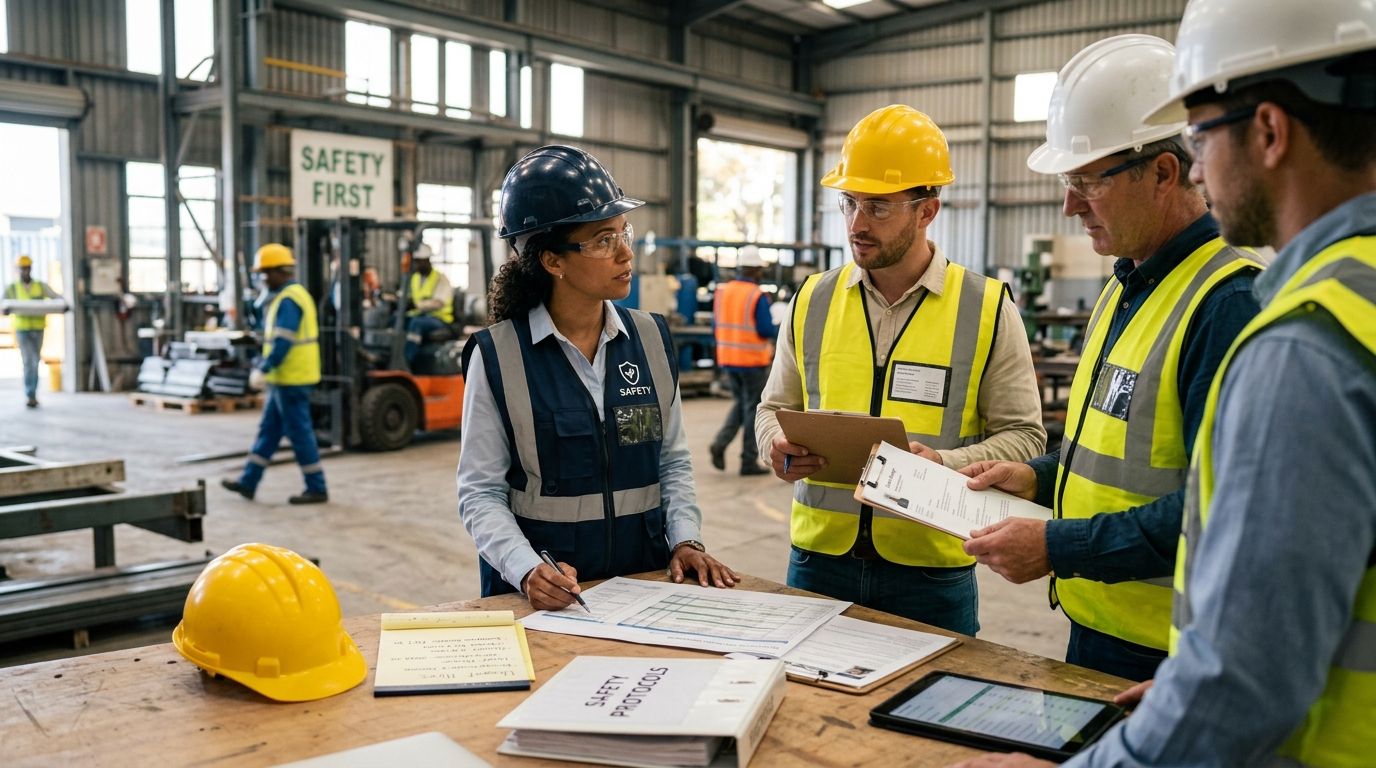
Safety staffing for warehouse and fulfillment centers is the practice of placing certified EHS professionals — safety coordinators, forklift trainers, confined space attendants, ergonomics specialists — into distribution operations on a temporary, project, or direct-hire basis. Warehouses and fulfillment centers run on speed: pick rates, dock schedules, and peak-season volume don't pause for a safety opening. That means the hiring bar is different here than in a slower manufacturing plant — you need someone credentialed and floor-ready inside days, not weeks.
- Safety staffing for warehouse and fulfillment centers works best when temp coverage and permanent hires are sourced through separate pipelines.
- Forklift and powered industrial truck certifications expire on a cycle — verify them before day one, not after an incident.
- Peak-season and holiday surge periods are the single biggest driver of safety staffing gaps in fulfillment operations in 2026.
- ResponsAble Staffing places vetted safety professionals for warehouse operations on temp, project, and direct-hire terms.
- A staffing agency beats an in-house hire when time-to-fill matters more than long-term headcount planning.
Why this matters for warehouse and fulfillment centers
A fulfillment center that adds a second or third shift for a seasonal surge is adding floor traffic, forklift movement, and new hires all at once — the exact combination that raises incident risk. The same is true for 3PL and freight brokerage operations juggling multiple client contracts on one site. Safety coverage has to scale with headcount, not lag behind it.
Most warehouses don't have a bench of pre-vetted, OSHA-certified safety professionals sitting around waiting for a surge. ResponsAble Staffing exists to be that bench — safety coordinators, confined space attendants, and fire watch personnel who can be on-site inside days when a facility opens a new shift or loses a safety hire mid-quarter. That's the difference between safety staffing built for warehouses and a generic temp agency filling a headcount number.
The cost of getting this wrong isn't abstract. A gap in safety coverage during a peak hiring ramp-up means untrained pickers running powered equipment near untrained hires, unlogged near-misses, and OSHA 300 recordkeeping that falls behind. None of that shows up until an inspection or an injury does.
Map the safety roles your warehouse actually needs
Warehouses don't need one generic "safety guy." They need specific, credentialed roles matched to specific hazards on the floor.
- Forklift and powered industrial truck (PIT) trainer — certifies operators under 29 CFR 1910.178
- Confined space attendant — covers mezzanines, tanks, and enclosed storage areas that meet OSHA's confined space definition
- Fire watch attendant — required for hot work in maintenance bays and equipment repair areas
- Ergonomics specialist — addresses repetitive-motion injury risk on high-volume packing and sortation lines
- Safety coordinator — owns OSHA 300 log recordkeeping, incident investigation, and daily floor audits
- EHS manager or director — sets policy across multiple sites for larger 3PL and multi-warehouse operators
Most fulfillment centers need three or four of these roles covered at any given time, not all six permanently. Start by listing which hazards are actually present on your floor before writing a single job posting.
Separate short-term coverage from permanent leadership hires
A temp safety coordinator covering a medical leave is a different hire than a safety director who'll set policy for the next five years. Mixing the two into one job posting slows both searches down.
- List temp and project-based roles separately from direct-hire leadership roles
- Set a clear end date or review point for every temp placement
- Budget direct-hire searches around a 4-8 week timeline, not a same-week fill
- Flag any role that could convert from contract to permanent before the search starts
Source certified candidates through channels that actually reach EHS professionals
General job boards return volume, not certifications. Warehouse safety roles need candidates who already hold the credential, not someone willing to get certified after being hired.
- Post through ASSP (American Society of Safety Professionals) chapter boards and regional EHS networks
- Ask current safety staff for referrals — certified professionals tend to know other certified professionals
- Work with a specialized safety staffing firm that maintains a pre-vetted bench, which is the fastest route when you need certified safety professionals for a fast-track job
- Check state OSHA outreach trainer rosters for confined space and hot work specialists
The manual route works when you have four to six weeks. When a surge hits with two weeks' notice, the agency route is the only one that closes the gap.
Verify certifications before anyone steps onto the floor
A certification that expired last quarter isn't "almost valid" — it's not valid. Warehouses that skip this step inherit the liability the moment an uncertified operator touches a forklift.
- Confirm OSHA 10 or OSHA 30 completion and issue date
- Verify powered industrial truck operator certification and its 3-year refresher cycle
- Check confined space entry and attendant training against the specific space type on your floor
- Confirm current first aid/CPR certification for anyone designated as an emergency responder
- Cross-check any state-specific licensing requirements for the facility's location
Verifying safety certifications before placing a candidate should happen before an offer goes out, not on the candidate's first day.
“A certification that expired last quarter isn't almost valid. It's not valid, and the liability transfers the moment that person touches equipment.”
Onboard fast without cutting corners on compliance training
Speed and compliance aren't opposites — a good onboarding checklist delivers both.
- Site-specific safety orientation before floor access, no exceptions
- Equipment walkthrough matched to the shift and area the hire will actually cover
- Documentation of every certification on file before day one, not after
- A named point of contact for incident reporting during the first two weeks
- A 30-day check-in to confirm the placement is working for both sides
Build coverage for nights, weekends, and peak season
Fulfillment centers running 24/7 operations or adding a holiday-season shift need safety coverage that matches the schedule, not a single day-shift coordinator stretched across three shifts. A facility that doubles headcount for a seasonal peak and doesn't double safety coverage is running exposed during its highest-incident window of the year.
Measure incident trends and rightsize your team
Headcount decisions should follow data, not guesswork.
- Track TRIR (Total Recordable Incident Rate) month over month, not just annually
- Log near-misses separately from recordables — a rising near-miss count predicts the next incident
- Review headcount against shift count, not total employee count
- Reassess safety staffing levels every time the facility adds a shift or a new SKU category
Staff your warehouse safety team faster
Temp, project, and direct-hire safety professionals for warehouse and fulfillment operations.
Comparing your safety staffing options
| Option | Best for | Key limitation |
|---|---|---|
| In-house safety hire | Facilities with stable headcount and budget for a full-time role | Long time-to-fill for certified candidates in a tight labor market |
| Temporary/contract staffing agency | Peak season, leave coverage, new site openings | Onboarding still takes days if certifications aren't pre-vetted |
| Direct-hire recruiting | Permanent safety manager or director roles | Runs 4-8 weeks; not built for short-notice gaps |
| Vendor management system (MSP) | Multi-site 3PL and freight operators managing several vendors | Adds administrative overhead smaller single-site warehouses don't need |
Verdict: for a single-site warehouse with a sudden coverage gap, a specialized safety staffing agency wins on speed. For a multi-site 3PL managing safety across a dozen facilities, an MSP-coordinated approach wins on consistency.
Common mistakes warehouses and fulfillment centers make
- Treating forklift certification as a one-time checkbox instead of tracking the 3-year refresher cycle across every operator
- Skipping confined space training for elevated storage or mezzanine areas that technically meet OSHA's definition
- Understaffing safety coverage during peak hiring surges when floor headcount doubles but the safety team doesn't
- Assuming one safety coordinator can cover multiple shifts in a 24/7 fulfillment center without gaps
- Waiting until after an incident to verify a temp hire's certifications instead of confirming them before placement
FAQ
What is safety staffing for warehouse and fulfillment centers?
It's the practice of placing certified EHS professionals — forklift trainers, confined space attendants, safety coordinators — into warehouse operations on a temporary, project, or direct-hire basis. It exists because fulfillment centers need floor-ready, credentialed coverage fast, especially during shift additions or seasonal surges.
How fast can a warehouse fill a safety coordinator role?
Through a specialized safety staffing agency with a pre-vetted bench, placements can happen inside days. An open job posting through general channels typically takes weeks because most candidates still need certification verification.
Is temp safety staffing better than an in-house hire for warehouses?
Temp staffing wins when the need is short-notice or seasonal, like a holiday peak or a leave coverage gap. An in-house hire makes more sense for a facility with stable, year-round headcount and budget for a permanent role.
What certifications should a warehouse safety hire have?
At minimum, OSHA 10 or OSHA 30 completion, current powered industrial truck operator certification, and first aid/CPR if the role includes emergency response duties. Confined space and fire watch certifications apply depending on the specific hazards on the floor.
How often does forklift certification need to be renewed?
OSHA requires a refresher evaluation at least every 3 years under 29 CFR 1910.178, or sooner after an incident, a near-miss, or a change in equipment. Warehouses running multiple shifts should track this per operator, not per site.
Does ResponsAble Staffing place safety professionals for fulfillment centers?
Yes. ResponsAble Staffing places vetted safety professionals — coordinators, confined space attendants, forklift trainers — for warehouse and fulfillment operations on temporary, project-based, and direct-hire terms nationwide.
How do you staff safety coverage for a 24/7 fulfillment center?
Coverage needs to match the shift schedule, not rely on one coordinator stretched across three shifts. Night and weekend shifts carry higher incident risk and need dedicated, credentialed coverage of their own.
What's the biggest safety staffing risk during peak season?
Headcount doubling without safety coverage doubling. Peak-season hiring surges are the single most common point where warehouses fall behind on OSHA recordkeeping and certification verification.
One last thing
The warehouses that avoid peak-season incidents aren't the ones with the biggest safety budget — they're the ones who staff up before the surge, not during it. Building a safety staffing plan two to three weeks ahead of a known volume spike, whether that's a holiday season or a new client contract, costs less than scrambling for coverage after headcount has already doubled. That's a 2026 planning problem, not a hiring-day problem.