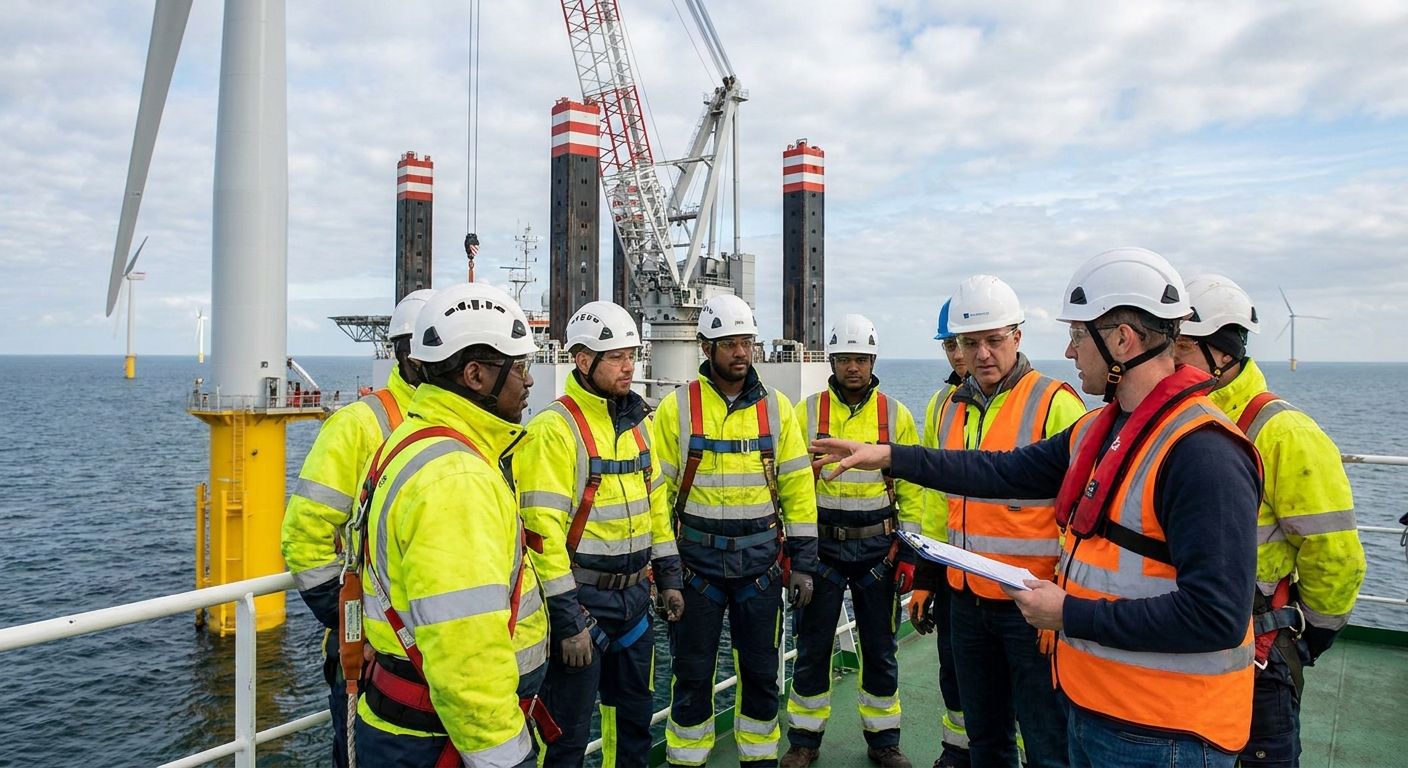
Offshore wind construction sites off the East Coast run on a mix of union riggers, marine crews, and safety professionals who've never worked a single day on solid ground. Getting the safety staffing wrong on one of these projects doesn't just slow the schedule — it stops vessel operations, trips OSHA and BOEM reporting requirements, and puts people 350 feet above open water.
- Offshore wind safety staffing in 2026 requires GWO Basic Safety Training, not just OSHA 30 — verify the credential before the resume.
- TWIC-cleared, STCW-trained marine safety coordinators are the single hardest role to fill fast on East Coast lease sites.
- Confined space attendants for turbine nacelles need rescue certification specific to vertical, not horizontal, confined spaces.
- ResponsAble Staffing places wind, marine, and confined-space safety professionals nationwide for temporary, project, and direct-hire needs.
- Land-based wind techs without marine or height experience above 300 feet are a common but costly mis-hire.
Why this matters
The US has a stated federal target of 30 GW of offshore wind capacity by 2030, and every gigawatt built means more turbines, more vessels, and more safety headcount that construction and marine contractors need on short notice. A generalist safety tech who's handled a highway job or a warehouse buildout doesn't automatically transfer to a lease site where the job includes climbing a turbine tower with a 350-foot hub height and working from a crew transfer vessel in a four-foot swell.
Miss on this hire and you don't get a second attempt mid-installation window — weather windows for offshore lifts are short, and a safety professional who can't pass a TWIC background check or hold a harness at height stalls the whole crew. Offshore wind safety staffing in 2026 is a different discipline than land-based wind or general industrial staffing, and treating it as interchangeable is the most expensive mistake a project director can make.
Who this is for
This guide is for project directors, EHS managers, and site safety leads at offshore wind developers, marine construction contractors, and turbine installation subcontractors staffing lease sites in 2026 — whether you're building out a foundation program, a substation interconnection, or a full turbine erection crew. If you're staffing land-based wind farms only, the requirements below are heavier than what you need; skip to a general renewable energy staffing approach instead. ResponsAble Staffing places these specialized safety roles on temporary, project-based, and direct-hire terms for employers across construction, oil and gas, manufacturing, and marine industrial sites nationwide.
What to look for in offshore wind safety staffing
GWO Basic Safety Training, verified, not assumed
Global Wind Organisation Basic Safety Training runs four modules — working at heights, manual handling, first aid, and fire awareness — and most lease site operators won't badge a technician onto a vessel or turbine without it. A resume that lists "wind experience" without a GWO card is a red flag, not a formality, because the certification body and expiration date are checkable in minutes.
Marine and vessel safety credentials
Anyone boarding a crew transfer vessel or working near port operations needs a TWIC card at minimum, and many contracts require STCW basic safety training on top of it. This is the credential gap that stalls mobilization more than any other on offshore projects — a safety professional without a current TWIC can't get past the dock gate, full stop.
Working at height and fall protection above 300 feet
Turbine towers on current-generation offshore projects run 260 to 350 feet to the hub, well beyond the height range most land-based construction safety staff have handled. Look for candidates with documented tower climbs, not just fall protection classroom certification, because the physical and psychological demands of a multi-hour vertical climb are different from a two-story scaffold inspection.
Confined space and rescue capability specific to nacelles
A turbine nacelle and hub assembly is a vertical confined space with limited egress, and rescue protocols differ from horizontal industrial confined spaces like tanks or vaults. A confined space attendant certified only on land-based industrial sites may not have trained on the specific rescue geometry a turbine requires.
Mobilization speed against weather windows
Offshore installation windows are dictated by sea state and wind speed, sometimes with only days of notice. A safety staffing partner needs bench strength to mobilize a crew in under two weeks, not the four-to-six-week timeline typical of standard industrial hiring.
Documentation and BOEM/OSHA compliance history
Federal offshore leases carry BOEM reporting obligations layered on top of standard OSHA recordkeeping. Safety staff who've worked compliance-heavy environments — refineries, LNG terminals, federal project sites — adapt faster to this paperwork load than a first-time offshore hire.
Roles to prioritize on your crew
Wind and renewable energy safety technicians — the core hire. These are your generalists for foundation, cable-laying, and substation phases, holding OSHA 30 plus GWO BST as baseline. A tech who's worked land-based wind and solar energy construction can transition to offshore with added marine credentials, but confirm the TWIC status before you count on them for port-adjacent work. Buy — this is the role you staff first and staff deepest.
Marine safety coordinators — the hard-to-fill role. STCW-trained, TWIC-cleared personnel who understand vessel operations, crew transfer logistics, and dock safety are the tightest labor pool on any offshore build. Staffing firms with existing marine terminal and shipyard placement networks fill this faster than generalist industrial recruiters. Buy early — this role has the longest lead time of any position on the list.
Confined space attendants and rescue techs — the specialist. Nacelle and hub work demands vertical rescue training that's genuinely different from tank or vault confined space work. Vet candidates through a confined space attendant staffing process that checks rescue certification specifics, not just a generic OSHA 1910.146 card. Buy — undertrained confined space staff on a turbine job is the single riskiest gap on this list.
Riggers and qualified persons for blade and nacelle lifts. Rigging on offshore lifts involves higher load tolerances and wind-speed cutoffs than most onshore crane work, and a qualified person sign-off carries real liability weight. Consider — strong onshore riggers with crane experience can cross-train, but budget time for offshore-specific orientation before they're lift-ready.
OSHA outreach trainers for crew onboarding. New hires cycling onto a lease site fast need condensed OSHA 10/30 and site-specific orientation, and a trainer who can run that in days instead of weeks keeps mobilization on schedule. Consider — useful during surge staffing, not a year-round headcount need for most contractors.
“If a technician's climbed a cell tower but never a turbine tower over open water, that's a liability, not a hire.”
What to avoid
- Land-based wind techs with no marine credentials. Their fall protection training transfers; their TWIC status and vessel experience don't, and that gap surfaces at the dock gate, not on the resume.
- OSHA 10-only safety generalists. OSHA 10 covers general awareness, not the height, confined space, and marine-specific hazards an offshore lease site actually presents in 2026.
- Staffing firms without a confined space rescue vetting process. A candidate who lists "confined space certified" without specifying vertical vs. horizontal training is an unverified claim, not a qualification.
Staff your offshore wind crew faster
Talk to a recruiter about GWO-certified, TWIC-cleared safety professionals available now.
Verdict comparison
| Role | GWO BST | TWIC/STCW | Height Cert (300ft+) | Mobilization | Verdict |
|---|---|---|---|---|---|
| Wind/renewable safety tech | Required | Preferred | Required | 1-2 weeks | Buy |
| Marine safety coordinator | Required | Required | Situational | 2-4 weeks | Buy early |
| Confined space attendant | Required | Situational | Required | 1-2 weeks | Buy |
| Rigger/qualified person | Required | Situational | Required | 2-3 weeks | Consider |
| OSHA outreach trainer | Preferred | Not required | Not required | Under 1 week | Consider |
FAQ
What certifications does offshore wind safety staffing require in 2026?
Offshore wind safety staffing in 2026 typically requires GWO Basic Safety Training, a current TWIC card, and OSHA 30 at minimum. Marine-facing roles add STCW basic safety training, and confined space attendants need vertical rescue certification specific to turbine nacelles.
How is offshore wind safety staffing different from land-based wind staffing?
Offshore wind safety staffing adds marine and vessel safety requirements — TWIC clearance, STCW training, and crew transfer vessel experience — that land-based wind roles don't need. Turbine heights on offshore projects also run up to 350 feet, higher than most onshore installations.
How fast can a safety staffing agency mobilize crews for offshore wind projects?
Wind and renewable safety technicians typically mobilize in one to two weeks when a staffing partner has an active bench. Marine safety coordinators take longer, often two to four weeks, because TWIC-cleared and STCW-trained candidates are the scarcest credential combination in the labor pool.
Do offshore wind safety staff need a TWIC card?
Yes, anyone boarding a crew transfer vessel or entering port-controlled areas needs a current TWIC card. Without it, a candidate can't clear the dock gate regardless of their other safety credentials.
Is GWO Basic Safety Training the same as OSHA 30?
No, GWO Basic Safety Training and OSHA 30 cover different content and aren't interchangeable. GWO BST covers four wind-specific modules — height, manual handling, first aid, and fire awareness — while OSHA 30 is a broader general industry or construction safety course.
What's the biggest staffing gap on offshore wind projects?
Marine safety coordinators with both STCW training and TWIC clearance are the hardest role to fill on offshore wind projects. The overlap between marine safety experience and construction site safety experience is a small labor pool nationally.
Can confined space attendants from other industries work offshore wind sites?
Only if their rescue certification covers vertical confined spaces, since turbine nacelles differ from the horizontal tanks and vaults most industrial confined space attendants train on. Vet the specific rescue protocol before placing them, not just the general OSHA 1910.146 credential.
One last thing
The candidates who transition best into offshore wind safety roles in 2026 aren't always the ones with the longest wind resumes — they're the ones who've already worked marine terminals or refinery turnarounds, because they're used to compliance documentation and weather-driven schedules before they ever climb a turbine tower.