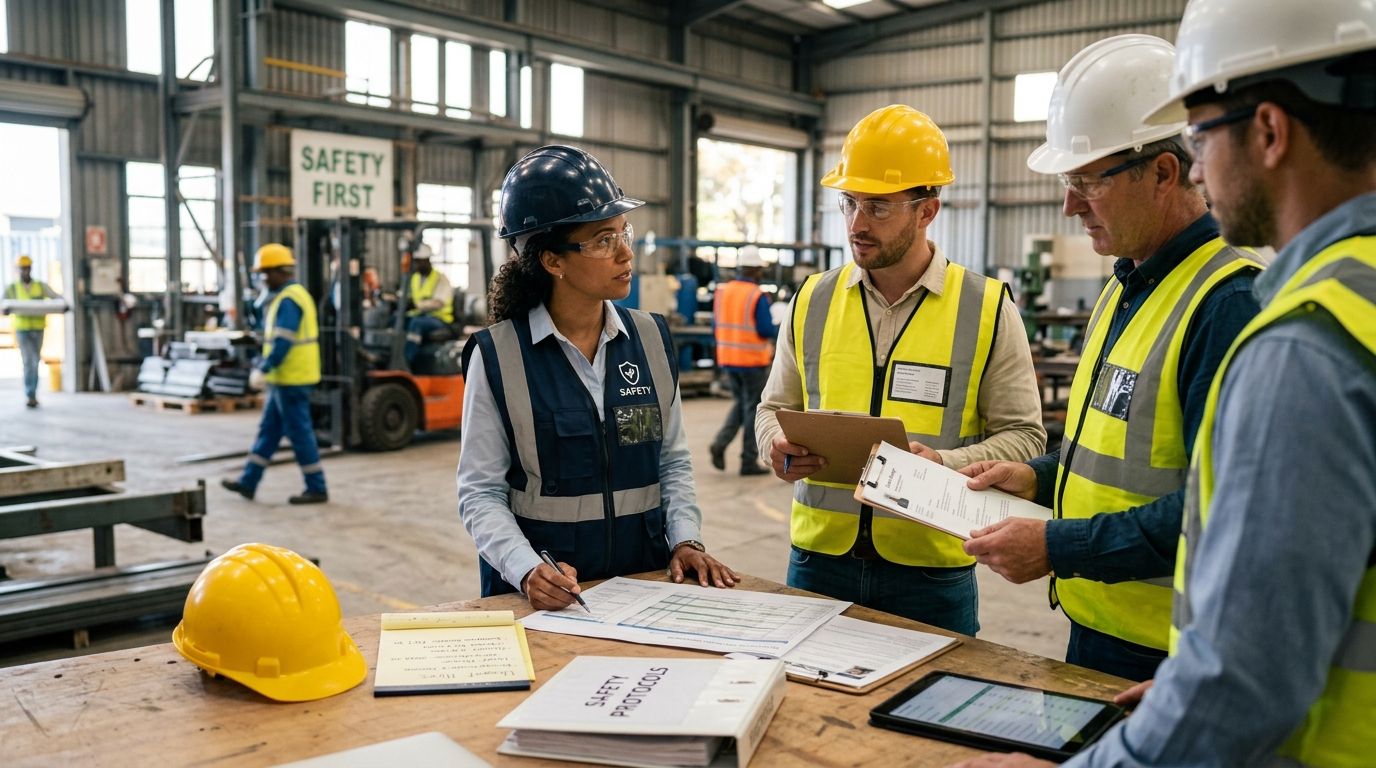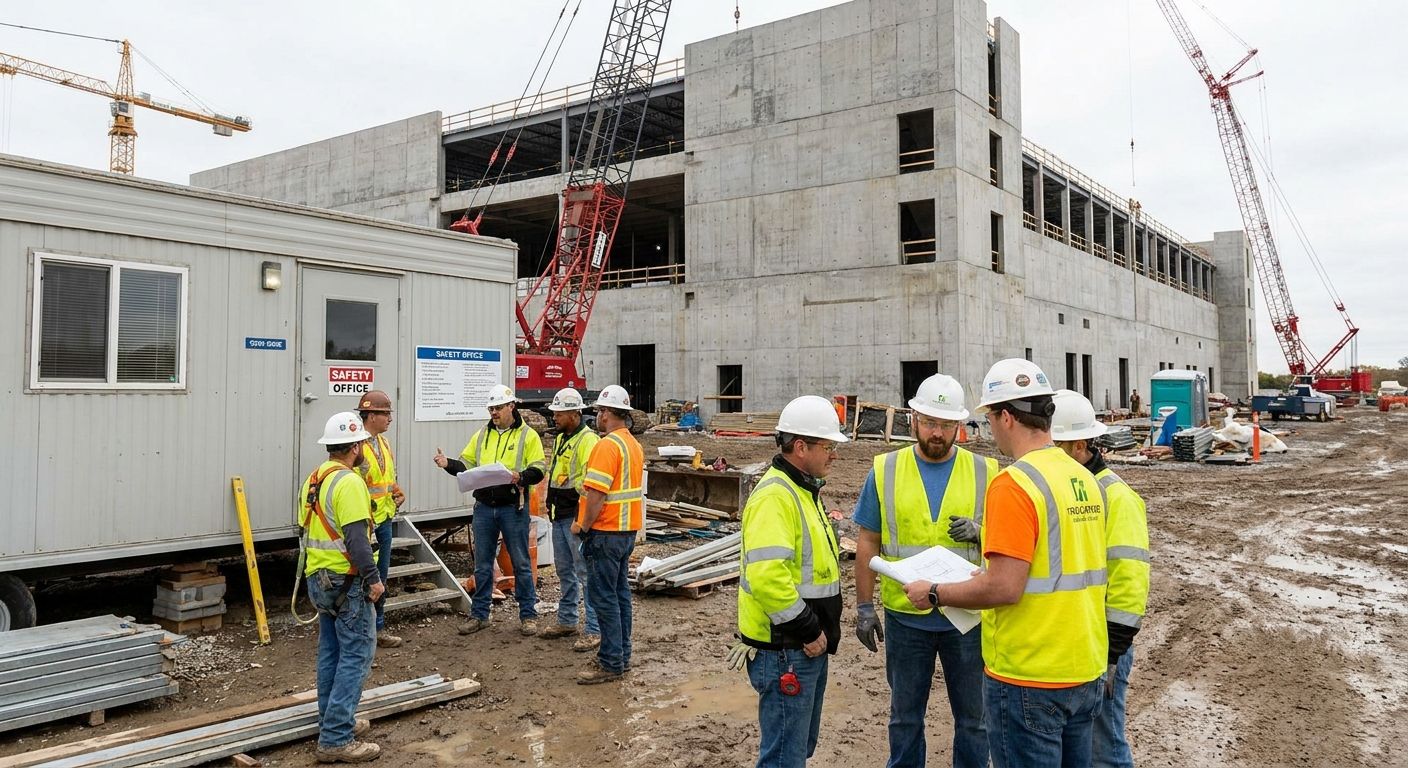
Data center construction safety staffing places credentialed EHS professionals on hyperscale and colocation builds, where medium-voltage electrical rooms, round-the-clock crews, and back-to-back trade handoffs make a single missed lockout/tagout step a multi-day shutdown risk. This segment moves faster and carries more electrical exposure than a typical commercial build, so the staffing plan has to account for arc-flash-rated supervision, fire watch during hot work on hyperscale racks, and safety coverage that doesn't stop when the general contractor's day shift clocks out.
Safety staffing for data center construction isn't the same problem as staffing a warehouse shell or a retail build-out. ResponsAble Staffing places safety professionals who already understand NFPA 70E arc-flash protocol, confined space entry in generator yards, and the fall protection rules that apply above 6 feet on catwalks and roof-mounted cooling units.
- Safety staffing for data center construction requires electrical-savvy EHS pros, not general laborers with a 10-hour OSHA card.
- ResponsAble Staffing places temporary, project-based, and direct-hire safety professionals for hyperscale and colocation builds nationwide.
- Fire watch coverage and confined space monitoring both need dedicated headcount separate from the site safety manager.
- Compressed hyperscale schedules mean 2026 projects need safety staff onboarded in days, not weeks.
Why safety staffing matters for data center construction
Data center builds run on compressed schedules because hyperscale developers and colocation operators are racing to bring capacity online. That pace means multiple trades working the same floor simultaneously: electrical, mechanical, low-voltage cabling, and fire suppression crews often overlap on the same shift.
Medium-voltage switchgear (often 480V to 13.8kV) sits inside these buildings well before the space is fully enclosed, which raises arc-flash exposure earlier in the schedule than on a typical commercial project. OSHA 1926 fall protection rules apply the moment work moves above 6 feet, and that threshold gets crossed constantly around rooftop cooling units, cable trays, and catwalks.
A generic safety hire who hasn't worked electrical-heavy sites will miss the specific hazards this project type creates. That's the gap safety staffing for data center construction has to close.
Calculate your headcount before mobilization
Data center general contractors and their subs need a safety-to-worker ratio that accounts for shift overlap, not just total headcount on the badge list. Underestimating this number is the single most common reason a project runs short-staffed on safety coverage during the electrical rough-in phase.
- Map peak trade overlap by floor and by shift, not just total project headcount
- Separate fire watch and confined space attendant roles from the general site safety manager count
- Build in coverage for planned outages, PTO, and no-shows before the schedule locks
- Revisit the ratio at every major schedule milestone, not just at project kickoff
A structured way to do this math is laid out in how to calculate headcount for a site safety team, which walks through the ratio logic before you're mid-mobilization and guessing.
Vet certifications for the hazards this project type creates
A safety professional with a general OSHA 30 card isn't automatically qualified to supervise arc-flash-rated work or confined space entry in a generator yard. Data center builds need EHS staff who can show specific, current credentials.
- NFPA 70E arc-flash training current within the certifying body's renewal window
- Confined space entry supervisor certification for generator and battery room work
- Fall protection competent person designation for rooftop and catwalk zones
- Documented experience on at least one prior electrical-heavy commercial build
Build a fire watch plan before hot work starts
Hot work on data center sites (welding conduit, cutting cable tray, torch work near battery rooms) triggers fire watch requirements the moment a permit is issued. Skipping dedicated fire watch coverage and assigning it to whoever's free is how minor incidents become OSHA citations.
- Assign fire watch as a standalone role, never a shared duty with another safety task
- Confirm fire watch staff know the specific extinguisher and alarm locations for that floor
- Keep fire watch coverage running 30 minutes past the last hot work permit closes
- Rotate fire watch staff on long shifts so attention doesn't degrade past hour six
Stage onboarding so it doesn't slow the schedule
Hyperscale timelines don't wait for a two-week background check and orientation cycle. Safety staff need to be badge-ready, drug-screened, and site-oriented inside days, not weeks, or the schedule absorbs the delay.
- Pre-screen candidates against site-specific background and drug policy before an offer goes out
- Run site orientation and PPE fit checks the same day as badge issuance where possible
- Keep a bench of vetted, ready-to-deploy safety professionals for last-minute schedule pulls
- Confirm certifications transfer cleanly across state lines if the project spans multiple sites
Projects with tight go-live dates should look at fast-track construction safety staffing as the model for compressing that onboarding window without cutting corners on vetting.
Coordinate safety supervision across overlapping trades
When electrical, mechanical, and low-voltage crews share a floor, safety supervision has to be structured so no trade assumes another crew's safety officer has them covered. That assumption is where near-misses turn into incidents.
- Assign a single point of accountability per floor or zone, not per trade
- Hold a daily cross-trade safety huddle before shift start, not just a toolbox talk per crew
- Flag any zone where two trades are working within arm's reach of live electrical work
- Document handoffs when a floor transitions from one trade's primary work to another's
Plan for surge staffing during equipment install phases
Equipment install and commissioning phases bring a spike in contractor headcount that outpaces the base safety staffing plan. Data center projects see this surge most sharply when server hall fit-out overlaps with electrical energization testing.
- Forecast the surge window from the master schedule, not from a headcount request that arrives too late
- Pre-clear a short list of surge-ready safety professionals before the surge date, not during it
- Track which surge staff can convert to longer-term coverage if the schedule slips
- Keep surge staffing separate budget-wise from base project safety staffing
Comparing staffing models for data center construction
| Option | Best For | Key Limitation |
|---|---|---|
| Direct hire safety manager | Long-duration single-site builds with a stable schedule | Slow to fill; doesn't flex for surge or multi-site work |
| Temporary/contract safety staffing | Compressed schedules, fire watch, surge coverage | Requires a partner with fast, verified vetting |
| In-house safety team build-out | Owners running a multi-year data center program | High fixed cost; slow to scale up or down |
| MSP/VMS-managed staffing program | Developers running multiple simultaneous sites | Needs a program structure in place before it works well |
Verdict: temporary and project-based safety staffing wins for most data center construction timelines because the schedule moves faster than a direct-hire process can keep up with, and ResponsAble Staffing builds that bench specifically for electrical-heavy, fast-moving builds.
Staff your data center build with vetted EHS pros
Temporary, project-based, or direct-hire safety staffing placed nationwide.
Common mistakes on data center construction projects
- Treating fire watch as a generic laborer duty. Hot work near battery rooms and cable trays needs a dedicated, trained fire watch, not whoever's standing nearby.
- Underestimating arc-flash exposure timing. Medium-voltage switchgear goes live before the building is fully enclosed, and safety staffing plans that assume otherwise miss the risk window.
- Ignoring multi-state licensing gaps. Traveling crews and certifications don't always transfer cleanly across state lines, and this trips up projects spanning more than one site.
- Waiting until the surge hits to staff for it. Equipment install and commissioning phases need surge safety coverage forecast weeks ahead, not requested the week it starts.
- Skipping the vetting step under schedule pressure. A fast-track timeline is not a reason to skip certification verification; it's a reason to work with a staffing partner that can verify quickly.
FAQ
What certifications matter most for data center construction safety staffing?
NFPA 70E arc-flash training, confined space entry supervisor certification, and OSHA fall protection competent person designation matter most for data center builds in 2026. General OSHA 10 or 30 cards alone don't cover the electrical-specific hazards these projects create.
Is temporary safety staffing better than direct hire for data center builds?
Temporary and project-based safety staffing generally fits data center construction better because project timelines move faster than a direct-hire process. Direct hire makes more sense for owners running a stable, multi-year single-site program.
How fast can safety staff get onboarded for a fast-track data center project?
With pre-screened candidates and same-day badge and orientation processes, safety staff can be site-ready inside days rather than the two-to-three weeks a standard hiring cycle takes. The bottleneck is usually background check and certification verification, not availability.
Do data center projects need dedicated fire watch staff?
Yes, any hot work permit on a data center site triggers a fire watch requirement, and it should be a standalone role rather than shared with another safety duty. Fire watch coverage needs to continue at least 30 minutes past the permit closing.
How many safety staff does a data center construction project need?
Headcount depends on peak trade overlap by floor and shift, not total project headcount alone. Fire watch and confined space attendant roles should be counted separately from the general site safety manager.
What makes data center construction different from other commercial safety staffing?
Data center builds bring medium-voltage electrical work into the schedule earlier and run multiple trades on the same floor simultaneously, raising arc-flash and coordination risk beyond a typical commercial build. The compressed hyperscale timeline also demands faster onboarding than standard hiring cycles allow.
One last thing
The projects that run into OSHA trouble on data center builds almost never fail on paperwork; they fail on the gap between when electrical systems go live and when arc-flash-qualified supervision is actually on site. Lock that timing down before the switchgear arrives, not after the first near-miss report.