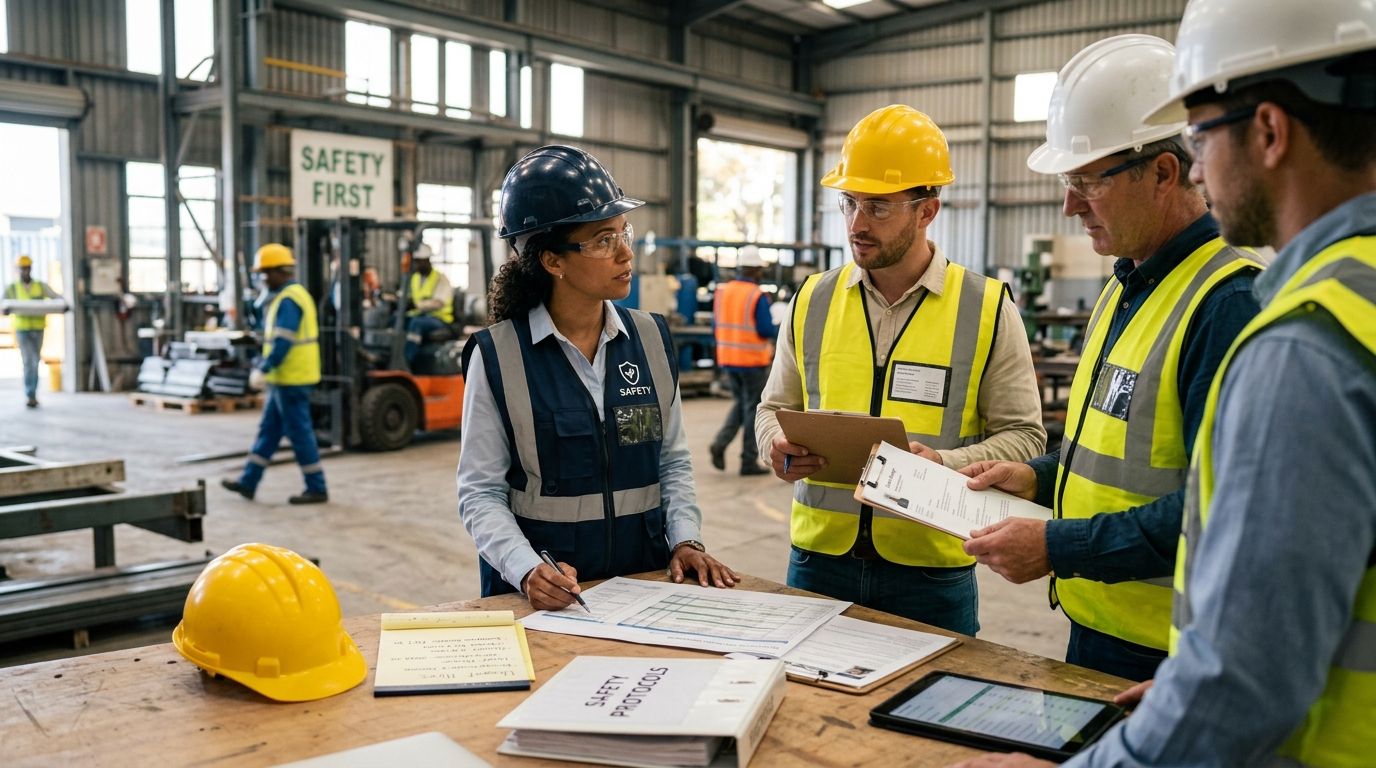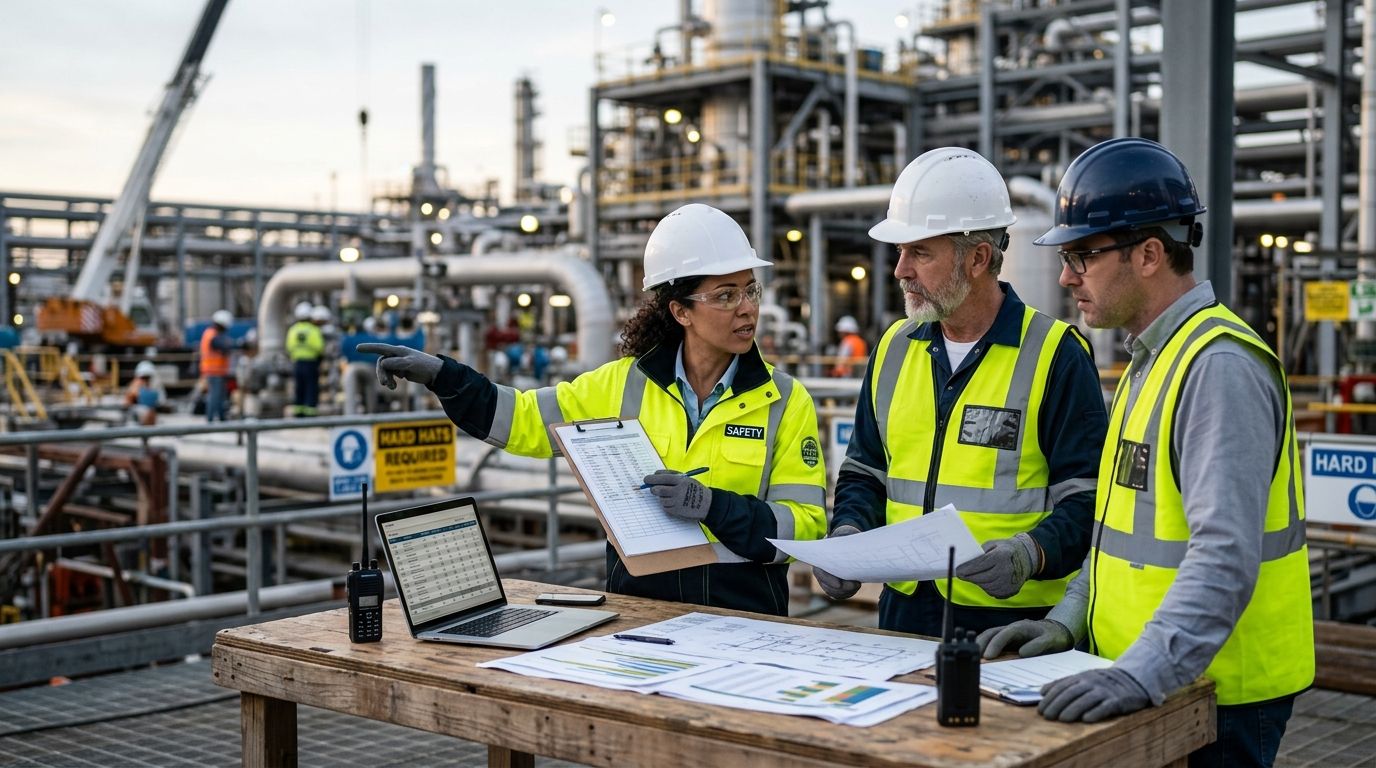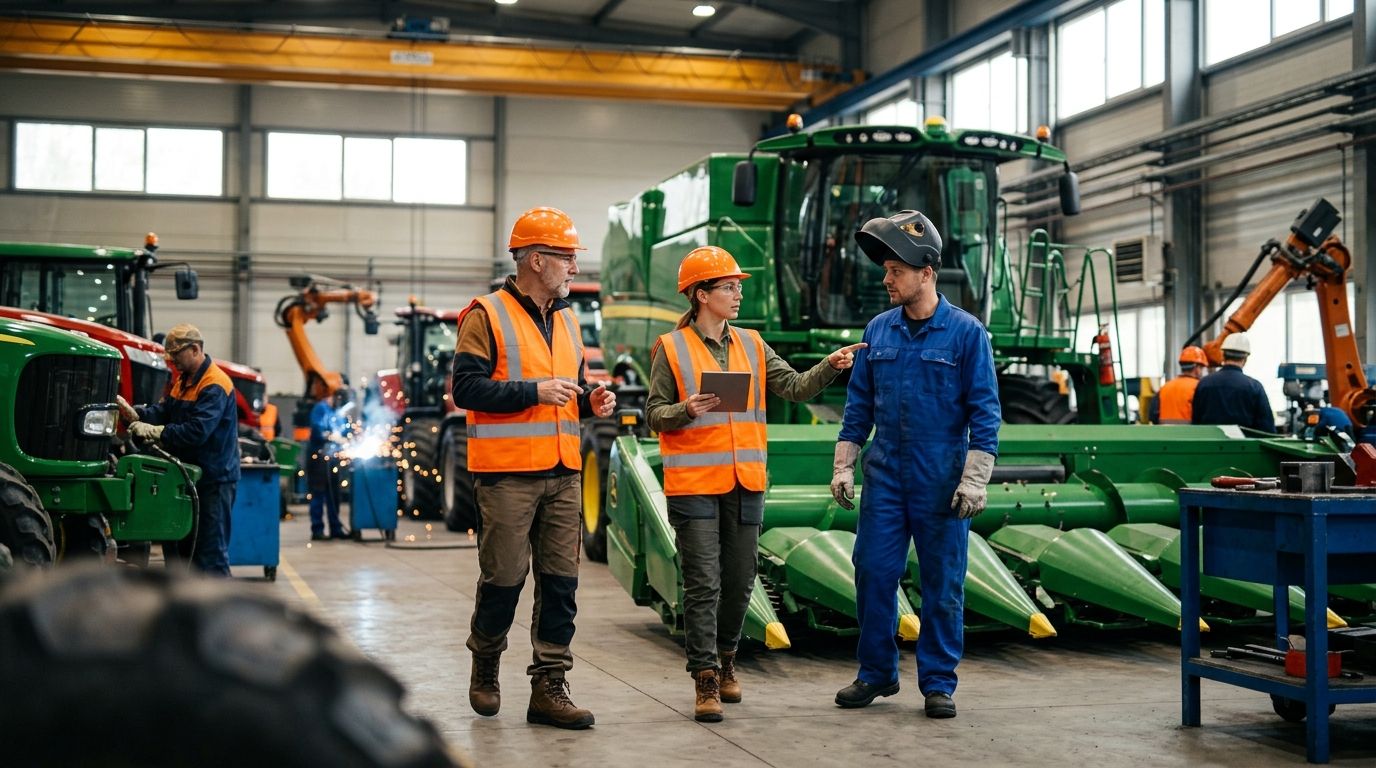
Safety staffing for agricultural equipment manufacturing plants is the practice of placing vetted safety technicians, EHS coordinators, and safety managers directly into welding bays, paint lines, and hydraulic assembly floors with the goal of cutting recordable injuries during the planting- and harvest-season production surges that define this industry. Ag equipment plants don't run on a steady factory calendar — output can triple ahead of spring planting and again before fall harvest, and safety headcount has to scale with it or the floor gets dangerous fast. A generalist industrial temp who has never stood next to a plasma cutter or a hydraulic press brake is a liability on day one, not an asset.
- Safety staffing for agricultural equipment manufacturing plants must flex with planting- and harvest-season output, not run flat year-round.
- ResponsAble Staffing places certified welding, fabrication, and paint-line safety technicians on temporary, project, and direct-hire terms nationwide.
- Machine guarding and lockout/tagout are among OSHA's most frequently cited standards on ag equipment production floors.
- A staffing plan built for a 40-person year-round crew fails when August headcount jumps 30% or more for harvest.
Why safety staffing matters for agricultural equipment manufacturing
Ag equipment plants combine some of the highest-hazard processes in manufacturing under one roof: MIG and TIG welding, plasma cutting, robotic welding cells, hydraulic press brakes, powder-coat booths, and heavy-frame assembly lines. Machine guarding violations under 29 CFR 1910.212 and lockout/tagout violations under 1910.147 rank among OSHA's most frequently cited standards in manufacturing every single year, and ag equipment fabrication floors carry both hazards at once.
The seasonal piece makes it harder. Farmers order tillage equipment, planters, sprayers, and combines on a calendar the plant doesn't control — dealers place bulk orders 8 to 12 weeks before planting and again before harvest, and production lines add second and third shifts to hit ship dates. Safety coverage that was fine for a 40-person year-round crew gets stretched thin the moment that crew jumps to 100 or more for a two-month push. ResponsAble Staffing places safety professionals on temporary, project-based, and direct-hire terms specifically to cover that kind of swing without asking a plant to carry full-time headcount it doesn't need in the off-season.
Map your safety headcount to the production calendar
Most ag equipment plants already know their surge dates — the mistake is not translating that into a safety staffing timeline until the surge has already started. Build the plan backward from your ship dates, not forward from your current headcount.
- Pull last year's shift-addition dates and line them up against this year's order calendar
- Flag the point 6-8 weeks out where safety coverage needs to double, not the week production actually ramps
- Identify which certifications expire mid-surge and renew them before the push, not during it
- Use a documented process to calculate headcount for a site safety team rather than guessing at a ratio
- Build in a two-week overlap between outgoing seasonal staff and incoming safety leads so nothing drops during handoff
Audit machine guarding and lockout/tagout on every line
Before adding a single body to the floor, know where your current gaps sit. A safety hire walking into an unaudited plant is patching problems reactively instead of preventing them.
- Walk every press brake, shear, and plasma table and confirm point-of-operation guarding is intact and unmodified
- Verify lockout/tagout procedures exist for every energy source on robotic welding cells, not just the obvious electrical disconnect
- Check that forklift traffic patterns near assembly staging areas are marked and enforced
- Confirm confined space entry procedures cover fuel tank and hydraulic reservoir welding on finished equipment
- Document gaps in writing before the surge, so incoming staff walk in with a punch list instead of a blank slate
Staff for welding and fabrication-specific hazards
Ag equipment frames, hitches, and implement arms are heavy-gauge steel fabrication work — the hazard profile looks a lot like a foundry floor, not a light-assembly line. The safety hazard set here overlaps closely with what plants handling steel mills and metal fabrication deal with daily: fume exposure, hot work, and heavy material handling in the same footprint.
- Require current welding fume exposure monitoring records before placing anyone on a robotic weld cell
- Confirm hot work permits and fire watch coverage are staffed for every torch-cutting station, not just the main weld bay
- Verify PPE fit-testing for respirators used during stainless or galvanized steel welding
- Check that powder-coat booth staff carry combustible dust and flammable atmosphere training, not just general PPE briefings
- Staff a dedicated safety presence for any pressure-testing of hydraulic components before shipment
Build a surge staffing plan for harvest and planting season
This is the piece most plants get wrong: they treat seasonal safety coverage like an afterthought bolted onto production hiring instead of its own plan. A dedicated approach to seasonal safety staffing for manufacturing surge periods treats the ramp-up and wind-down as two separate staffing events, each with its own start date, headcount target, and offboarding checklist.
- Set a firm start date for added safety coverage that precedes the production ramp by at least one week
- Stagger the wind-down of seasonal safety staff instead of cutting them all on the same day production output drops
- Keep one experienced safety lead on-site through the full surge to maintain continuity as contract staff rotate
- Track incident rates separately for surge weeks versus baseline weeks to catch drift early
Vet certifications before the candidate hits the floor
A credential that isn't verified is a liability waiting to happen. Ag equipment plants can't afford to discover mid-shift that a welding cert doesn't cover the process actually being run.
- Confirm OSHA 30 certification is current, not expired mid-contract
- Verify forklift certification matches the equipment class actually in use on the floor
- Check that confined space entry training covers permit-required spaces specific to fuel tank and hydraulic assembly work
- Cross-check welding certifications against the specific process — MIG cert on thin-gauge sheet metal doesn't guarantee competency on thicker structural frame welds
- Request documentation, not a verbal confirmation, before the first shift starts
Decide in-house, contract, or project-based coverage
The right structure depends on how steady your production calendar actually is versus how much it swings.
“If your safety headcount only flexes during harvest season, you don't need another full-time hire — you need a bench you can call.”
Comparison: staffing options for agricultural equipment plants
| Option | Best for | Key limitation |
|---|---|---|
| In-house safety hire | Single-plant operations with steady year-round output | Slow to scale for an 8-to-12-week surge |
| Temporary/contract safety staffing (ResponsAble Staffing) | Plants with planting- and harvest-season production spikes | Depends on the vetting partner verifying certs fast |
| Generalist industrial staffing agency | Filling forklift or general assembly labor | Rarely carries pre-vetted EHS or safety-tech candidates |
| EHS consultant on retainer | Program audits and OSHA VPP prep work | Not built for daily floor coverage shift-by-shift |
| Cross-training current employees | Small plants stretching an existing safety lead | Pulls a skilled worker off their real job during the surge |
Verdict: for plants whose headcount swings with the planting or harvest calendar, contract safety staffing through a specialized agency beats a generalist temp firm or a stretched-thin in-house team — it's the only option built for the swing itself.
Get safety coverage before your next surge
Talk through your planting- or harvest-season staffing plan.
Common mistakes ag equipment plants make
- Waiting until the surge starts to post safety roles — certification verification takes days, not hours, and a late start means the first two weeks of the ramp-up run under-covered.
- Treating powder-coat booth staffing like warehouse staffing — flammable coating operations need combustible dust training specific to the booth, not a general PPE briefing.
- Assuming a welding cert transfers cleanly across processes — a MIG cert earned on thin-gauge sheet metal doesn't guarantee competency on structural frame welds for a planter arm.
- Cutting safety headcount back to baseline the moment production drops — incident rates often spike during wind-down as fatigued crews rush to clear backlog, not just during ramp-up.
- Running one safety manager across two or three plants during peak season — a manager stretched across sites can't catch floor-level drift in real time.
FAQ
What's the best safety staffing option for agricultural equipment manufacturing plants?
Contract safety staffing through a specialized agency like ResponsAble Staffing works best for plants whose headcount swings with planting or harvest season, because it scales up and down without carrying full-time cost year-round. Plants with flat, steady output year-round often do better with an in-house hire instead.
How fast can a safety staffing agency place a certified technician during harvest season?
Speed depends on how far ahead the plant plans the surge — starting the request 6 to 8 weeks before the production ramp gives an agency time to verify certifications properly instead of rushing placements. Waiting until the surge has already started is the most common cause of coverage gaps.
Is contract safety staffing better than hiring a full-time safety manager for a seasonal plant?
For plants with a defined planting- or harvest-season spike, contract staffing avoids paying for safety headcount the plant doesn't need for eight or nine months of the year. A full-time hire makes more sense when production stays steady across the calendar.
What certifications should a safety technician have for welding and fabrication lines?
Current OSHA 30, hot work and fire watch training, confined space entry certification, and a welding fume exposure monitoring record are the baseline for ag equipment fabrication floors in 2026. The specific welding process matters too — a certification should match the actual gauge and material being welded, not just a general welding credential.
How does ResponsAble Staffing vet safety professionals before placement?
ResponsAble Staffing verifies certifications and process-specific experience before placing candidates on temporary, project, or direct-hire terms in high-risk industries including manufacturing. That vetting step is what separates specialized safety staffing from a generalist industrial temp agency.
Does seasonal safety staffing cost more than a full-time hire?
Cost comparisons depend on contract terms and should be confirmed directly with a staffing partner rather than estimated in general. The tradeoff to weigh is paying for flexible coverage during an 8-to-12-week surge versus carrying a salaried headcount through the slow months.
What OSHA standards apply most to agricultural equipment manufacturing plants?
Machine guarding under 29 CFR 1910.212 and lockout/tagout under 1910.147 are the two standards cited most often on fabrication and assembly floors, alongside welding fume exposure rules under 1910.252. Powder-coat operations add combustible dust and flammable atmosphere requirements on top of those.
Can a safety staffing agency cover multiple plants at once?
Yes — agencies working nationwide can staff multiple plant locations simultaneously, which matters for manufacturers running harvest-season surges across more than one facility at the same time. Coordinating that across time zones and state requirements is a separate planning step from staffing a single site.
One last thing
The plants that get hurt worst during harvest surge usually aren't the ones without a safety program — they're the ones whose safety program was built for a 40-person year-round crew and never redesigned for a 120-person August crew. If your headcount jumps 30% or more for planting or harvest season, build the safety staffing plan the same way you build the production plan: as two separate systems, not one stretched thin across twelve months.