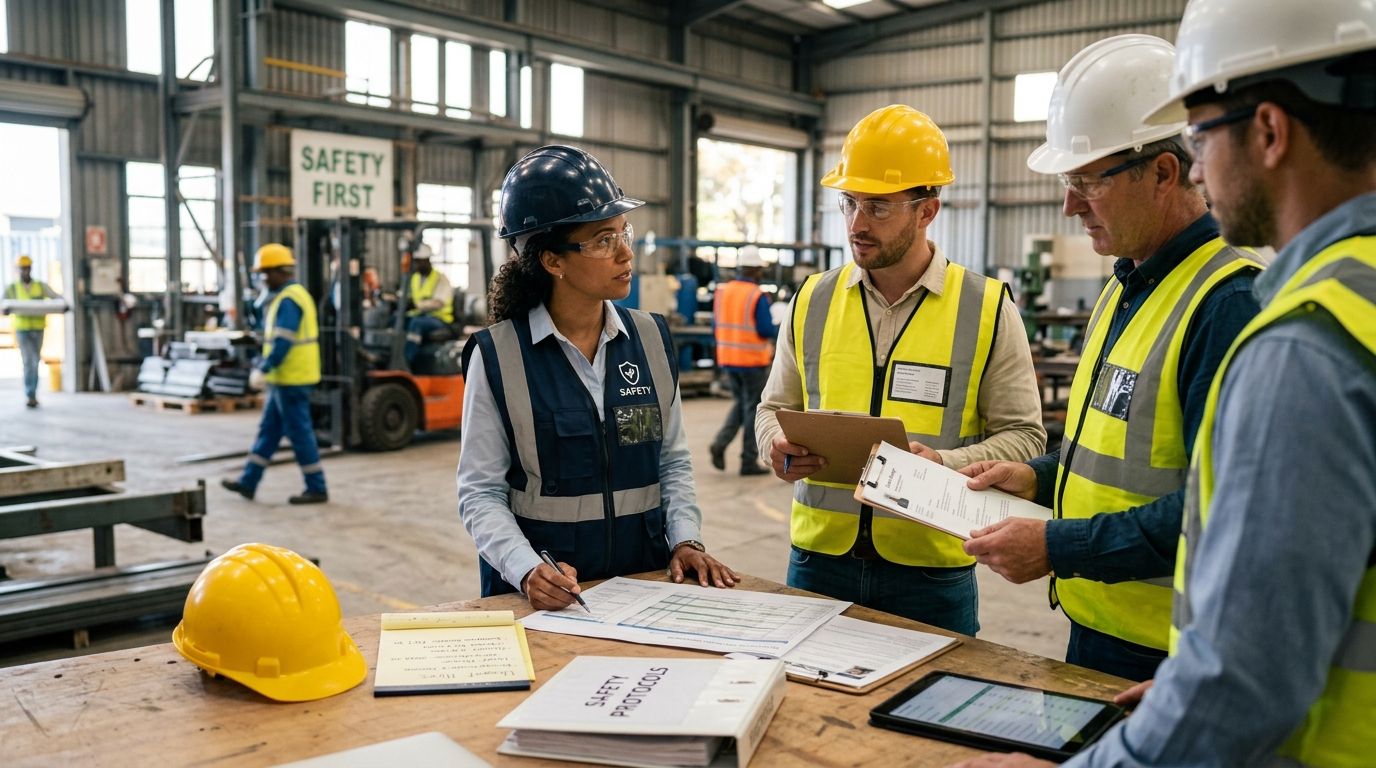
Third-party safety audits carry weight only when the person conducting them has no stake in the outcome — and no gap in credentials the auditee can exploit. Here's how to build that team in 2026, whether you need one auditor for a single site visit or a rotating bench for a multi-facility program.
- Third party safety audit staffing works best through a specialized EHS agency, not a general labor vendor — Buy this model for 2026.
- Contract-to-hire arrangements let you test an auditor's fit before committing to a direct-hire safety role.
- OSHA 30-hour and CSP/CIH credentials are the baseline filter for any third-party auditor you bring on site.
- ResponsAble Staffing places vetted safety auditors, HSE advisors, and PHA facilitators nationwide for construction, oil and gas, and manufacturing employers.
Why this matters
A safety audit only holds up in front of OSHA, an insurance carrier, or a corporate compliance office if the auditor is independent of the site's day-to-day chain of command. That's the entire point of "third party" — the person reviewing your confined space program or your lockout/tagout procedures can't have written the procedure they're now grading.
The mistake most employers make in 2026 is treating safety auditors and inspectors as interchangeable with any EHS generalist. They aren't. An auditor needs documentation literacy, regulatory fluency across whichever standard applies (OSHA general industry, OSHA construction, API, or a client-specific management system), and enough field time to spot the gap between what the binder says and what's happening on the floor.
Get that hire wrong and you've spent budget on a rubber stamp instead of a real finding.
How this list was ranked
Each staffing model below is ranked on three factors: independence (can this professional credibly sign off without a conflict), speed to deploy (how fast the role fills relative to a full-time hire search), and fit for high-risk industries where a missed finding has real consequences. The ranking reflects staffing patterns typical to construction, oil and gas, manufacturing, and other regulated industrial environments — not office-based compliance work.
Every model on this list is a real staffing arrangement ResponsAble Staffing places into active programs today, not a hypothetical.
The ranked list
1. Third-Party Safety Auditors and Inspectors — the audit specialist
This is the direct answer to third party safety audit staffing: a dedicated auditor engaged specifically to review a site, program, or management system with no reporting line to site leadership. Engagements typically run from a single-day walkthrough to a multi-week compliance review depending on facility size and scope.
The strongest candidates carry an OSHA 30-hour credential at minimum, often paired with a CSP (Certified Safety Professional) or a background in a specific regulatory framework. Verdict: Buy. This is the correct staffing model for any employer that needs a defensible, arms-length audit in safety staffing for safety auditors and inspectors.
2. HSE Advisors and Consultants — the pre-audit prep partner
Before the third-party auditor walks in, an HSE advisor closes the obvious gaps — missing training logs, expired permits, outdated JSAs. Think of this as the dress rehearsal that keeps the real audit from surfacing findings you already knew about.
An advisor engaged 30 to 60 days ahead of a scheduled audit routinely catches the documentation issues that account for the majority of minor citations. Verdict: Buy for any employer with a scheduled audit date already on the calendar. Safety staffing for HSE advisors and consultants covers this exact staffing need.
3. Process Hazard Analysis Facilitators — the specialist for PSM sites
If your facility falls under OSHA's Process Safety Management standard (29 CFR 1910.119), a third-party audit almost always includes a PHA review. A generalist auditor without PHA facilitation experience will miss half of what a PSM-covered site actually needs reviewed.
This is a narrow specialty — facilitators need both HAZOP or What-If methodology experience and enough chemical process background to ask the right questions. Verdict: Buy for chemical, petrochemical, and refinery sites specifically; Skip for facilities outside PSM coverage, where the specialty is overkill. Safety staffing for process hazard analysis facilitators fills this role directly.
4. Industrial Hygienists — the exposure and monitoring expert
When an audit needs air monitoring data, noise dosimetry, or exposure assessments to back up its findings, a Certified Industrial Hygienist (CIH) is the credential that makes the numbers defensible. This role is usually staffed as a direct hire when a site has ongoing exposure monitoring needs beyond a single audit cycle.
Verdict: Consider — direct hire makes sense for sites with recurring IH needs; contract engagement works fine for a single audit-driven assessment.
5. Loss Control Consultants — the insurance-side reviewer
Carriers and brokers sometimes require their own loss control review alongside an internal safety audit, particularly for workers' comp experience modification concerns. This professional speaks the language of both safety compliance and underwriting risk.
Verdict: Consider when an insurance renewal or experience mod review is driving the audit timeline; otherwise this role is a lower priority than a dedicated auditor.
6. OSHA VPP Program Support Specialists — the certification-track hire
Facilities pursuing OSHA's Voluntary Protection Program need a specialist who understands the VPP application and self-assessment process specifically, which is distinct from a standard compliance audit. This is a longer commitment, not a one-time engagement.
Verdict: Hold unless VPP certification is an active 2026 goal — otherwise this specialty adds cost without matching the current need.
7. Contract-to-Hire Safety Staffing — the flexible model, not a role
Rather than a job title, this is a staffing structure: bring an auditor or advisor on as a contractor first, then convert to a permanent hire if the fit and the ongoing need justify it. It's the lowest-risk way to test a safety professional against your site's actual culture before a full-time offer.
Verdict: Buy for employers unsure whether the audit need is a one-time project or an ongoing role.
Need an auditor placed fast?
ResponsAble Staffing vets and deploys safety auditors nationwide.
Comparison table
| Staffing Model | Independence | Typical Engagement | Verdict |
|---|---|---|---|
| Third-Party Safety Auditor | High | Single audit cycle | Buy |
| HSE Advisor / Consultant | Moderate | 30-60 days pre-audit | Buy |
| PHA Facilitator | High (PSM sites) | Per-review | Buy for PSM sites |
| Industrial Hygienist (CIH) | Moderate | Ongoing or per-assessment | Consider |
| Loss Control Consultant | Moderate | Insurance-driven | Consider |
| VPP Program Specialist | High | Multi-month | Hold |
| Contract-to-Hire Structure | Depends on role | Trial then convert | Buy |
Where to source these professionals
- Go specialized, not generalist. A general staffing firm placing warehouse labor is not the vendor for a third-party safety audit — the credential vetting is different work entirely.
- Confirm the credential before the contract, not after the site visit. Ask for the OSHA 30-hour card, CSP, CIH, or CHST number up front; a real agency verifies these before submitting a candidate.
- Match the engagement length to the actual need. A single-audit engagement should never be staffed as a full-time direct hire, and an ongoing compliance role should never be staffed month-to-month indefinitely — it costs more and creates turnover risk on your program.
FAQ
What is third-party safety audit staffing?
Third-party safety audit staffing is the process of engaging an independent, credentialed safety professional — with no reporting line to site management — to review a facility's compliance program. In 2026, this typically means placing an OSHA 30-hour or CSP-credentialed auditor for a defined audit cycle rather than a permanent role.
How much does third-party safety audit staffing cost in 2026?
Cost depends on the auditor's specialty, the length of the engagement, and whether the arrangement is contract or contract-to-hire. Employers should request a scoped quote based on facility size and audit type rather than relying on a flat rate.
Is contract-to-hire better than direct hire for safety auditors?
Contract-to-hire is the lower-risk option when the audit need is uncertain or one-time, letting you evaluate fit before committing to a permanent safety role. Direct hire makes more sense when the site has an ongoing, recurring compliance program that needs a dedicated professional.
What certifications should a third-party safety auditor hold?
At minimum, look for an OSHA 30-hour General Industry or Construction card. For higher-stakes sites, a Certified Safety Professional (CSP) or Certified Industrial Hygienist (CIH) credential adds the depth needed for defensible findings.
Do third-party auditors need OSHA VPP experience?
Only if your facility is actively pursuing OSHA's Voluntary Protection Program certification. A standard compliance audit does not require VPP-specific experience, though it helps if VPP is a future goal.
Can safety staffing agencies provide bilingual auditors for multi-site programs?
Yes, agencies with a broad national bench can source bilingual safety professionals for sites with Spanish-speaking crews or multilingual documentation needs. Confirm this requirement with the agency before the search starts.
What's the difference between an EHS auditor and a safety inspector?
An EHS auditor reviews the full management system — policies, training records, documentation — against a regulatory or corporate standard. A safety inspector typically focuses on physical site conditions and immediate hazard identification during a walkthrough.
How fast can a third-party safety auditor be placed?
Placement speed depends on the specialty and credential requirements, with contract-based auditor roles generally filling faster than permanent direct-hire safety positions. A specialized agency with an active bench moves faster than a general staffing vendor building a search from scratch.
One last thing
The OSHA recordkeeping rule at 29 CFR 1904.33 requires employers to retain OSHA 300 logs for 5 years — and a third-party auditor worth hiring will ask for all five years of records on day one, not just the current year. If your prospective auditor doesn't ask for that history, that's the tell you're looking at a walkthrough, not an audit.