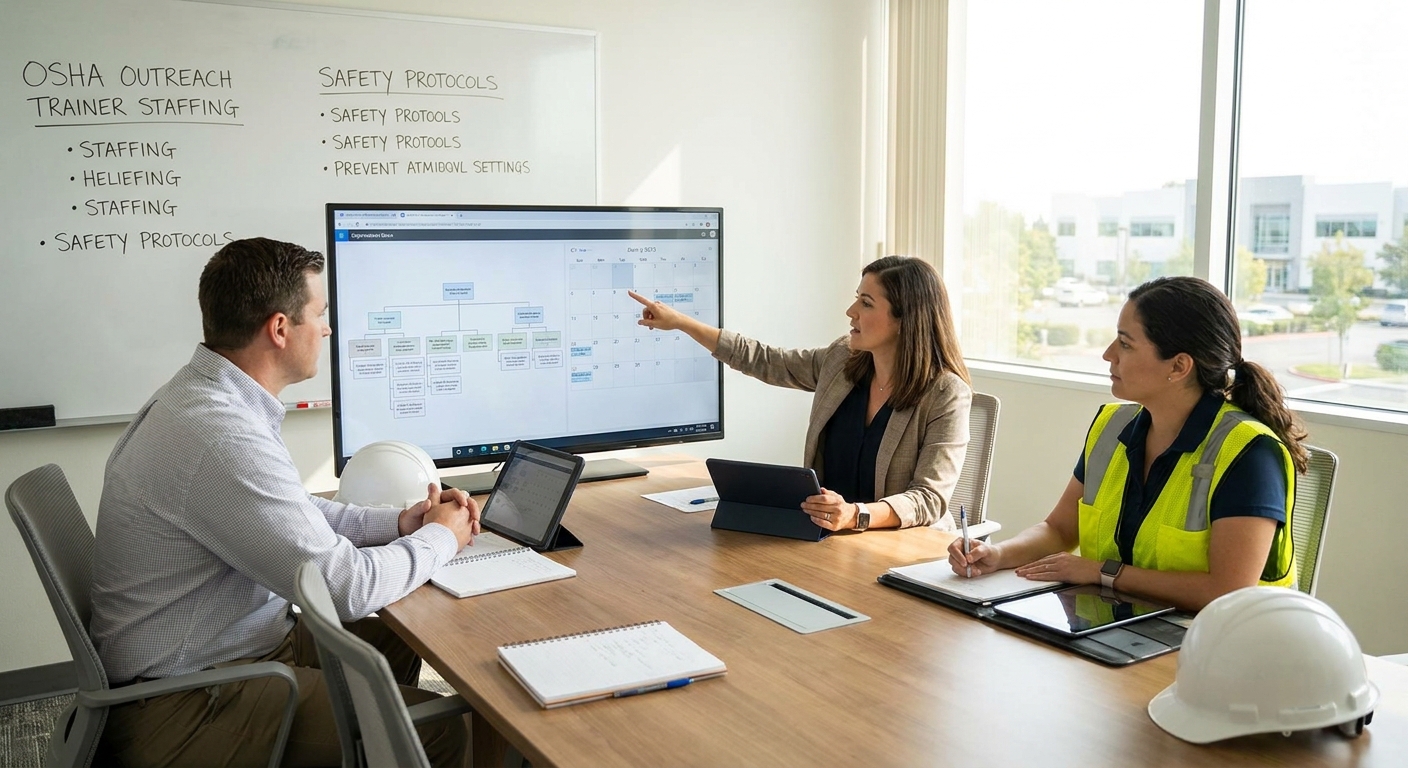
Finding a qualified OSHA outreach trainer on short notice is one of the harder staffing problems in construction, oil and gas, and manufacturing — the person needs an active DOL authorization, real field credibility, and the ability to start before your next mobilization date slips.
- OSHA outreach trainer staffing works best on direct hire for permanent training programs and temporary contracts for one-off mobilizations.
- OSHA 10-Hour and 30-Hour Outreach trainer cards stay valid for five years — verify the expiration date before you sign anyone.
- ResponsAble Staffing places authorized outreach trainers on direct hire, temp, and project-based terms across construction and industrial sites.
- Skip a trainer whose authorization lapsed or who has never delivered outreach cards to a crew larger than 20 workers.
- Time to fill for a qualified outreach trainer typically runs faster through a specialized agency than a general job board in 2026.
Why this matters
An OSHA outreach trainer isn't a generalist EHS hire. The person has to hold current DOL authorization under the OSHA Outreach Training Program, know how to structure a 10-hour or 30-hour course for your specific industry track, and document attendance correctly so your cards actually hold up in an audit.
Get this wrong and you're looking at invalid cards, a delayed start date, or a trainer who can teach construction but not general industry — three separate problems that all cost you schedule time in 2026.
Who this is for
This guide is for site safety managers, EHS directors, and project executives who need to staff an OSHA outreach trainer for a new hire onboarding wave, a plant startup, or a standing training program and don't have the bandwidth to vet DOL authorization paperwork themselves. ResponsAble Staffing works this exact problem daily across construction, oil and gas, and manufacturing sites nationwide.
If you're hiring one trainer to run quarterly refreshers, your criteria look different than a company staffing three trainers for a 400-person plant startup. Both scenarios are covered below.
What to look for in OSHA outreach trainer staffing
Current DOL authorization
Every legitimate OSHA outreach trainer holds an authorization card issued through the OSHA Outreach Training Program, and that card is only good for five years. A trainer working off an expired authorization can still run a class, but the 10-hour or 30-hour cards they issue afterward won't hold up if OSHA or your client audits your files.
Ask for the authorization number and expiration date before the contract starts, not after the first class.
Industry-specific course track
Outreach trainers are authorized for construction, general industry, maritime, or disaster site work — and the tracks aren't interchangeable. A construction-authorized trainer can't legally issue general industry cards, so matching the trainer's track to your actual site type matters more than years of experience.
Class size and delivery format
A trainer who has only run 10-person refreshers may struggle to structure a 30-person plant startup class inside a compressed 30-hour window. Ask how many people they've trained per session and whether they've run compressed multi-day schedules before.
Job description clarity before you post the role
Vague job descriptions pull in unqualified applicants and waste weeks of screening time. A job description that attracts candidates spells out the required authorization track, course volume, site type, and start date up front — that alone filters out trainers who don't match your program.
Contract structure — direct hire vs. temporary
A one-time plant startup needs a project-based or temporary trainer. A standing training program with quarterly refreshers is usually cheaper and more consistent as a direct hire. Decide this before you start interviewing, because it changes who you're even looking at.
Bilingual delivery capability
Crews with a significant Spanish-speaking population need a trainer who can deliver the full 10-hour or 30-hour curriculum bilingually, not just translate a handout. This is a specific, screenable skill — ask for a sample bilingual session before you commit.
Staffing options to consider
Direct hire OSHA outreach trainer — the standing-program pick. Best when you're running quarterly refreshers or onboarding waves at a fixed site. One number that matters: an authorized outreach trainer's card is good for five years, so a direct hire locks in continuity through at least one full re-authorization cycle if timed right. Direct hire safety director and trainer recruiting handles the sourcing and vetting. Verdict: Buy if you have a recurring training need past six months.
Temporary or project-based trainer — the fast-mobilization pick. Best for a single plant startup, a fast-track construction job, or a short surge in new hires needing 10-hour cards before badge day. These contracts typically run weeks to a few months rather than a full year. Verdict: Buy for one-time mobilizations, Skip it for a program you'll need running past 2026 into next year — direct hire is cheaper over that horizon.
Contract-to-hire trainer — the trial-run pick. Good when you're not sure yet whether the training volume justifies a permanent headcount. You get a defined trial period to confirm the trainer's class quality before converting. Verdict: Consider if your training volume is trending up but not yet proven.
In-house EHS coordinator cross-trained as outreach trainer — the budget-stretch pick. Some companies try to have an existing safety coordinator get authorized and run outreach classes on the side. It works at small sites with light training volume; it falls apart once you're running more than one class a month, because the coordinator's day job gets neglected. Verdict: Consider only under 20 employees, Skip above that.
Need an OSHA outreach trainer fast?
Talk to ResponsAble Staffing about direct hire, temp, or project-based trainer placement.
What to avoid
- A trainer with an expired authorization card. The classes look identical from the outside, but the cards issued afterward won't survive an audit.
- A general industry trainer staffed onto a construction site. The authorization tracks aren't interchangeable, and this mismatch is one of the most common mistakes companies make when they skip a specialized agency and hire off a general job board.
- An agency that can't explain its own vetting process. Before you sign with any staffing partner, ask exactly how they confirm authorization status and course history — how to vet a safety staffing agency walks through the questions that separate a real EHS recruiter from a general staffing shop that happens to have a safety category.
Verdict comparison
| Option | Best for | Typical commitment | Verdict |
|---|---|---|---|
| Direct hire trainer | Standing training program | Ongoing, 5-year authorization cycle | Buy |
| Temporary/project trainer | Single mobilization or startup | Weeks to a few months | Buy |
| Contract-to-hire trainer | Uncertain training volume | Defined trial period | Consider |
| In-house coordinator, cross-trained | Small site, light volume | Ongoing, informal | Consider under 20 employees |
FAQ
What is OSHA outreach trainer staffing?
OSHA outreach trainer staffing means sourcing and placing a DOL-authorized instructor who delivers 10-hour and 30-hour Outreach Training Program courses to your workforce. Employers use it for direct hire, temporary, or project-based needs depending on training volume.
How much does it cost to hire an OSHA outreach trainer?
Cost varies by contract type, region, and whether you need direct hire or temporary coverage. Ask any staffing partner for a scoped quote based on your specific site and course volume before comparing options.
Is a direct hire OSHA trainer better than a temporary one?
Direct hire is better for standing, recurring training programs, while temporary staffing fits one-time mobilizations or plant startups. The right answer depends on whether your training need runs past six months.
How long does it take to fill an OSHA outreach trainer role in 2026?
Time to fill depends on the authorization track and location, but working with a specialized safety staffing agency generally moves faster than a general job board search in 2026 because the candidate pool is already vetted for authorization status.
What certifications should an OSHA outreach trainer hold?
An outreach trainer needs an active authorization card under the OSHA Outreach Training Program, valid for five years, matched to your site's track: construction, general industry, maritime, or disaster site work.
Can OSHA outreach trainers work bilingual crews?
Yes, but bilingual delivery of the full 10-hour or 30-hour curriculum is a specific skill you should screen for directly, not assume from a resume. Ask for a sample bilingual session before signing a contract.
Do OSHA outreach trainer cards expire?
The trainer's own DOL authorization expires after five years, and the 10-hour or 30-hour cards they issue to workers don't expire but won't be considered valid if issued under a lapsed trainer authorization. Always confirm the trainer's authorization date before the class starts.
What industries need dedicated OSHA outreach trainers?
Construction, oil and gas, manufacturing, and other high-risk industries all rely on outreach trainers for new hire onboarding and recurring refreshers. Any site running regular safety inductions benefits from a trainer matched to its specific authorization track.
One last thing
The detail most companies miss: the five-year authorization clock on an outreach trainer doesn't reset when you hire them — it started when they were originally authorized, which means a trainer who looks perfect on paper in 2026 might need re-authorization eighteen months into your contract. Ask for the original authorization date, not just confirmation that the card is "current," before you sign anything.