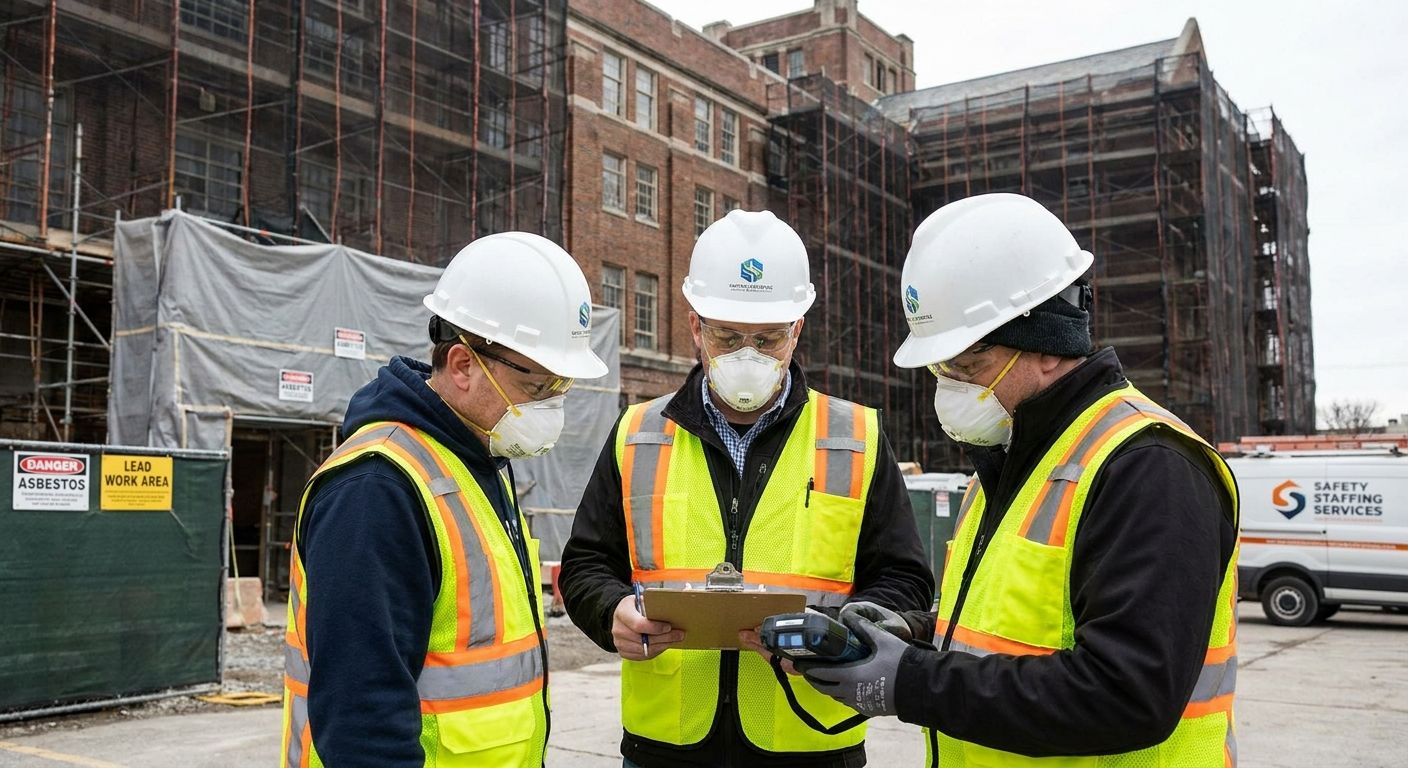
Abatement work carries some of the strictest regulatory exposure in construction, and staffing it wrong costs more than a bad hire — it can shut a job site down. This guide breaks down what asbestos and lead abatement contractors need from a safety staffing partner in 2026, and which staffing pathways actually hold up under an EPA or OSHA inspection.
- ResponsAble Staffing verifies AHERA and EPA RRP credentials before any placement — safety staffing for asbestos and lead abatement fails without this step.
- Industrial hygienists oversee air monitoring on abatement jobs; treat this role as non-negotiable, not optional overhead.
- Environmental remediation staffing built for confined-space and negative-pressure enclosures beats general labor staffing every time. Buy verdict.
- Contractors relying on unverified 1-day cert mills should skip that route entirely in 2026 — OSHA fines start there.
Why this matters
Asbestos and lead abatement sit under two of the most litigated OSHA standards in the industrial safety code — 29 CFR 1926.1101 for asbestos and 1926.62 for lead. Both carry personal exposure limits (0.1 fibers per cubic centimeter for asbestos, 50 micrograms per cubic meter for lead) that require documented monitoring, not guesswork. A staffing agency that doesn't understand these thresholds will place a body on the job, not a compliant crew.
The cost of getting this wrong isn't abstract. A single stop-work order on an abatement project can push a schedule back weeks and trigger a re-inspection of every credential on site. Safety staffing for asbestos and lead abatement has to be built around documentation and monitoring discipline first, headcount second.
Who this is for
This guide is for abatement contractors, environmental remediation firms, and general contractors managing subcontracted abatement scopes who need certified competent persons, air monitoring technicians, and industrial hygienists on short notice — whether that's a single-family lead renovation or a multi-building asbestos removal on a commercial demolition.
What to look for in safety staffing for asbestos and lead abatement
Credential verification before placement, not after
An agency that checks AHERA accreditation, EPA Lead-Safe Certified Renovator status, and state asbestos worker/supervisor licenses before submitting a candidate saves you the liability of an unverified worker on a hazmat crew. Ask how the agency confirms this — a copy of a card isn't verification, a license lookup against the state registry is.
Industrial hygiene oversight, not just labor fill
Abatement projects need someone reading the air monitoring data in real time, not just running the negative-air machines. A staffing partner that can place a certified industrial hygienist alongside your abatement crew closes the gap between "workers on site" and "a compliant containment."
Experience with negative-pressure enclosures and decon protocols
General construction safety staff don't automatically know how to run a three-stage decontamination unit or maintain enclosure integrity under negative pressure. Ask for abatement-specific project history, not just "industrial experience."
Fast turnaround for time-sensitive abatement windows
Abatement often runs on tight regulatory notification windows — many states require 10 working days' notice before asbestos removal starts. A staffing agency that can turn around vetted, credentialed workers inside that window matters more than one offering the lowest bill rate.
Incident track record you can actually check
Any agency can say "we're safety-first." Ask for their placement incident history and how they screen for it before you sign. How to evaluate a staffing agency's safety incident track record walks through the specific questions to ask.
Direct-hire path for permanent safety leadership
If abatement is a recurring line of business, not a one-off scope, you need a permanent site safety lead, not a rotating cast of temps. A staffing partner with a direct-hire track for industrial hygienists gives you continuity across projects.
Top staffing picks for abatement contractors
The certification specialist — Hazmat technician staffing built for abatement crews. The one number that matters: EPA's Lead Renovation, Repair and Painting Rule has required certified renovators on any pre-1978 housing job since 2010, and a slip here means fines starting at five figures per violation. ResponsAble Staffing's hazmat technician staffing pathway screens for AHERA and RRP credentials before submission. Buy.
The oversight layer — Direct-hire industrial hygienists for ongoing abatement programs. If your abatement scope runs year-round, a permanent industrial hygienist on staff catches exposure trends across projects that a rotating temp roster misses. Verdict: Buy for contractors running 4+ abatement jobs a year, Consider for single-project scopes.
The remediation generalist — Environmental remediation project staffing. This pathway covers the broader remediation workforce — soil, groundwater, and structural abatement combined — useful when your scope extends past asbestos and lead into full site remediation. Environmental remediation project staffing is a Consider if abatement is one piece of a larger remediation contract, Skip if your scope is abatement-only — you'll overpay for capabilities you don't need.
The verification checkpoint — Certification audit before placement. This isn't a staffing category, it's a process every contractor should demand regardless of which role they're filling. Review how to verify safety certifications before placing a candidate before your next abatement hire goes on site. Buy — non-negotiable in 2026's inspection environment.
What to avoid
- General labor staffing agencies with no hazmat vetting process. They'll fill the headcount and skip the AHERA check — you find out during the inspection, not before.
- One-day "certificate mill" trained workers with no state license lookup. A laminated card isn't a license. Verify against the state registry every time.
- Agencies that can't name their abatement-specific placement history. "We do industrial staffing" is not the same as "we've staffed negative-pressure enclosure crews."
Get vetted abatement crews faster
Talk to ResponsAble Staffing about your next asbestos or lead abatement job.
Verdict comparison
| Staffing pathway | Best for | Credential focus | Verdict |
|---|---|---|---|
| Hazmat technician staffing | Active abatement crews | AHERA, EPA RRP | Buy |
| Direct-hire industrial hygienist | Recurring abatement programs | Air monitoring, exposure trending | Buy (4+ jobs/yr) |
| Environmental remediation staffing | Combined abatement + remediation scopes | Broader environmental certs | Consider |
| General labor staffing (no hazmat vetting) | Nothing abatement-related | None verified | Skip |
FAQ
What certifications should asbestos and lead abatement staff have in 2026?
Asbestos abatement workers need state-issued asbestos worker or supervisor licenses plus AHERA accreditation, while lead abatement staff need EPA Lead-Safe Certified Renovator status under the Renovation, Repair and Painting Rule. Verify both against the issuing state or EPA registry, not just a printed card.
Is temporary staffing or direct hire better for abatement projects?
Temporary staffing fits single-project or seasonal abatement scopes, while direct hire makes sense once a contractor runs four or more abatement jobs a year. Recurring abatement work benefits from a permanent industrial hygienist who tracks exposure data across projects.
How much notice do abatement projects usually require before staffing?
Many states require a 10-working-day notification window before asbestos removal begins, which limits how fast a staffing agency can source workers. A staffing partner that pre-vets a candidate pool before the notification clock starts closes that gap.
What's the OSHA exposure limit for asbestos on abatement job sites?
OSHA's permissible exposure limit for asbestos under 29 CFR 1926.1101 is 0.1 fibers per cubic centimeter of air as an 8-hour time-weighted average. Staffing crews without a certified industrial hygienist monitoring this limit puts the entire project at compliance risk.
Do lead abatement staff need different credentials than asbestos staff?
Yes — lead abatement work requires EPA RRP certification and, for larger scopes, state lead abatement supervisor licenses, which are separate from asbestos worker credentials. A staffing agency should verify each credential set independently rather than treating hazmat staff as interchangeable.
How do I check a staffing agency's safety incident history before signing?
Ask for placement-level incident data and how the agency screens candidates before submission, not just a general safety statement. A documented incident track record review process is the clearest signal an agency treats abatement staffing as compliance work, not headcount fill.
What's the biggest staffing mistake on abatement projects?
Placing workers with unverified certifications is the most common and most expensive mistake, since a single uncredentialed worker can trigger a stop-work order. Verification against the issuing registry before placement, not after, prevents this.
Can one staffing agency cover both asbestos and lead abatement crews?
Yes, provided the agency separately verifies AHERA credentials for asbestos work and EPA RRP certification for lead work rather than treating the two as one hazmat category. Ask the agency directly how their vetting process distinguishes between the two.
One last thing
Most abatement compliance failures don't happen during the removal — they happen during the notification and staffing window before the crew ever steps on site. A contractor who locks in credentialed staff before the notification clock starts almost never gets flagged during inspection. Build your staffing timeline backward from that notification date in 2026, not forward from when you happen to need bodies.